The Advocate-08/18/2005
Down through the ages, the figure of the vampire has exercised a great power over the human imagination. Whether this figure takes the form of the Greek lamia, the Malaysian langsuyar, the Serbian vukodlak or Bram Stoker's iconic Transylvanian count, people from all different cultural backgrounds have found themselves simultaneously fascinated and repulsed by this mythos.
Fascinated, in part, because in the vampire we see an individual who does not lie at rest at death, as we ourselves must, but goes forth from the grave, straddling the world of the living and that of the dead - meanwhile repulsed because this creature lives like a parasite off our most precious bodily commodity, spreading its own brand of damnation through our ranks as it does.
It was mainly this latter factor that concerned the people of Manchester, Vt., in the year 1793, according to an incident recorded in John S. Pettibone's Early History of Manchester." Three years earlier, Captain Isaac Burton lost his wife, Rachel, to consumption, or "the White Death," as it was sometimes known. A year or so later, Burton married again, to a girl by the name of Hulda Powel. Not long after, Hulda also began showing telltale signs of the same decline: an unnatural pallor, loss of vitality and a bloody cough. By February 1793, the girl was in the late stages of the disease. It was at this point that a number of Manchesterites reached a conclusion that to our modern minds must come across as nothing short of preposterous.
The wasting away of Burton's wives, they concluded, was due to the sinister agency of a "demon vampire." To save Hulda, it was thought, the vampirism had to be stopped - and this would require a most odious procedure. The body of Burton's deceased wife, Rachel, was disinterred, and what remained of her heart, liver and lungs were removed. They were taken to Jacob Mead's blacksmith forge, where they were burned until nothing but ash remained. Sadly, despite this grisly attempt at a cure, Hulda continued to weaken, passing away the following September.
Macabre and mystifying as such a scenario may seem to us, there is a great deal of evidence that this was not a wholly uncommon practice in early New England. In his book Food for the Dead, Rhode Island folklorist Michael Bell lists the approximately 20 such incidents in New England he has uncovered from the late 18th through to the late 19th century. Many others may have gone unrecorded. With close examination of the historic and folkloric record, it becomes clear that this practice was looked upon by its participants as being less like a supernatural exorcism than as simply a loosely accepted form of folk medicine (and in some cases, this method was recommended and even overseen by trained physicians).
Keep in mind that these New Englanders were battling a scourge they could not have hoped to comprehend, and one that was increasingly prevalent. Tuberculosis had been on the rise in North America since around 1730, and by 1800 accounted for 25 percent of all deaths. It remained the leading cause of death throughout the 19th century and into the 20th. For most of that time, its precise cause remained unknown. All that was known was what could be readily observed: that this was a kind of contagion that moved unseen from victim to victim, often within families and close-knit groups, draining away the vitality of a person - just like a vampire. The fact that upon exhumation, many bodies were found to display features of decomposition which had not yet been explained by science, such as posthumous hair and nail growth and blood coagulated in the heart and around the mouth, tended to lend credence to the vampire theory.
These were not people who were particularly morbid, sadistic or amoral, as some later commentators opined; just decent communities willing to pursue any option, unpleasant and grotesque though it might have been, to save the lives of their loved ones and neighbors. In the context of their own era, their actions were not all that irrational. Given the significant limitations that still exist in today's medicine, I cannot help but wonder: How many of our own disease-fighting methods will be looked upon by future historians as little more than well-intentioned barbarism?
Thursday, August 18, 2005


Friday, July 29, 2005
A Poltergeist in Pownal?
There was a time, less than two centuries ago, when if you claimed that a stone fell from the sky, you could expect that at some point someone would say you were deluded, or a liar, or worse. Certainly, any well-educated, rational person would scoff at you. Why? Well, because, there are no stones in the sky, silly. Therefore stones cannot fall from the sky.
Today, of course, in our infinitely more knowledgeable times, they’d just call that meteor activity. Now if you were to say that you saw many stones fall, for a prolonged period of time (like weeks, or months), from several different directions at once- up and sideways as well as down- well, then you might once again be in line for some ridicule. At the very minimum, a condescendingly patient explanation about how what it seemed like you saw wasn’t actually what you saw, because, silly, stones don’t just up and act like that. When they move at all, it is in chartable, predictable ways, dictated by known physical processes. Of course, at some point, someone might drop the word ‘poltergeist’ into the conversation- a tricky word, which in German means something along the lines of “noisy or mischievous spirit,” and in English tends to mean something roughly equivalent to “I don’t know, leave me alone.”
It was in the fall of 1874 that a farmer from North Pownal found himself in a predicament along these lines. Sometime in October, Thomas Paddock- described as “a respectable farmer, of excellent character” by the Burlington Free Press and Times- found his house and barns under a brutal bombardment from reoccurring showers of stones. Fearing precisely the kind of derision referred to above, Paddock and his family tried to keep the occurrences a secret. Word got out, however, as always it does in such bizarre matters. Witnesses described rocky showers that ensued intermittently, apparently out of the clear sky. They were said to fall randomly at all hours of the day and night, and varied in size from tiny pebbles to five inches in diameter. At one point, one fell that weighed more than twenty pounds, and left a three-inch crater in solidly frozen ground. A number of people tried to duplicate this incident by hurling similar boulders, but made scarcely any impression at all.
Nor was this the strangest aspect of it all. The stones did not behave at all as falling stones ought. When they hit the ground, they did not bounce or skip; instead, they just rolled calmly along the ground. They also tended to be warm to the touch. Worst of all, witnesses reported that on occasion they would make contact on the roof near the eaves, then, as if possessed, roll slowly up the roof and back down the other side.
Can this possibly true? Stones that fall from the sky? Stones that roll up? Admittedly, there are probably gaping holes in my meteorological knowledge, but this does not seem at all like any meteorites I have ever heard of. Certainly not meteorites with any sense of propriety.
Still, these happenings are not without precedent. Dedicated Advocate readers will recall a similar case from Sheffield that I wrote about in October, and there are a number of others in New England history. The earliest of these seems to be from New Hampshire, where the home of George Walton was barraged for months by similarly cantankerous stones. The occurrences were witnessed by the Secretary of the Colony, Richard Chamberlain, who coined the term “Lithobolia” to describe it, intertwining the Greek word “Lithos” with the Latin “diabolis,” or devil- a “stone-throwing devil.”
According to the late D. Scott Rogo, noted parapsychologist, stone-throwing is one of the most commonly reported kinds of poltergeist phenomenon. “Sometimes rocks will bombard the outside of a house,” he writes, “or sometimes…the inside… the rocks themselves are sometimes found to be warm to the touch… and will often follow odd trajectories.” These kind of poltergeists also seem to have a long history worldwide. The Annales Fuldenses chronicles a case of apparently supernatural stone-throwing in 858 A.D. in the small town of Bingen on the Rhine, where Roman forces were fighting the gauls. Other historical records expose a case even farther back, in 530 A.D., that afflicted the home of the chief physician to the Ostrogoth King Theodoric.
In the case of the stonings in Pownal, a variety of potential explanations were offered. One medium from Hoosac Falls claimed that the spirit of a local woman was responsible, and would not stop until the stones were removed from the coffin in which her body lay. Perhaps the most outlandish theory was presented by the Brooklyn Daily Eagle (a paper with a reputation for whimsical and sardonic editorializing) who speculated that a man with “a new style of catapult with which fortifications can be stormed at a distance, has been practicing with it on a mountain nearby.”
Reporters who covered the story claimed that his house was situated that no human prankster could have possibly thrown the stones without being seen. Nevertheless, this was the suspicion of a group of “investigators” from North Adams (who, curiously, are not referred to by name in any of the newspaper accounts) who ventured up to Pownal that December. According to their account of the inquiries they made, their suspicion from the outset was that a hired boy by the name of Jerry was the culprit. They told reporters later that one of them remarked to Jerry how interested he was in Spiritualism, and wished that he could witness the extraordinary phenomenon himself. Later, while Jerry was off doing his chores, a stone came tumbling over the roof of the house. At this point, according to the Hoosac Valley News, “Not wishing to wound the feelings of Mr. Paddock, who firmly believes the imposition so long practiced upon him to be the work of spirits; and not caring to have any trouble with Jerry, the visitors departed, convinced that they had solved the mystery.”
There are problems with the account given by the North Adams skeptics, however. According to their report, “No one but Jerry had ever seen the stones fall.” Yet this does not agree at all with earlier reports published in the Troy Press, the Rutland Herald, and the Burlington Free Press, who state unequivocally that the bombardments had been witnessed by many dozens of people, several of whom are quoted by name. Furthermore, Jerry himself was present and accounted for among the crowd of onlookers during most of these incidents. Their assertion that Paddock believed the stones to be the work of spirits was also patently false, as he had stated repeatedly in earlier interviews that he did not believe spirits were to blame. Finally, their explanation failed to account for the extreme behavior of many of the flying stones.
The pattern of this case has more than a passing resemblance to many of the other New England “lithobolia” incidents I have looked at. In most of these cases, and adolescent is present at the time of most of the stone hurling, and at some point or another someone suggests a connection between the two. Usually though, the child is in plain view when the stones come flying, apparently out of nowhere. Perhaps more importantly, common sense suggests to most that while young boys (or girls) are certainly capable of a wide variety of mischief, the idea of one having the attention span for such ongoing, elaborately systematic pranks, stretching out over weeks or months in most cases, is harder to take seriously than a stone-throwing demon. An alternative interpretation is offered by parapsychologist William Roll, who has spent decades studying alleged poltergeist cases. He calls this phenomenon Recurrent Spontaneous Psycho-Kinesis, the idea that that a high level of emotional tension, if repressed, can produce outward physical effects which are consistent with poltergeist reports. This, he predicts, would no doubt be particularly seen in young persons, who do not usually have the power to redress their grievances by conventional and socially acceptable means.
Of course, this should not be taken to suggest that you should refrain from grounding your preteen son or daughter when circumstances merit- just don’t be too terribly surprised if you should hear a pebble or two come rolling across the roof of your home.
Selected Sources:
Brooklyn Daily Eagle Dec. 9, 1874
Troy Press, Oct.-Dec., 1874
Hoosac Valley News, Dec. 10, Dec. 17, 1874
Citro, Joseph A. Green Mountain, Dark Tales, 1999
Today, of course, in our infinitely more knowledgeable times, they’d just call that meteor activity. Now if you were to say that you saw many stones fall, for a prolonged period of time (like weeks, or months), from several different directions at once- up and sideways as well as down- well, then you might once again be in line for some ridicule. At the very minimum, a condescendingly patient explanation about how what it seemed like you saw wasn’t actually what you saw, because, silly, stones don’t just up and act like that. When they move at all, it is in chartable, predictable ways, dictated by known physical processes. Of course, at some point, someone might drop the word ‘poltergeist’ into the conversation- a tricky word, which in German means something along the lines of “noisy or mischievous spirit,” and in English tends to mean something roughly equivalent to “I don’t know, leave me alone.”
It was in the fall of 1874 that a farmer from North Pownal found himself in a predicament along these lines. Sometime in October, Thomas Paddock- described as “a respectable farmer, of excellent character” by the Burlington Free Press and Times- found his house and barns under a brutal bombardment from reoccurring showers of stones. Fearing precisely the kind of derision referred to above, Paddock and his family tried to keep the occurrences a secret. Word got out, however, as always it does in such bizarre matters. Witnesses described rocky showers that ensued intermittently, apparently out of the clear sky. They were said to fall randomly at all hours of the day and night, and varied in size from tiny pebbles to five inches in diameter. At one point, one fell that weighed more than twenty pounds, and left a three-inch crater in solidly frozen ground. A number of people tried to duplicate this incident by hurling similar boulders, but made scarcely any impression at all.
Nor was this the strangest aspect of it all. The stones did not behave at all as falling stones ought. When they hit the ground, they did not bounce or skip; instead, they just rolled calmly along the ground. They also tended to be warm to the touch. Worst of all, witnesses reported that on occasion they would make contact on the roof near the eaves, then, as if possessed, roll slowly up the roof and back down the other side.
Can this possibly true? Stones that fall from the sky? Stones that roll up? Admittedly, there are probably gaping holes in my meteorological knowledge, but this does not seem at all like any meteorites I have ever heard of. Certainly not meteorites with any sense of propriety.
Still, these happenings are not without precedent. Dedicated Advocate readers will recall a similar case from Sheffield that I wrote about in October, and there are a number of others in New England history. The earliest of these seems to be from New Hampshire, where the home of George Walton was barraged for months by similarly cantankerous stones. The occurrences were witnessed by the Secretary of the Colony, Richard Chamberlain, who coined the term “Lithobolia” to describe it, intertwining the Greek word “Lithos” with the Latin “diabolis,” or devil- a “stone-throwing devil.”
According to the late D. Scott Rogo, noted parapsychologist, stone-throwing is one of the most commonly reported kinds of poltergeist phenomenon. “Sometimes rocks will bombard the outside of a house,” he writes, “or sometimes…the inside… the rocks themselves are sometimes found to be warm to the touch… and will often follow odd trajectories.” These kind of poltergeists also seem to have a long history worldwide. The Annales Fuldenses chronicles a case of apparently supernatural stone-throwing in 858 A.D. in the small town of Bingen on the Rhine, where Roman forces were fighting the gauls. Other historical records expose a case even farther back, in 530 A.D., that afflicted the home of the chief physician to the Ostrogoth King Theodoric.
In the case of the stonings in Pownal, a variety of potential explanations were offered. One medium from Hoosac Falls claimed that the spirit of a local woman was responsible, and would not stop until the stones were removed from the coffin in which her body lay. Perhaps the most outlandish theory was presented by the Brooklyn Daily Eagle (a paper with a reputation for whimsical and sardonic editorializing) who speculated that a man with “a new style of catapult with which fortifications can be stormed at a distance, has been practicing with it on a mountain nearby.”
Reporters who covered the story claimed that his house was situated that no human prankster could have possibly thrown the stones without being seen. Nevertheless, this was the suspicion of a group of “investigators” from North Adams (who, curiously, are not referred to by name in any of the newspaper accounts) who ventured up to Pownal that December. According to their account of the inquiries they made, their suspicion from the outset was that a hired boy by the name of Jerry was the culprit. They told reporters later that one of them remarked to Jerry how interested he was in Spiritualism, and wished that he could witness the extraordinary phenomenon himself. Later, while Jerry was off doing his chores, a stone came tumbling over the roof of the house. At this point, according to the Hoosac Valley News, “Not wishing to wound the feelings of Mr. Paddock, who firmly believes the imposition so long practiced upon him to be the work of spirits; and not caring to have any trouble with Jerry, the visitors departed, convinced that they had solved the mystery.”
There are problems with the account given by the North Adams skeptics, however. According to their report, “No one but Jerry had ever seen the stones fall.” Yet this does not agree at all with earlier reports published in the Troy Press, the Rutland Herald, and the Burlington Free Press, who state unequivocally that the bombardments had been witnessed by many dozens of people, several of whom are quoted by name. Furthermore, Jerry himself was present and accounted for among the crowd of onlookers during most of these incidents. Their assertion that Paddock believed the stones to be the work of spirits was also patently false, as he had stated repeatedly in earlier interviews that he did not believe spirits were to blame. Finally, their explanation failed to account for the extreme behavior of many of the flying stones.
The pattern of this case has more than a passing resemblance to many of the other New England “lithobolia” incidents I have looked at. In most of these cases, and adolescent is present at the time of most of the stone hurling, and at some point or another someone suggests a connection between the two. Usually though, the child is in plain view when the stones come flying, apparently out of nowhere. Perhaps more importantly, common sense suggests to most that while young boys (or girls) are certainly capable of a wide variety of mischief, the idea of one having the attention span for such ongoing, elaborately systematic pranks, stretching out over weeks or months in most cases, is harder to take seriously than a stone-throwing demon. An alternative interpretation is offered by parapsychologist William Roll, who has spent decades studying alleged poltergeist cases. He calls this phenomenon Recurrent Spontaneous Psycho-Kinesis, the idea that that a high level of emotional tension, if repressed, can produce outward physical effects which are consistent with poltergeist reports. This, he predicts, would no doubt be particularly seen in young persons, who do not usually have the power to redress their grievances by conventional and socially acceptable means.
Of course, this should not be taken to suggest that you should refrain from grounding your preteen son or daughter when circumstances merit- just don’t be too terribly surprised if you should hear a pebble or two come rolling across the roof of your home.
Selected Sources:
Brooklyn Daily Eagle Dec. 9, 1874
Troy Press, Oct.-Dec., 1874
Hoosac Valley News, Dec. 10, Dec. 17, 1874
Citro, Joseph A. Green Mountain, Dark Tales, 1999
Friday, July 22, 2005
October Mountain Forest Death
On Sunday evening I emailed this week’s installment of my new column for The Advocate Weekly, a print companion to this blog, a piece on odd encounters in October Mountain State Forest. The following morning news broke that a body had been found in the forest, which was later identified as that of 20-year-old Anthony Colucci, missing since July 4. The cause of death has not been determined. The piece itself appeared in print yesterday. I want to take this opportunity to make it known that this is a morbid coincidence, and totally unintentional on my part. Had I found out about the discovery of the body one day earlier, I would have supplied a different column piece for this week. I have no desire to exploit or sensationalize this tragic event, and my heart goes out to Mr. Colucci’s family.
More information on this tragedy:
Capital News 9
North Adams Transcript
Berkshire Eagle
More information on this tragedy:
Capital News 9
North Adams Transcript
Berkshire Eagle
Tuesday, July 12, 2005
The Disappearing Drunkard
 The roads which criss-cross southern Vermont and eastern New York are replete with stories of strange encounters. Tunic Road has its accounts of phantom soldiers; UFOs have been sighted by drivers along Route 7 and also White Creek Road; Route 7 has also been the sight of alleged Bigfoot sightings, as has Prospect Mountain.
 One day in the 1970’s, author David J. Pitkin reports, he had a strange roadside encounter of his own while driving to and from Bennington. On his way there from his home in Troy, New York, he happened to spot a man hitchhiking in the distance. As he grew closer, the man’s ragged attire and unkempt hair became apparent, and his weaving back and forth made it quite apparent that the man was blind drunk. Finding in favor of prudence, Pitkin sped by without stopping.
On his return trip, he saw that the man had changed lanes and was now hitchhiking in the opposite direction, toward Troy. Pitkin had intended to keep driving and pass the dubious looking man once more, but just then it began to pour rain. Taking pity, he pulled over and let the man in. The reeking, obviously intoxicated man got into the car. He was nearly incomprehensible, and it was not clear where he was going. They drove in silence, until they reached the outskirts of Troy and stopped at a red light, the man mumbled “This is good enough.” They pulled over and the man stumbled out of the car without closing the door. Pitkin leaned over to close it, and when he looked up, the man was gone. “I scanned the full 360 degrees around my car, for at least a hundred yards in every direction, for at least a hundred yards in every direction. He was nowhere to be seen. Where could he have gone? There were no nearby doorways where he could hide. He had just vanished into thin air.”
Stories of this sort are not rare. Folklorists recognize this as a variant of the “Vanishing Hitchhiker,” a class of urban legend, though the term contemporary legend is gaining ground as the preferred classifier. Modern folklore expert Jan Brunvand calls the Vanishing Hitchhiker narrative “the classic automobile legend.”
“This returning ghost tale,” Brunvand states, “was known by the turn of the century both in the United States and abroad. It acquired the newer automobile motif by the period of the Great Depression, and thereafter spawned a number of subtypes with greatly varied and oddly interlocking details, some of which themselves stemmed from earlier folk legends.”
In one of the most common types, the story centers on a young girl asking for a ride home. Before the driver and passenger reach her house, however, the girl has vanished into thin air. The driver proceeds on to the house anyway, typically because she has left something behind in the car. When he knocks on the door, the person who answers (usually her father) tells the driver that his daughter died on this very day, X amount of years ago. In other versions, the hitchhiker may be a man or an elderly woman dressed in black, who deliver some sort of prophetic message.
In most cases, these stories, like others classed as contemporary legend, are FOAF (friend-of-a-friend) tales, passed on from person to person as a morphing, undocumented narrative, typically introduced with a statement like “this happened to someone my sister’s friend knows,” or “someone who went to my co-worker’s college said…” Therefore, folklorists tend to treat these stories as fictional- socially meaningful, perhaps, but without root in an event taking place in real space time. This becomes problematic, however, when one is confronting a first hand account. It is certainly more awkward to declare something a legend when the something is a specific person coming forward with what they maintain is a personal experience they had in a real place and time. Pitkin’s experience is not a unique occurrence, either; a number of other first hand accounts of vanishing hitchhikers exist. The most well known of these is probably that of a man named Anton Lagrange, from Durban, South Africa, which was documented in an article in FATE by Cynthia Hind.
What are we to make then, of these stories? Are they all lies concocted by a few individuals, inspired by FOAF tales, or do certain concepts taken for granted in the study of folklore beg reexamination? Perhaps the quandary is best stated by University of Pennsylvania folklorist Bill Ellis when he says, “…The major limitation of the folklorist’s perspective is that it presumes that if a story is found in variant form attached to many places and times, then that is proof presumptive that it never happened at any place or time… granted, the vanishing hitchhiker circulates widely and usually in anonymous of friend-of-a-friend form. But does that in itself impugn every firsthand account?”
It does not, I would venture. Too many examples exist to negate the idea that all, or even most, types of FOAF tales arise out of the ether of human imagination without some analogue or antecedent in actual incidents and experiences. Ellis cites the work of Gary Alan Fine, who in researching urban legends of mice in Coca-Cola bottles, found numerous documented cases in which various rodents had been found in different kind of soda containers. Similarly, the immensely popular “alligators in the sewer” tales seem to be rooted in verifiable incidents. Documentation of an apparently quite real problem with alligators in the Manhattan sewer system in the 1930’s has been found in the NY Times and in records of the office of the New York City Commissioner of Sewers.
Folklore is a kind of running social narrative that explores the boundaries of what we know or believe to be real. Perhaps the survival and popularity of many of FOAF tales and contemporary legends, and the reason that they are often believed, is based on an instinctive sense on the part of the population at large that the world really is stranger than we ever give it full credit for, and sometimes, just sometimes, the weirdest things anyone can think up really do happen.
Sources:
Pitkin, David J. Ghosts of the Northeast, 2002
Brunvand, J.H. The Vanishing Hitchhiker: American Urban Legends & their Meanings, 1981
Ellis, Bill. Aliens, Ghosts & Cults: Legends We Live, 2003
Hind, Cynthia. “Girl Ghost Hitches Ride.” FATE July 1979
Wednesday, June 29, 2005
Spirits of ’76: Revolutionary Ghosts in the Berkshires
The history of Berkshire County’s involvement in the Revolutionary War is a rich one, full of noteworthy participation in some of the most important actions of the war (the taking of Fort Ticonderoga, the Battle of Bunker Hill, the Battle of Bennington, etc) and exotic characters (General John Patterson, James Easton, the “Fighting Parson” Thomas Allen, etc). Given this, it should not be surprising that legends of lingering ghosts from this period abound in the area. As a special Fourth of July installment of These Mysterious Hills, I will present two of my favorite such tales.
The first concerns Franz Wagner, a Hessian soldier attached to General Burgoyne’s forces. Wagner was wounded at the Battle of Saratoga, and died while making his way south after his company was scattered. Some men from North Egremont buried him in the old burial yard there, but it soon became clear that he refused to rest in peace. Within a few days of his burial, rumors began to spread that the Hessian had been seen wandering about at night. He had been seen, with his full uniform glistening in the darkness, wandering around the cemetery, and floating along the banks of the Green River. As whispers of encounters with this formidable specter multiplied, some village men decided to investigate. Two men, Joe Tanner and Tom Hendricks, bolder than the rest, went ahead while the rest of the group trailed a safe distance behind. They advanced slowly to the place where the Hessian had been interred, seeing nothing and beginning to feel slightly silly. When they were nearly upon the grave itself, however, a diaphanous form leaped up from out of the ground. The two men stood there silently, paralyzed with fear and awe, watching it as it slowly drew closer. Wagner’s ghostly form appeared to be moving its mouth, as if trying to speak to them, but no words were heard. This was too much for them, and they turned and ran, the other men fleeing in front of them.
As news of their encounter made its way around town, the level of slight unease in Egremont grew to a state almost akin to a panic. People stopped going out after dark altogether, even for prayer meetings. They even began blocking up their doors. Joe Tanner, convinced that there must be a way to rid the town of the ghost, got together some of the heartier of the men in town to discuss the matter. Tanner suggested that perhaps, if they moved the Hessian’s grave to some other location, he would move on with it and leave them alone. There was some uneasiness about the idea of disinterring a corpse, and some concern that they might get in a bit of trouble with the authorities. In the end, though, they decided that is was the best plan anyone could come up with, and preparations for the task were made.
When the night to enact the gruesome bit of business came, the men assembled, and Tanner brought his wagon along to carry the soldier’s coffin. Sentries were posted at both sides of the cemetery to keep an eye out while this secret project was conducted. Wagner had been a rather large man, and so all the remaining men were required to help haul his coffin up from the grave and move it into the wagon. Once completed, they started out in the darkness heading northeast, Joe Tanner and two others in the wagon with the Hessian and the rest on horseback. When they reached the eastern side of Tom Ball Mountain they found they could take the wagon no farther, and Tanner and the other two men left the others with the coffin while they went ahead into the forest to look for a good burial spot.
They didn’t get far before they heard clamorous screaming behind them. Running back to the wagon, they saw a horrible sight: the vapory Hessian was sitting atop his coffin in the back of the wagon. Once again, he appeared to be trying to talk, but no sound came out. The men all around the wagon scrambled down from their horses and took cover, fearing some sort of violent reprisal from the ghost. When they looked over again, he was gone. They leapt to their feet and grabbed the coffin up, heading into the woods with it as quickly as possible. They went a little ways up the eastern base of the mountain to a natural hollow, at which point they grabbed their spades and began digging as fast as their arms would work. When they dug a suitably deep hole, they deposited the coffin inside (carefully, lest they arouse the Hessian’s anger any further). They rode out of there that night, and did not speak of the incident again until sometime after, when the threat of getting into trouble had subsided, and the whole story came out publicly.
In later years it was said that the Hessian had been seen, from time to time, wandering the woods on the side of Tom Ball, and around West Stockbridge, but he was never again seen in Egremont.
***
Another tale of spectral soldiers dates back to the spring of 1977. Caleb Hudson, who deserted from the Continental Army at the Battle of Breed’s Hill, was on his way to a meeting of Tories at the home of Jared Musgrove in east Lee. Word had it that General Washington was on route to meet up with the colonial troops positioned in Connecticut and eastern New York, where they intended to stop the advance of British troops under General Tyron.
The Berkshire area Tories new that many attempts had been made to kidnap Washington, but none so far had succeeded. Now, another such plot was being hatched. It was decided that to avert suspicion falling on the Connecticut Loyalists nearest to the area, the plan should be handled by Berkshire men, who could slip into the Patriot encampment unrecognized under the auspices of joining up. They could then get close enough to steal away with the Continental commander in the night. Six men were selected from their midst to undertake the operation. Caleb Hudson was among them, much to his chagrin. Caleb, apparently, did not have much of a stomach for real war action on either side, though he was not above joining in on the looting of Patriot farms when the risk of being caught was minimal.
It was decided that each of the six men should ride south separately, so as not to be noticed, and meet up in Ridgefield, Connecticut, from whence they would proceed with their devious mission. So Caleb set out on horseback, and began making his way south. He never made it very far. As he reached south Lee and prepared to cross the Housatonic River, he saw a regiment of continental soldiers on the march. Fearing that they might be looking for recruits and that he might be conscripted into service, he hung back in the brush while they passed by. The troops marched by, hundreds of them, eight abreast, and slowly it dawned upon Caleb that there was something not right. They were making no noise at all. Not a single sound was coming up from any of them.
His horse began rearing and snorting, clearly disturbed. Hudson tried to calm the mare but she was becoming increasingly upset and would not be still. He feared the soldiers would take note, but they never looked up, just proceeded to ford the river silently. Caleb looked on in horror as dozens or rows of pale, deathly still soldiers entered into the river. Not a single soldier came out the other side. They simply vanished.
At this point his horse took off, with him holding on for dear life, and sped off. He rode and rode and did not stop or slow until he reached the South Lee Inn, where, pale-faced and trembling, he told his tale (minus the nature of his journey south) to the bemused bartender there. That was the end of Caleb Hudson’s involvement in the Tory cause.
Sources:
Coxey, Willard Douglas. Ghosts of Old Berkshire, 1934
Belland, Debra & Frederick Talarico. There's no place like home: a journey through the rich legacy of the Berkshires, 2000
FOR MORE ON BERKSHIRE COUNTY REVOLUTIONARY HISTORY, SEE:
Berkshire Patriots
Berkshire Tories
The first concerns Franz Wagner, a Hessian soldier attached to General Burgoyne’s forces. Wagner was wounded at the Battle of Saratoga, and died while making his way south after his company was scattered. Some men from North Egremont buried him in the old burial yard there, but it soon became clear that he refused to rest in peace. Within a few days of his burial, rumors began to spread that the Hessian had been seen wandering about at night. He had been seen, with his full uniform glistening in the darkness, wandering around the cemetery, and floating along the banks of the Green River. As whispers of encounters with this formidable specter multiplied, some village men decided to investigate. Two men, Joe Tanner and Tom Hendricks, bolder than the rest, went ahead while the rest of the group trailed a safe distance behind. They advanced slowly to the place where the Hessian had been interred, seeing nothing and beginning to feel slightly silly. When they were nearly upon the grave itself, however, a diaphanous form leaped up from out of the ground. The two men stood there silently, paralyzed with fear and awe, watching it as it slowly drew closer. Wagner’s ghostly form appeared to be moving its mouth, as if trying to speak to them, but no words were heard. This was too much for them, and they turned and ran, the other men fleeing in front of them.
As news of their encounter made its way around town, the level of slight unease in Egremont grew to a state almost akin to a panic. People stopped going out after dark altogether, even for prayer meetings. They even began blocking up their doors. Joe Tanner, convinced that there must be a way to rid the town of the ghost, got together some of the heartier of the men in town to discuss the matter. Tanner suggested that perhaps, if they moved the Hessian’s grave to some other location, he would move on with it and leave them alone. There was some uneasiness about the idea of disinterring a corpse, and some concern that they might get in a bit of trouble with the authorities. In the end, though, they decided that is was the best plan anyone could come up with, and preparations for the task were made.
When the night to enact the gruesome bit of business came, the men assembled, and Tanner brought his wagon along to carry the soldier’s coffin. Sentries were posted at both sides of the cemetery to keep an eye out while this secret project was conducted. Wagner had been a rather large man, and so all the remaining men were required to help haul his coffin up from the grave and move it into the wagon. Once completed, they started out in the darkness heading northeast, Joe Tanner and two others in the wagon with the Hessian and the rest on horseback. When they reached the eastern side of Tom Ball Mountain they found they could take the wagon no farther, and Tanner and the other two men left the others with the coffin while they went ahead into the forest to look for a good burial spot.
They didn’t get far before they heard clamorous screaming behind them. Running back to the wagon, they saw a horrible sight: the vapory Hessian was sitting atop his coffin in the back of the wagon. Once again, he appeared to be trying to talk, but no sound came out. The men all around the wagon scrambled down from their horses and took cover, fearing some sort of violent reprisal from the ghost. When they looked over again, he was gone. They leapt to their feet and grabbed the coffin up, heading into the woods with it as quickly as possible. They went a little ways up the eastern base of the mountain to a natural hollow, at which point they grabbed their spades and began digging as fast as their arms would work. When they dug a suitably deep hole, they deposited the coffin inside (carefully, lest they arouse the Hessian’s anger any further). They rode out of there that night, and did not speak of the incident again until sometime after, when the threat of getting into trouble had subsided, and the whole story came out publicly.
In later years it was said that the Hessian had been seen, from time to time, wandering the woods on the side of Tom Ball, and around West Stockbridge, but he was never again seen in Egremont.
***
Another tale of spectral soldiers dates back to the spring of 1977. Caleb Hudson, who deserted from the Continental Army at the Battle of Breed’s Hill, was on his way to a meeting of Tories at the home of Jared Musgrove in east Lee. Word had it that General Washington was on route to meet up with the colonial troops positioned in Connecticut and eastern New York, where they intended to stop the advance of British troops under General Tyron.
The Berkshire area Tories new that many attempts had been made to kidnap Washington, but none so far had succeeded. Now, another such plot was being hatched. It was decided that to avert suspicion falling on the Connecticut Loyalists nearest to the area, the plan should be handled by Berkshire men, who could slip into the Patriot encampment unrecognized under the auspices of joining up. They could then get close enough to steal away with the Continental commander in the night. Six men were selected from their midst to undertake the operation. Caleb Hudson was among them, much to his chagrin. Caleb, apparently, did not have much of a stomach for real war action on either side, though he was not above joining in on the looting of Patriot farms when the risk of being caught was minimal.
It was decided that each of the six men should ride south separately, so as not to be noticed, and meet up in Ridgefield, Connecticut, from whence they would proceed with their devious mission. So Caleb set out on horseback, and began making his way south. He never made it very far. As he reached south Lee and prepared to cross the Housatonic River, he saw a regiment of continental soldiers on the march. Fearing that they might be looking for recruits and that he might be conscripted into service, he hung back in the brush while they passed by. The troops marched by, hundreds of them, eight abreast, and slowly it dawned upon Caleb that there was something not right. They were making no noise at all. Not a single sound was coming up from any of them.
His horse began rearing and snorting, clearly disturbed. Hudson tried to calm the mare but she was becoming increasingly upset and would not be still. He feared the soldiers would take note, but they never looked up, just proceeded to ford the river silently. Caleb looked on in horror as dozens or rows of pale, deathly still soldiers entered into the river. Not a single soldier came out the other side. They simply vanished.
At this point his horse took off, with him holding on for dear life, and sped off. He rode and rode and did not stop or slow until he reached the South Lee Inn, where, pale-faced and trembling, he told his tale (minus the nature of his journey south) to the bemused bartender there. That was the end of Caleb Hudson’s involvement in the Tory cause.
Sources:
Coxey, Willard Douglas. Ghosts of Old Berkshire, 1934
Belland, Debra & Frederick Talarico. There's no place like home: a journey through the rich legacy of the Berkshires, 2000
FOR MORE ON BERKSHIRE COUNTY REVOLUTIONARY HISTORY, SEE:
Berkshire Patriots
Berkshire Tories
Monday, June 20, 2005
Over the Edge: Lover's Leap Legends in the Berkshires

Bash Bish Falls
According to legend, Bash Bish Falls, in the extreme southwest corner of Berkshire County, draws its name from the Indian woman Bash-Bish, who lived in a village near the falls. She was well liked because of her good-looks and equally pleasant nature, but her beauty did occasionally provoke jealously from the other squaws. Eventually, this led one of her friends to accuse her of adultery against her husband. Though she protested her innocence, the village elders sentenced her to death. She was strapped to a canoe and set adrift atop the falls. The moment before she tumbled down, a halo appeared around her head, and a ring of butterflies encircled her. Frightened, some of the men went below, where they found pieces of her canoe, but no sign of Bash Bish. They concluded that she must have been a witch.
Years passed, and though stories of the incident were told, it lapsed into the background. Meanwhile, Bash Bish had left a daughter, White Swan, too young to truly remember her mother. As the years passed, White Swan grew even more beautiful than her mother, and became the wife of the chief's son, Wey-au-wey-ya (Whirling Wind). However, despite their best efforts, she remained unable to conceive, and some of the older men whispered among themselves that perhaps this was the gods' punishment to the tribe for their execution of Bash Bish. Perhaps, they thought, it might even be her own witchcraft that cursed her daughter. Reluctantly, Whirling Wind took a second wife, for it was imperative that the chief's son have a son of his own. White Swan grew increasingly despondent at her failure to bear children, eventually ceasing to leave the wigwam at all. One day, Whirling Wind returned to the wigwam to learn from his second wife that White Swan had run off toward the falls. By the time he reached the base of the falls, he saw her standing on the protruding rock platform above.
"Mother, mother," she cried out over the falls, "Mother, take me into your arms." Whirling Wind was then shocked to see the glowing, ethereal figure of a white-robed woman step out of the water beneath, stretching out her arms to White Swan. Panicked, he began clambering up the rocks to the platform. She turned to look at him.
"Wey-au-wey-ya, my brave, my chief," she whispered, and then turned back to the rushing waters. "Mother," she cried, and dropped forward into the waterfall. Crying her name, the brave leaped after her into the water, and was lost. Later, the chief and his men found his son's body, but not White Swan's. Some say that her face, and that of her mother, can sometimes still be seen in the pool below. *
***
Monument Mountain, standing between Stockbridge and Great Barrington, is best remembered as being the site of the first meeting between Herman Melville and Nathaniel Hawthorne, in 1850. The former, who was then struggling through Moby Dick, and the latter, who had just completed the Scarlet Letter, were accompanied by Oliver Wendell Holmes, who carried along ice and a bottle of champagne in his emptied doctor's bag. Melville later dedicated his masterpiece to his new friend.
Long before that meeting, Monument Mountain was known as the site of yet another native girl's sorrowful leap. A beautiful maiden from the Mahican settlement in Stockbridge fell in love with her warrior cousin, who was forbidden to her by tribal law. She tried in vain to rid herself of these feelings, but they persisted, and she grew more and more unhappy. She began to wither away. The poet William Cullen Bryant**, who based a poem on the legend, describes her spiral:
"She went to weep where no eye saw, and was not found
When all the merry girls were met to dance,
And all the hunters of the tribe were out;
Nor when they gathered from the rustling husk
The shining ear; nor when, by the river's side,
They pulled the grape and startled the wild shades
With sounds of mirth."
Eventually, she could bear no more torment. She dressed herself in her finest jewelry and ornamentation, wove flowers into her hair, and made her way up the mountain, where she climbed up the face of the pillar known as Devil's Pulpit. She waited there until dusk, and then threw herself down the face of the cliff. It is said that her tribe buried her body on the slope of the mountain and marked it with a pile of stones (thus accounting for the cairn which can still be seen there to this day).
***
At least one version of the story of the native girl Wahconah, from whom the waterfall in Dalton gets its name, ends in a similar manner. Wahconah was a Pequot, part of a group of them who had been driven up from Connecticut. As the story goes, she was at the waterfall when she encountered a Wampanoag named Nessacus, who had made his way west after the death of his chief, Metacomet (this places the story in a more concrete historical context than the previous ones, sometime in 1676). Wahconah gave him lodging with her tribe on behalf of her father Miacomo, the chief, who was off negotiating with the Mohawks on the other side of the Taconic Mountains. Over the course of the next few days, Nessacus and Wahconah became enamored with one another. However, when her father returned, he brought with him the much older Mohawk warrior Yonnongah, to whom he had promised his daughter as wife. Nessacus challenged Yonnongah to a dual to decide who would marry the girl, but Tashmu, the scheming village shaman who favored the Mohawks, argued against this. Tashmu said that he would go that night to Wizard's Glen (an array of rocks with a somewhat dark and mysterious body of lore of its own) with the Mohawk, to ask the spirits which of the suitors they favored. Instead, he went to the brook and with Yonnongah's help dug out one side so that it was much deeper than the other.
In the morning, Tashmu told the tribe that the spirits had said for them to place the girl in a canoe and float it down the river to where the rock divides it. Nessacus and Yonnongah would each stand on one side, and whichever side she passed the rock on would indicate who she should marry. The canoe was then let go a good distance upstream from the rock. Tashmu, of course, had placed the Mohawk on the deeper side. He was therefore shocked to see that the canoe drifted over to the other side, grounding by the feet of Nessacus.*** Enraged that he had been foiled, Tashmu left the tribe and went east, where he betrayed them by guiding Major John Talcott to the valley (-here history once more pokes its head into the legend narrative, for Talcott is known to have pursued a band of Wampanoag into the Berkshires as part of the last major skirmish of King Phillip's War, becoming the first known white man to enter the area).
In most versions, Tashmu was slain, either by Nessacus or by one of the other Pequot warriors, and the tribe moved on west. In one version, however, Nessacus himself was slain in battle. Stricken with grief, Wahconah leaped to her death from the top of the falls.
***
What lies behind all these legends of love gone wrong, ending in a suicidal lead from a high precipice?
Stories of "Lover's Leaps" are to be found throughout history. The first recorded location of such incidents appears to be a cliff on the southwest side of the Greek island of Leucadia. It was here, some classical sources tell us, that the poet Sappho of Lesbos, and Queen Artemisia of Caria, ended the sorrow of their impossible love by plunging into the sea.
It is a common motif in American Indian lore. Folklorist Jan Brunvand, in his American Folklore: An Encyclopedia defines the Lover's Leap motif: "Typically, two Indian lovers, often from different tribes, are prevented from marrying because of tribal enmity or taboo; in despair or defiance, one or both commit suicide by jumping off a precipice."
In a paper on lover's leap legends, philosophy professor Phil Hoebing points out that there is no single explanation for the existence of such legends. He voices the opinion that many may be products of the western imagination, and that the proximity of high ledges may be one factor, adding in that tourism may help perpetuate the legend, as it makes a romantic addition to tours of scenic sites.
How do we explain the existence of so many such legends concentrated in one small regional area, though? Can we posit that these stories fulfilled some social function, either for the natives who lived there first, or for later European communities? Or do some real events underlie these occurrences, as the historical details in the case of the Wahconah story, and the physical existence of the rock pile at Monument Mountain, might suggest?
In his book Suicide Clusters, Loren Coleman demonstrates how accounts of a suicide, when spread (today by modern media forms, in earlier times by oral tradition), can shape the method by which other suicidal individuals, especially in the same community or neighboring communities, decide to take their lives. Perhaps something of this nature took place in the Berkshire Hills, at some point in the distant past. Perhaps there was a spate of such suicides by jumping, egged on by the contagion effect that seems to be at work in cycles of suicide behavior. It may have had nothing to do with doomed or unrequited love, but with unbearable pressures brought on by the incursion of colonial settlers in the late 17th and early 18th century, and only later been remembered in a few romanticized stories.
We cannot know for sure. All we can do is look up at these lofty places, marveling at the way the hills stand sentinel over the horizon, silently holding on to the secrets of their history.
Endnotes:
*There have been a number of accidental deaths at Bash Bish Falls over the years as well. During the 1960's, climbers and swimmers died there at a rate of two or three a year. Swimming is now prohibited, and climbing is allowed only by special permit from the parks department.
** According to yet another local legend, Bryant himself eventually returned to the Berkshires as a ghost.
*** In my favorite twist on this legend, one version claims that after the canoe contest, one of the braves from the tribe found a large twig jutting out of the brook. It occurred to him that it by using such a twig against the mud at the bottom of the brook, it would have been possible for Wahconah to have steered the canoe in whichever direction she chose. He told Miacomo of his suspicions, but the old chief only nodded, smiling.
Selected Sources:
Belland, Debra & Frederick Talarico. There's no place like home: a journey through the rich legacy of the Berkshires, 2000
Brunvand, Jan. American Folklore: An Encyclopedia, 1998
Coleman, Loren. Suicide Clusters, 1987
Coxey, Willard Douglas. Ghosts of Old Berkshire, 1934
Hoebing, Phil. Legends of Lover's Leaps, 2001
Bryant, William Cullen, 1794-1878: Poems
-Various other oral and written versions of these three legends.
Friday, June 10, 2005
The Enchanted State Forest
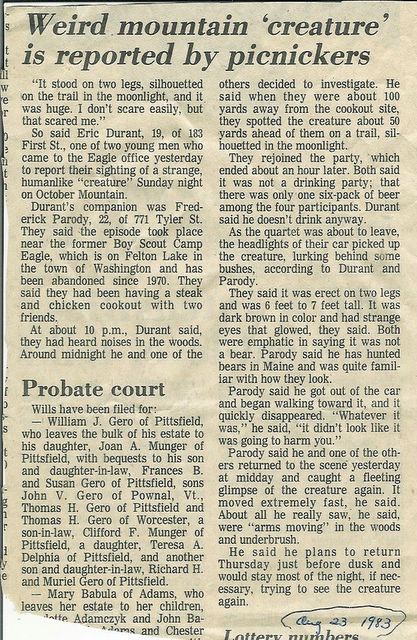
Among the most extraordinary and curious places in Berkshire County, as far as I'm concerned, is October Mountain State Forest.
The name 'October Mountain' was apparently first coined by Herman Melville in a short story from 1853 entitled "Cock-a- doodle-doo." He referred to it as such, he explained, "on account of its hampered aspect in that month." He later wrote another, fairly unremarkable short story called "October Mountain" for Putnam Magazine.
The largest state forest in Massachusetts, it consists of over 11,000 acres of land in Washington, Lenox, Lee and Becket. Most of this land was once the estate of William C. Whitney, who served as Secretary of the Navy under President Cleveland. It was purchased by a group of individuals in 1915, and donated to the state.
Long before Whitney, though, it was here that Gideon Smith, one of Berkshire County's most determined Loyalists, fled after it was learned that he had harbored a British prisoner-of-war. There he hid out in a gorge which hence became known as Tories Glen. There, legend has it, Indians from the settlement at Stockbridge brought him food and kept him protected from the zealous Berkshire patriots until the end of the war.
Also on the mountain is a small cemetery from the 19th century, which has long been said to be haunted. Stories have been told of people hearing strange humming noises and of seeing a ghostly young girl in a white dress. If these tales are true, the most likely candidate for the identity of this ghost would have to be a girl named Anna Pease. According to her headstone, Anna died on January 22, 1829 at the age of 10. The daughter of one Olivea Pease, who died in 1850, she appears to be the only female child in the small graveyard.
More than ghosts may be lurking in the dense woods, however. In 1983, two Pittsfield men were picnicking near the site of Camp Eagle, an old Boy Scout camp on Felton Lake, when they saw what they claimed was some strange anthropoid creature in the woods. They described it as dark brown, and standing erect at between six or seven feet tall. They said that it appeared to have glowing eyes, though this could have been due to the fact that it was standing in the path of their headlights when they saw it. A similar sighting was reported to have occurred in 1989. A hiker nearing the top of the mountain saw something large moving in the brush, about a hundred yards away. He at first thought it might have been a bear, until he stopped and looked at it through binoculars. What he beheld then was an extremely tall animal standing erect, covered all over in reddish hair or fur. It had a very human face, and extremely long arms. It appeared to be grubbing for roots or insects in a very methodical way- stacking the rocks that it moved upon each other in a neat pile.
Perhaps these creatures have even attracted some attention beyond that of humans. Some time around 1970, when Camp Eagle was still open, a scout there witnessed two unusual lights hovering in the sky. They appeared to be checking a certain spot over and over again. At no time did either object make any noise at all. After about five minutes of this, they shot off vertically into the sky, one after another, at incredible speed.
To top off this list of weird happenings, the forest has even, in recent years, had sightings of the elusive and controversial eastern panther, according to an article in last year's Berkshire Eagle. I cannot help but wonder, what other strange sightings may not have been reported, and what other unknown mysteries might this dense, sprawling forest hold?
Selected Sources:
Melville, Herman. Great Short Works of Herman Melville Perennial Press, 1970
Skinner, Charles M. Myths and Legends of Our Own Land J.P. Lippincott, 1896
The Berkshire Eagle August 23, 1983; February 23, 2004
National UFO Reporting Center
Friday, June 03, 2005
The Old Britton Place

Clapp Park, circa 1945
I've been collecting and tracking down strange tales and bits of lore long enough to have noticed that in searching for reputedly haunted places and spooky stories, one tends to find great laundry lists of the former, accompanied by a significantly shorter quantity of the latter. A great many of the places pointed out to me as being tinged with the mystical are joined by such vague references as "people have seen stuff there" (my subsequent "which people?" "what sort of stuff?" typically being countered with a shrug) or "strange things have gone on there" ("such as?" again, the shrug). Subsequent prodding and research without any more elucidation have lead me conclude that frequently these reputations are built on vapors, and not the ectoplasmic sort, either.
Some of the houses are haunted only by rotting wood and negligible real-estate values, while many demon-infested woods have more to do with Boy Scout campers hopped up on sugar and high school students hopped up on, well, hops- both groups managing to spook themselves silly with joggling flashlights and snapping twigs, than with preternatural manifestations. On occasion, however, these vague allusions are rooted in much older, more complete narratives that may be buried in the cracks of recorded history, virtually forgotten by even the most elder members of a community. Such seems to be the case with the area surrounding Pittsfield's Clapp Park. Some time ago I found, on a list of haunted places provided by the website http://www.theshadowlands.net , a brief fragment sentence describing paranormal activity around the train tracks by Clapp Park. It mentioned that "large white silhouettes have been spotted", and furthermore that "mysterious footsteps and blood-stained, almost ape-like fingerprints frequently occur."
As all of the entries on that particular website are submitted by random internet users, and a great many apparently by adolescents with little or no aptitude at spelling, it would be easy for me to dismiss this, if there did not happen to be a history of reported ghost sightings in that very same location dating back more than a century. In fact, the "large white silhouettes" sound a great deal like those that used to be reported being seen all over this section of West Housatonic Street. According to an 1897 article I found in Pittsfield's Sunday Morning Call, a floating white silhouette was routinely seen by employees returning home at night from the Tillotson mill, which stood around where Osceola Street now runs. This apparition was often seen "dancing in the wind, teetering on the limb of some tree, or retreating mysteriously into the woods."
This ghost was apparently a refugee from what was once Pittsfield's most famous haunted house, Greenwood, or "the old Britton Place." While sources vary on the exact placement, it seems that the house probably stood on the hill on the south side of West Housatonic between Barker Road and what is now Britton Street. It was built shortly before 1850 by Thomas Britton, a retired sea captain, who moved there with his wife Elizabeth and his daughter Martha. Captain Britton named the house "Greenwood," his wife's maiden name. Their occupancy was marked by many festive parties, but was to prove short-lived. One later source mentions the story that a robbery took place there at some point, and some shots were fired, but it is not clear whether or not anyone was killed during this incident. What is clear from census records is that by 1860 Captain Britton was deceased, and his wife had gone on to live a few remaining years with another family. Their daughter may have married and left the state, though it is possible she too may have died before 1860.
In the decades that followed, the house became commonly known as the local haunted house, and according to one source, "hosts of interesting stories" were told about it. After the Brittons, there were no permanent residents in the house. Sometime in the 1880's, it was purchased by Thaddeus Clapp, who owned the Pontoosuc woolen mill. Clapp had the place renovated and occasionally spent summers there with his family. Finally, on April 12, 1890, the house burned to the ground, while the local fire department, unable to secure enough water, tried in vain to check the flames. According to the Pittsfield Sun, the cause of the fire was "a mystery," as the house was unoccupied at the time.
As near as I can tell, no photographs of Greenwood survive, but a partial description may be found in a historic piece of New England literature. A few sources have expressed the opinion that Oliver Wendell Holmes incorporated Greenwood into his description of Hyacinth Cottage in his novel Elsie Venner, a study of a girl whose sociopathic nature is caused by her mother having been bitten by a rattlesnake while she was in the womb. This seems a reasonable claim, as it is commonly thought that nearby South Mountain served as an inspiration for "The Mountain" in Holmes's novel, along with a story about rattlesnakes passed on to him by Professor Alonzo Clark while at Williams College. Certainly Holmes would have known of the Britton house, which was built and occupied during his time in Pittsfield; he may even have attended parties there. In the novel, Hyacinth Cottage was built by one "Major Rowena," recently deceased, as Captain Britton would have been at the time the novel was penned. Holmes describes it as "a pretty place enough, a little too much choked round with bushes, and too much overrun with climbing-roses, which, in the season of slugs and rose-bugs, were apt to show so brown about the leaves and so coleopterous about the flowers, that it might be questioned whether their buds and blossoms made up for these unpleasant animal combinations."
After the house was destroyed, ghostly encounters along West Housatonic Street became even more common. Many a night, it was said, its vaporous silhouette could be seen hovering over the bridge, racing along the train tracks, and finally retreating up to the top of the hill where the house had been. Once on the spot of its former residence, the ghost would set about "teetering up and down silently and uncannily, as if beckoning someone to come that way." Sometimes the manifestations proved so frightening that workers walking down that road at night would be overwhelmed, and run all the way back to the mill.
But what to make of the mention of "blood stained, almost ape-like fingerprints"? This does not appear to be the M.O. of the Britton place ghost at all. This bit of lore may in fact be a fragmented recollection of the dragon "Pitt". Pitt was a float created by General Electric for the 1950 Halloween Parade. As part of a publicity campaign, it was decided to slowly reveal hints of its existence, a press release was sent out claiming that huge claw tracks had been spotted in Clapp Park. This proved unnerving to many, and rather than risk a War of the Worlds -style panic, this approach was abandoned. It seems very possible to me that in the intervening half century, these alleged claw tracks may well have become rumors of bloody, "ape-like" prints.
As for the rest, who knows? Perhaps the same apparition that was seen so frequently a century ago continues to make occasional forays to its favorite spot. Is it Captain Britton, unable to let go of the place he chose to make his retirement home? Or perhaps his widow, returned after death to the place where a pleasant life of social affairs was cut short too soon? Impossible to say for sure, but I would counsel anyone walking down West Housatonic Street at night to keep half an eye out for a glimpse of the ghost of the "old Britton place."
Sources:
The Pittsfield Sun April 17, 1890
The Sunday Morning Call, November 28, 1897
Holmes, Oliver Wendell. Elsie Venner, 1861
Abbot, Katharine M. Old Paths and Legends of the New England Border Knickerbocker Press, 1907
The Berkshire Eagle, December 10, 1935
Thursday, June 02, 2005
Berkshire Paranormal Conference

[A version of this article appeared in The Advocate Weekly]
In the past I have penned pieces on ghosts, psychics, and strange happenings in Berkshire County's history. Now I have the opportunity to announce a local event in the near future which comprises all of these elements: the Berkshire Paranormal Conference. The first of its kind, this conference and seminar is set to take place in North Adams at the Lafayette Greylock Masonic Lodge- also known as the Houghton Mansion- on July 15, 16 & 17.
Organized by the New England Ghost Project, based in Dracut, the conference promises to be quite an interesting affair including an array of lectures and activities. Speakers will include Rhode Island folklorist Michael Bell, whose book Food for the Dead, a study of New England vampire traditions, is one of my personal favorites; Jeff Belanger, author of The World's Most Haunted Places; and Karen Mossey, whose work in the area of Electronic Voice Phenomenon was featured in the recent film White Noise- just to name a couple. Conference attendees will also view a screening of the film The Bell Witch Haunting, based on one of the most famous American hauntings ever recorded. Activities will also deal directly with the strange goings on reported in the mansion itself, with tours of the facility and even a midnight seance conducted by Sean Portier of The Salem Witches. Two meals, a buffet at Steeples restaurant and a Sunday brunch at the mansion, are also included in the conference fees.
A bit of background is probably in order here. The Houghton Mansion was once the home of North Adam's first mayor, Albert C. Houston, and his family. Their life there was marred by tragedy early on, when Laura, one of their five daughters, died of a childhood illness. Then, on August 1, 1911, Albert Houghton and his daughter Mary, along with Mary's friend Sybil Hutton (a niece of North Adam's second mayor, H. Torrey Cady), set out to spend the day in Bennington. They were driven by John Widders, a servant who had been with the family since the 1870's. While climbing Pownal Center Hill, Widders had to pull around a stone sled being pulled by a team of horses. As he did so, the shoulder of the road gave out, and the car tumbled down the hill. Mary Houghton and Sybil Hutton were killed. Albert Houghton was brought home and treated for what were thought to be minor injuries, but passed on a few days late, on August 11. John Widders was unhurt but extremely emotional. The night Albert died, Widders excused himself, saying he was going to tend to the horses. He never returned. He was found in the cellar of the barn, having shot himself in the head with a horse pistol. Albert Houghton's widow lived out seven more sad and lonely years in the house, perishing in 1918.
It is thought by some that when events of sufficient tragedy occur, something may be left behind to linger around the place where such suffering took place. Whether this something is in fact some part of the spiritual essence of the deceased parties or some sort of "place memory" not yet explained by science, if such a thing is possible then the Houghton Mansion must surely be a candidate. Ever since the Masons acquired the property in 1920, there have been rumors of strange happenings in the building. According to David J. Pitkin's Ghosts of the Northeast, in 1993 three maintenance workers were taking a lunch break on the second floor when they heard heavy footsteps on the stairs. When they went to see who it was, there was no one there. They searched downstairs but there was no one else in the building. Apparently, this is not a unique occurrence, but has been reported a number of times over the years. Another strange event was reported by an accountant named Robin in 1994, who was working late in the building after a Masonic carnival fundraiser. A blast of icy air hit him and at that moment he felt someone pass behind him; but there was no one there.
Others have told of a range of unexplained phenomena, including loud banging on doors and walls, inexplicable cold spots in certain rooms, and intermittent problems using cell phones. The basement and the third floor seem to be particular trouble spots; strange voices have been heard in both areas. Some have reported seeing a light on from outside in an area on the third floor which has no working light, and of seeing someone through the window there when no one was in the building. The third floor, it should be noted, is where the servant's bedrooms were once located, and where John Widders would have slept throughout his time there.
I personally had an experience in the Houghton Mansion some years back which, while not supernatural, was utterly chilling, if only for the briefest of moments. After a rehearsal dinner there for my brother's wedding, myself and a couple of my brothers went to get a look at the rest of the building. Being seventeen at the time, with my head full of absurd anti-Masonic notions gleaned from dubious conspiracy theory books, my nerves were already slightly excited. Upon opening up one door, I let out a little gasp as my eyes beheld a variety of horrors, including what appeared to be an electric chair and assorted human body parts. After only a second or so my eyes focused properly and I realized I was looking at plastic props from some sort of Halloween party or "Haunted House" event.
In 2004, investigations of a less comic sort than mine were undertaken both by the New England Ghost Project and by Isis Paranormal Investigations, based in upstate New York. During the first investigation, wild temperature variations from within and without a perceived "cold spot", and unusual readings on a device for gauging electro-magnetic fluctuations were observed. As I have no real experience with this type of "ghost-hunting", and having not been present, I cannot comment on the reliability of these findings, but pass them along for what they are worth.
I can say that the Houghton Mansion, which has been called one of the Berkshire's "five most haunted places", seems a very appropriate venue for an event like this conference. Those interested should act quickly; conference registration is still open at this time, but is expected to fill up rapidly as July approaches.
For rates, and more information about planned speakers and activities, go to: www.neghostproject.nstemp.com/catalog.html
See also:
http://houghton-mansion.tripod.com/
Ghosts of the Northeast, by David J. Pitkin
Wednesday, June 01, 2005
The Age of Ghosts and Hobgoblins in Manchester
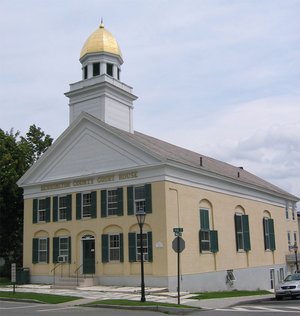
Court House, Manchester, Vermont- Photo Courtesy of Jared Benedict
When one thinks of spring, one tends to think of spring cleaning, setting the clocks back, and maybe even pulling out a couple of pairs of shorts from the bottom of the drawer. Occasionally, however, when the snow melts, and the sun begins working overtime hours, it reveals more than just chapped lawns and some misplaced squirrel food. Sometimes, just sometimes, when the spring sets in, it reveals old bones, and old mysteries.
Such was the case in Manchester, Vermont in April of 1819. That was the year Amos Boorn, a farmer in East Manchester, saw a ghost. That sighting, and the events that transpired in its wake, would lead to a most fascinating chapter in Vermont's legal history, and an enduring mystery.
Before we look too closely at this happening, we should go back a bit and explore the events which paved the way for this apparition to appear. The exact nature of those events has been a matter of great debate ever since, but the core of facts which almost everyone seems to agree upon is the following: On May 10, 1812, Russell Colvin was seen clearing rocks from a field owned by his father-in-law, Barney Boorn. He was in the company of his son Lewis and his two brother-in-laws, Stephen and Jesse Boorn. According to some later witness testimony, an argument seemed to be transpiring between Colvin and the two Boorns. Following this, Russell was not seen again in Manchester. He was thought to have wandered off during the altercation, a possibility which the residents of Manchester (those who bothered to take notice at all) found perfectly plausible, given that Colvin was considered "half-witted" by most and was known to have left town for weeks or months in the past.
It was not until seven years later that people began to seriously question this assumption. When they finally did, it was in large part due to the appearance of a ghost.
In April of 1819, Amos Boorn, who was Stephen and Jesse's uncle, told of a dream in which the ghost of Russell Colvin stood beside his bed. Colvin's shade told him that he'd been murdered and that he wanted to show him where his body was buried. He lead Amos to an old cellar hole in a field which had previously belonged to Barney Boorn. Not to be dismissed lightly, this dream occurred not once but three times in all.
Though Amos's dreams were to become one of the major catalysts for the events which followed, it had not appeared entirely out of the blue. Rather, a small handful of neighbors and relatives had grown suspicious in recent months, due to vaguely sinister comments that had been made offhand, mostly by Stephen Boorn, who had moved to Denmark, New York two years earlier but had returned for a visit. Stephen had told one acquaintance that he and Jesse had put Colvin "where potatoes would not freeze." Something similar had also been stated or implied by Nathaniel Boorn, another uncle, to Amos in the form of a death-bed confession. It was shortly after this that Amos had his ghostly dreams. So soon after, in fact, that some sources have suggested that the dreams were fabricated as a way for Amos to put forth his suspicions without overtly accusing his nephews of murder.
Whatever their nature, when word began to circulate about Amos's dreams, other Machesterites began having, as one source puts it, "strange dreams and unaccountable visions." Samuel Putnam Waldo, a lawyer from Hartford, wrote that it seemed "as if the age of ghosts and hobgoblins had revived; and that every house was haunted by the ghost of Colvin," and furthermore that this ghost "seemed to have had, if possible, a more serious effect upon the minds of the people, than that of the King of Denmark upon Hamlet."
At the point where the spectral dreams had reached critical mass, particularly in the more rural East Manchester, town officials in Manchester village began to take note, and eventually arrested Jesse Boorn on April 7, while a Court of Inquiry was convened to investigate whether or not a crime had been committed. The following day the investigators headed out to the cellar hole where Amos had been directed in his dream. Digging there produced several small objects: a coat-button, two knives (a long jackknife and a small pen knife). Some bones were found, but these proved not to be human remains. The objects were taken to Russell's wife Sarah, (who, it should be added, had already voiced an interest in having Russell declared dead, having another child, who under Vermont law was only eligible for support from the father if the mother was unmarried or widowed.), and she identified them as belonging to Russell.
Nevertheless, with the bones found proving to be of animal origin, the inquiry was left with little beside some refuse from an old cellar hole. In the minds of many inhabitants of East Manchester, guilt had already been determined, largely on the basis of the spectral dreams of Amos Boorn and others. The Manchester village elite who were the legal authority in this matter were adamant that such "ghost stories" be left out of the issue entirely.
So, by Saturday, May 1, with naught but rumors and circumstantial evidence that a crime might have been committed, town officials were prepared to free Jesse Boorn when Thomas Jefferson, a farmer who claimed to have witnessed the Boorns feuding with Colvin on the day he was last seen, asked to speak with Jesse in his jail cell. What was said is unknown, but when he emerged Jesse hastily confessed that he believed Stephen may have killed Colvin. He added that he thought he had an idea "within a few rods of where Colvin was buried."
This revelation lead to a new search, which ultimately revealed nothing. Meanwhile, in another part of Manchester, a boy discovered a cache of bones in the hollow of an old stump. This generated a great deal of excitement, but once more, upon close examination these too appeared to be animal bones. However, with Jesse's statement in hand, the matter of a corpus delicti was no longer so crucial. Some men were dispatched to New York to arrest Stephen Boorn and bring him to Manchester. He came willingly enough, but protested his innocence when pressed to confess the murder
Once back in Manchester, Stephen was first placed in a separate cell; then, hoping that putting the two together would provoke a full admission, hew was moved in with Jesse. Having quite the opposite of the desired effect, Jesse promptly rescinded his earlier statement.
The rage and indignation of the people of Manchester was by this time very intense. Amos Boorn's dreams, in particular, were accepted as "confirmation strong as holy writ," according to contemporary source. Still, the town officials close to the case knew that the case against the brothers, now united, was far from perfect. What followed, then, over the course of the long summer they spent sitting in their cell, was that virtually everyone involved took a turn at badgering, cajoling, and even threatening the brothers into a full confession.
Finally, after what some sources have termed coercion, Stephen offered a confession, that he had in fact killed Colvin. In his account, however, Jesse was not even present, leading later scholars to wonder if he may just have been trying to secure the release of his brother. He later tried to retract this confession, as had Jesse with his, but by this time it was too late. The machinery of law was in motion.
The trial for murder, at least the official one, was carried out in October of 1819. The Boorns, who pleaded not guilty, were represented by Richard Skinner, along with his associate Leonard Sargeant, who later served as Lt. Governor of Vermont. All prospective jurors from Manchester and from neighboring Sunderland were dismissed, due to the intense prejudice that had developed against the Boorns (so intense, in fact, that their mother, Elizabeth Boorn, was excommunicated from the Baptist church).
The trial itself proceeded quickly, from Tuesday, October 27, to Saturday, October 31 (the date of its conclusion if of course ironic, given the supernatural undertones of the entire affair). Despite a brilliantly executed defense by Skinner and Sergeant, the Boorns were, perhaps inevitably, convicted, and sentenced to death. Skinner called the trial "an instance of those strange popular delusions, which sometimes sweep through the most intelligent and conscientious communities, subverting truth and reason and justice." The sentence seemed particularly severe, especially in Jesse's case, and is an indicator of how intense the anti-Boorn sentiment had become.
Sympathetic to their plight, his attorney's circulated a petition for clemency. At the same time, a novel idea occurred to them: what if Russell Colvin was really alive, and could be found? If the Boorns had indeed not killed him, this seemed very possible. With this in mind, they purchased advertisements in papers throughout the northeast, seeking information from anyone, along with a detailed description. It went out about two months before the brothers were due to be hanged.
As the weeks passed, it eventually made its way to New York City, where it was seen by two crucial individuals. One was Taber Chadwick, a visiting Methodist minister from New Jersey, who after mulling it over a few days, wrote to the newspaper that he believed he knew the man in question and that he was alive and well in New Jersey. The second, as fate would have it, was Manchester expatriate and New York City tavern owner by the name of James Whelpley. When he saw Chadwick's letter, he sprung into action. He found the preacher, who told him that the man he believed to be Colvin worked for his brother-in-law, William Polhemus. Whelpley hired a wagon and made haste to Polhemus's mill, in what was then Monmouth County, New Jersey. When he found Polhemus, he was told that he did have a man from Vermont working for him, who had originally given his name as Russell Colvin before changing it, and that this man was "mildly deranged" ("slow", in today's parlance). Whelpley met the man, and knew at once that this was indeed Colvin. Securing Polhemus's permission, Whelpley took Colvin by stage coach to Vermont. They arrived in Bennington on December 22, to great crowds of spectators. Though somewhat confused, Russell addressed several people he knew there by name. All in Bennington were unanimous- this was indeed the man thought dead, standing before their very eyes!
Days before their arrival, word had reached Manchester, and was met with great skepticism and even consternation. Stephen Boorn, when told the news, seemed the most shocked of all, declaring that "had Colvin made his appearance right then, it would have caused immediate death." When finally the stage coach did reach Manchester, it was greeted by a mob - nearly every man, woman and child in town had come to see this man "returned from the dead."
Colvin greeted all he knew immediately by name, and seemed confused by all the fuss. When Stephen was allowed to make his way through the crowd, Colvin stared at him, finally asking why he was in chains. "Because they say I murdered you," Stephen replied. "You never hurt me," said Colvin. "Jesse struck me with a briar once, but it did not hurt me much." Colvin stayed in town for a week, during which time nearly everyone from Manchester, as well as people from neighboring towns, stopped and spoke to him. All were convinced that, both in appearance and behavior, was the missing man. Even his wife, Sally, knew him- though he was cold and aloof at her visit, and said to have muttered "that is all over with."
For legal purposes, he was asked to undergo an official examination to definitively prove his identity. The examination, run by the state's attorney who had prosecuted the Boorns, went smoothly and without incident. According to Leonard Sargeant, Colvin "told so many little incidents that could not have been known to an imposter [sic], however well posted, that there could be no doubt in the mind of any rational person as to the identity of the man."
On December 29, Colvin left Manchester for the last time. He made final appearance in Albany, before returning to New Jersey, at which point he becomes lost to history. What may have become of him after this is totally unknown. Stephen and Jesse were, of course, released. Both sued the state for damages and lost. Stephen returned to New York and Jesse moved to Ohio. Ever since then, the case has occupied a place of interest in the legal annals, held up as a classic case of wrongful conviction due to community prejudice and superstition. But was it?
In his book The Counterfeit Man, UMASS historian Gerald McFarland makes a case for the possibility that the "Russell Colvin" which appeared in Manchester in December of 1819 was actually a paid imposter. The basis for his argument, however, seems even more circumstantial than the evidence which convicted the Boorns to begin with. It relies on a conspiracy of no less than five people, and perhaps more: Barney Boorn, their father, and potentially other Boorns to help finance it, along with James Whelpley, Taber Chadwick (a Methodist minister, remember), William Polhemus, and the impersonator himself. It would also necessitate that these conspirators locate someone who not only so closely resembled Colvin that after only seven years no one would notice, and who could be so meticulously coached that he could supply on demand virtually any information Russell could be expected to know. Finally, all this would have had to have been accomplished in about two weeks time. Personally, I find the idea that such an enterprise could be pulled off so smoothly, secretively, and in such short order, harder to swallow than the original ghost story. After all, I think Jamie Foxx deserved every ounce of his Oscar, but even I knew that he wasn't actually Ray Charles (and I'm one who is prone to credulity and to flights of pure imagination- or so they tell me). Then again, ours is a world of strange incongruities and unlikely events- I rule nothing out.
In the end, it seems, we are left with a persistent shroud of mystery over the whole affair. Was it really Russell Colvin who appeared at the last moment in Manchester? Or was it indeed all a con to save the Boorns from the gallows?
Or was it, in fact, Colvin's ghost, having now forgiven even his own death, sweeping through town for one last incredible finale?
Sources:
Hard, Walter; Greene, Janet. Mischief in the Mountains: Strange Tales of Vermont and Vermonters
McFarland, Gerald. The Counterfeit Man: The true story of the Boorn-Colvin Murder Case
"Old Mystery Revived." Brookyln Daily Eagle, August 3, 1860
"Strange Murder Case." Brooklyn Daily Eagle, Dec 8, 1895
Tuesday, May 31, 2005
The Bizarre Berkshires
http://www.iberkshires.com/story.php?story_id=15903
Bizarre Berkshires: tales spooky and otherwise
By Joe Durwin
The Advocate Weekly- October, 27 2004
Most residents of Berkshire County know that nestled in the scenic wooded hills of Western Massachusetts is an area heavily steeped in history and culture.
But it should also perhaps not come as too much of a surprise that a place that has been host to such wild imaginations as those of Herman Melville, Edith Wharton and even Nathaniel Hawthorne should also be quite rich in odd stories, anomalies, and downright bizarre lore. Some of it goes back centuries; other tales have surfaced quite recently.
In the early days of our nation, the town of Cheshire was well known for its delicious cheese. So when Thomas Jefferson was elected president in 1800, Elder John Leland, pastor of Cheshire’s Baptist Church and a passionate supporter of Jefferson’s anti-Federalist politics, proposed to the people of Cheshire that a massive wheel of cheese be made to send to the new president as a gift. Leland found considerable local support for this idea, and farmers donated an impressive yield to the effort, resulting finally in a wheel estimated to be roughly 900 pounds.
The cheese was stored at the cider mill of one Captain Brown, in preparation for shipping. Now, at the same time, according to legend, there lived on Mount Greylock an old Indian medicine man by the name of Hokaposset. This old shaman was viewed with much trepidation by locals, who attributed vast powers to him, including the power to kill a stag merely by pointing a rifle at it and to cause mysterious deaths to befall his enemies. The old native sorcerer, as the story goes, had but one living relative, his granddaughter, Shonoma, also known as “Humming Bird.” Humming Bird was much in love with, and loved by, a local boy by the name of Ichabod Rannolds. But Pastor Leland advised the boy’s mother to forbid the match.
When Ichabod, a dutiful son, broke the bad news to Humming Bird, she became furious. She warned him of her grandfather’s powers and that he would cause suffering to those who caused pain to his only granddaughter. Ichabod did not relent, and the next day, Pastor Leland was shocked when one of his deacons brought him some bad news from Captain Brown — the entire cheese wheel had disappeared! Ichabod, suspecting the culprit to be the old shaman, went with some other men to the mountain to confront him, but when they arrived, Humming Bird said her grandfather was very ill and was indeed near death. She begged him to leave and let him die in peace. Hokaposset, who was indeed quite sick, died that very night. That morning, when Captain Brown opened the door of his cider mill, he was shocked to see that the cheese wheel, completely intact, had mysteriously reappeared!
While that story is more than a little amusing, more sinister “vanishings” have occasionally been known to happen in the area. In fact, Charles Fort, perhaps the most famous of all chroniclers of strange happenings, makes note of one such strange disappearance in, or over, the Berkshire Hills. According to a story in The New York Times, a pilot by the name of Captain Mansell R. James, took off from Lee on May 29, on route to Mitchel Field in Long Island, and was not seen again. Search parties scoured the area, and later, on the 4th of June, Army planes arrived to continue the search. Despite these and other efforts, not to mention much media attention, no trace was ever found of Captain James.
But the Berkshires have not only been the scene of strange disappearances; occasionally, things appear that ought not. A notable example is Pittsfield’s “ghost train,” which was seen by a number of persons at the Bridge Lunch diner, including its owner, John Quirk, one afternoon in February 1958. The train, as described by every person present that day, consisted of a steam locomotive and half a dozen cars, speeding down the tracks under North Street Bridge toward Boston. A month later, the train was seen again by every customer during a busy breakfast at the Bridge Lunch. Again the description was consistent from all witnesses: a steam engine with several cars, which appeared solid and clear as day. Railway officials maintained that no steam train had traveled those tracks in years, and when the train was sighted yet again, the railroad firmly stated that no train whatsoever was using those tracks at the time.
Another example of objects appearing apparently “out of nowhere,” can be found in reports of strange goings-on in the vicinity of Sage’s Ravine in Sheffield. At the time, Simeon Sage owned a garment manufacturing shop on his property, and it was here that, according to historical accounts, a series of bombardments that might today be called a “poltergeist,” occurred.
On the night of Nov. 8, 1802, as the accounts have it, an old man and two boys were in the shop. Shortly after 10 p.m., with the boys already in bed and the old man himself preparing to retire for the night, they were suddenly all given a jolt as a large chunk of wood crashed through the window. Pieces of mortar followed it. Terrified, they ran to get Mr. Sage. When he arrived on the scene, various objects continued to crash against the building. Sage could see the windows breaking, but try as he might, he could not discern where the objects were coming from. Then suddenly, the hail of miscellaneous missiles ceased. But about 8 the next night, it promptly started up again and continued on until midnight, when it again stopped abruptly. This strange bombardment occurred again the next night. While all three nights the torrent of objects occurred after dark, on the fourth day it began an hour before sunset. It continued for an hour in broad daylight, but even as those present searched the area around the building, they still could not find the source. Then, after an hour, it stopped once again — but this time it began again, almost immediately, at the Landon house, a quarter of a mile away on the Sheffield-Washington line. Rocks pelted the house for hours before abating, only to begin again around breakfast time the next morning.
By this time, word had spread of these events, and a steady stream of onlookers began showing up, including clergymen. None could discern the source of the mischief. Though many witnesses were themselves pelted with objects, some in broad daylight, all swore that they could not see the objects or their trajectory until after they struck. The possibility of a single assailant handy with a slingshot seemed to be eliminated, since the shower of refuse sometimes struck the buildings from several directions at once. The Sage place was hit with a variety of ammunition, including pieces of wood, stones, charcoal and a strange kind of mortar that did not resemble any to be found in the neighborhood. The Landon house was bombarded only by stones.
The phenomenon continued through the night of November 13, then ended for good. In total, 38 panes of glass were destroyed at the Sage’s and 13 at the Landon’s. No culprit was ever determined.
Those are not the only mysterious objects that have been reported whizzing through the Berkshire skies. I have collected no less than 10 reports of UFOs sighted throughout the county, over a period that spans from 1908 to 2003. In the interest of brevity, I will only share a couple: In 1981, a Pittsfield man was walking his dog when he suddenly felt a strange sensation pass over him. Looking up at the night sky, he saw the stars blacked out by a very large triangular object. Orange light glowed from beneath it. He described this sighting as having a strange effect on him. Rather than panicking or even thinking of it as odd, he felt very calm and simply pulled his dog’s leash and continued walking. Only later did the strange nature of the experience occur to him.
In another, more recent case, four witnesses in Becket reported seeing three disc-shaped objects with flashing white and red lights over Greenwater Pond. They were hovering and chasing each other across the pond and continued doing so for nearly 45 minutes before disappearing.
For some reason, sightings such as this frequently take place on or around mountains. Both Mount Greylock and October Mountain have yielded reports of strange aerial objects, but I will save those for another time, for both of these mountains have also been the scene of even more interesting sightings of the bizarre. In August 1983, The Berkshire Eagle reported on such a case. Two Pittsfield men, Eric Durant, and Frederick Parody, told reporters they had been recreating near Camp Eagle, a former Boy Scout retreat, when they saw a strange creature in the woods. The two men first spotted it in the moonlight when they heard noises not far from their campsite and went to investigate. Later, as they were leaving, they caught a glimpse of it in their headlights, lurking behind some bushes. What they described was a dark brown, hairy creature, which stood erect about 6 or 7 feet tall. They also claimed it had glowing red eyes, but this could have been due to the reflection of the headlights. What the Eagle did not know, however, was that an adult leader of a local Boy Scout troop told me that he and one of the Scouts also caught a brief glimpse of a similar creature while hiking on October Mountain that same weekend. He remembered that it was the same weekend because of the media attention brought on by the other two men’s sighting. Another person made a report of a similar hairy biped seen near the top of this same mountain to the Bigfoot Field Research Organization. This creature, which the informant claimed to have seen in the summer of 1989, appeared to be carrying and stacking stones in the brush.
I have heard more than half a dozen reputable verbal accounts of similar sightings from wooded areas all over the Berkshires — and, if that doesn’t satisfy you that an unknown creature haunts our forests, I’ve heard dozens more dis-reputable accounts! Nor is this a recent development. In fact, a piece in the New York Times dated Oct. 18, 1879, reported a “Wild Man” about 5 feet tall, covered in hair, seen by two young Vermont men hunting “in the mountains south of Williamstown.” The men were so frightened, the Times reported, that they dropped their guns and ammunition in their hasty retreat and never dared to go back for them.
Mount Greylock, it seems, may be home to an even more esoteric entity. He is known as the “Old Coot,” and is sometimes seen wandering up the mountain near the trail that runs through the Bellows Pipe area. As the story goes, the ‘Coot’ is the astral remnant (or should I say revenant?) of a man named Bill Saunders, who lived in Adams nearly a century and a half ago. Saunders left his wife and child to fight in the Union Army. A year later, his wife received word that he had been badly wounded and was in a field hospital. When, after many months passed, she heard nothing more of him, she assumed him to be lost. She hired a local man to help work the farm. Eventually they married. Then, after the war had ended, Saunders returned, only to find another man had taken his place. Devastated, he spent the rest of his life living as a hermit in a small shack in Bellows Pipe. Many years later, hunters discovered him dead in his cabin but were mystified to see a strange man-shaped shadow dart out of the shack and into the woods, heading up the mountain. Ever since, hunters and hikers have reported seeing a shadowy, bedraggled form walking through the woods up Mount Greylock.
Twice, the North Adams Transcript has published photographs alleged to be of the “Coot,” one by Randy Trabold, in 1939, the second by Richard Lodge in 1979. The Lodge photograph seems to depict a tall, dark, man-like form walking through the woods with his head hung low. Was this the ghost of Bill Saunders?
The Berkshires can also boast a few more high-profile manifestations. Indeed, specters are said to haunt two of the county’s most prominent cultural tourist locations. In Lenox, it is said that Edith Wharton still inhabits the The Mount, the beautiful Estate she had built in 1902. Visitors sometimes tell of strange noises, including the laughter of a woman, thought to be Wharton herself. Shakespeare & Company, the esteemed theater troupe for whom The Mount is home, frequently reports footsteps made by invisible feet and the appearance of various apparitions, including Henry James, who is thought to keep his friend Wharton company there. Elsewhere in Lenox, a ghostly occupant is said to inhabit the Highwood Manor House on the scenic grounds of Tanglewood. It is thought that this spirit may be the shade of Oreb Andrews, who died on the grounds in 1822 and was awakened in 1986, when workmen disturbed a memorial marker. Doors opening and closing and water faucets turning themselves on and off are among the unexplained activities attributed to this restless soul. Some have speculated that it was perhaps this being that appeared in front of Leonard Bernstein, prompting him to leap from a window seat in shock. John Williams even joined a band of ghost hunters to pursue this personage, if such a word applies, but they were unable to catch a glimpse of their quarry. Odd occurrences, though infrequent, continue to this day.
Perhaps most disturbing are the reports that have reached this writer regarding Springside Park and the surrounding area. Many Pittsfield locals will recall the grisly rashes of “vandalism” — as the Eagle euphemistically put it — which took place at the petting zoo in the ’70s and ’80s, in which a number of animals were mutilated and killed, finally leading to its closing in 1984. But few recall that, in the late 19th century, the dismembered torso of a human corpse was found not far from the Springside House, then called the Elmhurst House. The body was never identified and the killer never apprehended, but the crime may have left some lasting residue on the area. A local woman of exceedingly solid character shared with me the story of how, some decades ago, she and her boyfriend were walking down the circular drive of Springside House when what they then thought to be an uprooted tree stump suddenly began lumbering toward them. Later, when they heard of the murder, they speculated that it might actually have been the hands and feet of the unfortunate victim. And reports have continued to trickle in over the years of a horrific floating head, which has been seen by many residents of the west side of North Street, across the street from the Springside house. “The Head,” as it is often called, is usually described as a ghastly skull with bits of decomposed skin still clinging to it. It is interesting to note that these houses stand on land that was once a landfill.
These are but a smattering of some of my favorite tales of the bizarre originating in the Berkshires. There are many more, including the oft-repeated story of Hoosac Tunnel’s “Bloody Pit,” the tragic Indian lovers who are sometime seen canoeing across Pontoosuck Lake, the menacing apparition said to inhabit the Eagle building, the grim Chauffeur who haunts the old Houghton Mansion in North Adams, a spectral woman who wanders Hinsdale’s Walsh Camp, Egremont’s undead Hessian soldier, bizarre happenings in Lenox’s High Point and many, many others. It is said that some areas produce more than their fair share of paranormal encounters, and Berkshire County certainly seems to be one such place. Whether it is due to some kind of eldritch magic, misunderstood electromagnetic phenomena or simply a kind of geographical favoritism on the part of supernatural creatures, these legends, like the beings they portray, are likely to live on evermore — in our hearts and in our cultural heritage.
Bizarre Berkshires: tales spooky and otherwise
By Joe Durwin
The Advocate Weekly- October, 27 2004
Most residents of Berkshire County know that nestled in the scenic wooded hills of Western Massachusetts is an area heavily steeped in history and culture.
But it should also perhaps not come as too much of a surprise that a place that has been host to such wild imaginations as those of Herman Melville, Edith Wharton and even Nathaniel Hawthorne should also be quite rich in odd stories, anomalies, and downright bizarre lore. Some of it goes back centuries; other tales have surfaced quite recently.
In the early days of our nation, the town of Cheshire was well known for its delicious cheese. So when Thomas Jefferson was elected president in 1800, Elder John Leland, pastor of Cheshire’s Baptist Church and a passionate supporter of Jefferson’s anti-Federalist politics, proposed to the people of Cheshire that a massive wheel of cheese be made to send to the new president as a gift. Leland found considerable local support for this idea, and farmers donated an impressive yield to the effort, resulting finally in a wheel estimated to be roughly 900 pounds.
The cheese was stored at the cider mill of one Captain Brown, in preparation for shipping. Now, at the same time, according to legend, there lived on Mount Greylock an old Indian medicine man by the name of Hokaposset. This old shaman was viewed with much trepidation by locals, who attributed vast powers to him, including the power to kill a stag merely by pointing a rifle at it and to cause mysterious deaths to befall his enemies. The old native sorcerer, as the story goes, had but one living relative, his granddaughter, Shonoma, also known as “Humming Bird.” Humming Bird was much in love with, and loved by, a local boy by the name of Ichabod Rannolds. But Pastor Leland advised the boy’s mother to forbid the match.
When Ichabod, a dutiful son, broke the bad news to Humming Bird, she became furious. She warned him of her grandfather’s powers and that he would cause suffering to those who caused pain to his only granddaughter. Ichabod did not relent, and the next day, Pastor Leland was shocked when one of his deacons brought him some bad news from Captain Brown — the entire cheese wheel had disappeared! Ichabod, suspecting the culprit to be the old shaman, went with some other men to the mountain to confront him, but when they arrived, Humming Bird said her grandfather was very ill and was indeed near death. She begged him to leave and let him die in peace. Hokaposset, who was indeed quite sick, died that very night. That morning, when Captain Brown opened the door of his cider mill, he was shocked to see that the cheese wheel, completely intact, had mysteriously reappeared!
While that story is more than a little amusing, more sinister “vanishings” have occasionally been known to happen in the area. In fact, Charles Fort, perhaps the most famous of all chroniclers of strange happenings, makes note of one such strange disappearance in, or over, the Berkshire Hills. According to a story in The New York Times, a pilot by the name of Captain Mansell R. James, took off from Lee on May 29, on route to Mitchel Field in Long Island, and was not seen again. Search parties scoured the area, and later, on the 4th of June, Army planes arrived to continue the search. Despite these and other efforts, not to mention much media attention, no trace was ever found of Captain James.
But the Berkshires have not only been the scene of strange disappearances; occasionally, things appear that ought not. A notable example is Pittsfield’s “ghost train,” which was seen by a number of persons at the Bridge Lunch diner, including its owner, John Quirk, one afternoon in February 1958. The train, as described by every person present that day, consisted of a steam locomotive and half a dozen cars, speeding down the tracks under North Street Bridge toward Boston. A month later, the train was seen again by every customer during a busy breakfast at the Bridge Lunch. Again the description was consistent from all witnesses: a steam engine with several cars, which appeared solid and clear as day. Railway officials maintained that no steam train had traveled those tracks in years, and when the train was sighted yet again, the railroad firmly stated that no train whatsoever was using those tracks at the time.
Another example of objects appearing apparently “out of nowhere,” can be found in reports of strange goings-on in the vicinity of Sage’s Ravine in Sheffield. At the time, Simeon Sage owned a garment manufacturing shop on his property, and it was here that, according to historical accounts, a series of bombardments that might today be called a “poltergeist,” occurred.
On the night of Nov. 8, 1802, as the accounts have it, an old man and two boys were in the shop. Shortly after 10 p.m., with the boys already in bed and the old man himself preparing to retire for the night, they were suddenly all given a jolt as a large chunk of wood crashed through the window. Pieces of mortar followed it. Terrified, they ran to get Mr. Sage. When he arrived on the scene, various objects continued to crash against the building. Sage could see the windows breaking, but try as he might, he could not discern where the objects were coming from. Then suddenly, the hail of miscellaneous missiles ceased. But about 8 the next night, it promptly started up again and continued on until midnight, when it again stopped abruptly. This strange bombardment occurred again the next night. While all three nights the torrent of objects occurred after dark, on the fourth day it began an hour before sunset. It continued for an hour in broad daylight, but even as those present searched the area around the building, they still could not find the source. Then, after an hour, it stopped once again — but this time it began again, almost immediately, at the Landon house, a quarter of a mile away on the Sheffield-Washington line. Rocks pelted the house for hours before abating, only to begin again around breakfast time the next morning.
By this time, word had spread of these events, and a steady stream of onlookers began showing up, including clergymen. None could discern the source of the mischief. Though many witnesses were themselves pelted with objects, some in broad daylight, all swore that they could not see the objects or their trajectory until after they struck. The possibility of a single assailant handy with a slingshot seemed to be eliminated, since the shower of refuse sometimes struck the buildings from several directions at once. The Sage place was hit with a variety of ammunition, including pieces of wood, stones, charcoal and a strange kind of mortar that did not resemble any to be found in the neighborhood. The Landon house was bombarded only by stones.
The phenomenon continued through the night of November 13, then ended for good. In total, 38 panes of glass were destroyed at the Sage’s and 13 at the Landon’s. No culprit was ever determined.
Those are not the only mysterious objects that have been reported whizzing through the Berkshire skies. I have collected no less than 10 reports of UFOs sighted throughout the county, over a period that spans from 1908 to 2003. In the interest of brevity, I will only share a couple: In 1981, a Pittsfield man was walking his dog when he suddenly felt a strange sensation pass over him. Looking up at the night sky, he saw the stars blacked out by a very large triangular object. Orange light glowed from beneath it. He described this sighting as having a strange effect on him. Rather than panicking or even thinking of it as odd, he felt very calm and simply pulled his dog’s leash and continued walking. Only later did the strange nature of the experience occur to him.
In another, more recent case, four witnesses in Becket reported seeing three disc-shaped objects with flashing white and red lights over Greenwater Pond. They were hovering and chasing each other across the pond and continued doing so for nearly 45 minutes before disappearing.
For some reason, sightings such as this frequently take place on or around mountains. Both Mount Greylock and October Mountain have yielded reports of strange aerial objects, but I will save those for another time, for both of these mountains have also been the scene of even more interesting sightings of the bizarre. In August 1983, The Berkshire Eagle reported on such a case. Two Pittsfield men, Eric Durant, and Frederick Parody, told reporters they had been recreating near Camp Eagle, a former Boy Scout retreat, when they saw a strange creature in the woods. The two men first spotted it in the moonlight when they heard noises not far from their campsite and went to investigate. Later, as they were leaving, they caught a glimpse of it in their headlights, lurking behind some bushes. What they described was a dark brown, hairy creature, which stood erect about 6 or 7 feet tall. They also claimed it had glowing red eyes, but this could have been due to the reflection of the headlights. What the Eagle did not know, however, was that an adult leader of a local Boy Scout troop told me that he and one of the Scouts also caught a brief glimpse of a similar creature while hiking on October Mountain that same weekend. He remembered that it was the same weekend because of the media attention brought on by the other two men’s sighting. Another person made a report of a similar hairy biped seen near the top of this same mountain to the Bigfoot Field Research Organization. This creature, which the informant claimed to have seen in the summer of 1989, appeared to be carrying and stacking stones in the brush.
I have heard more than half a dozen reputable verbal accounts of similar sightings from wooded areas all over the Berkshires — and, if that doesn’t satisfy you that an unknown creature haunts our forests, I’ve heard dozens more dis-reputable accounts! Nor is this a recent development. In fact, a piece in the New York Times dated Oct. 18, 1879, reported a “Wild Man” about 5 feet tall, covered in hair, seen by two young Vermont men hunting “in the mountains south of Williamstown.” The men were so frightened, the Times reported, that they dropped their guns and ammunition in their hasty retreat and never dared to go back for them.
Mount Greylock, it seems, may be home to an even more esoteric entity. He is known as the “Old Coot,” and is sometimes seen wandering up the mountain near the trail that runs through the Bellows Pipe area. As the story goes, the ‘Coot’ is the astral remnant (or should I say revenant?) of a man named Bill Saunders, who lived in Adams nearly a century and a half ago. Saunders left his wife and child to fight in the Union Army. A year later, his wife received word that he had been badly wounded and was in a field hospital. When, after many months passed, she heard nothing more of him, she assumed him to be lost. She hired a local man to help work the farm. Eventually they married. Then, after the war had ended, Saunders returned, only to find another man had taken his place. Devastated, he spent the rest of his life living as a hermit in a small shack in Bellows Pipe. Many years later, hunters discovered him dead in his cabin but were mystified to see a strange man-shaped shadow dart out of the shack and into the woods, heading up the mountain. Ever since, hunters and hikers have reported seeing a shadowy, bedraggled form walking through the woods up Mount Greylock.
Twice, the North Adams Transcript has published photographs alleged to be of the “Coot,” one by Randy Trabold, in 1939, the second by Richard Lodge in 1979. The Lodge photograph seems to depict a tall, dark, man-like form walking through the woods with his head hung low. Was this the ghost of Bill Saunders?
The Berkshires can also boast a few more high-profile manifestations. Indeed, specters are said to haunt two of the county’s most prominent cultural tourist locations. In Lenox, it is said that Edith Wharton still inhabits the The Mount, the beautiful Estate she had built in 1902. Visitors sometimes tell of strange noises, including the laughter of a woman, thought to be Wharton herself. Shakespeare & Company, the esteemed theater troupe for whom The Mount is home, frequently reports footsteps made by invisible feet and the appearance of various apparitions, including Henry James, who is thought to keep his friend Wharton company there. Elsewhere in Lenox, a ghostly occupant is said to inhabit the Highwood Manor House on the scenic grounds of Tanglewood. It is thought that this spirit may be the shade of Oreb Andrews, who died on the grounds in 1822 and was awakened in 1986, when workmen disturbed a memorial marker. Doors opening and closing and water faucets turning themselves on and off are among the unexplained activities attributed to this restless soul. Some have speculated that it was perhaps this being that appeared in front of Leonard Bernstein, prompting him to leap from a window seat in shock. John Williams even joined a band of ghost hunters to pursue this personage, if such a word applies, but they were unable to catch a glimpse of their quarry. Odd occurrences, though infrequent, continue to this day.
Perhaps most disturbing are the reports that have reached this writer regarding Springside Park and the surrounding area. Many Pittsfield locals will recall the grisly rashes of “vandalism” — as the Eagle euphemistically put it — which took place at the petting zoo in the ’70s and ’80s, in which a number of animals were mutilated and killed, finally leading to its closing in 1984. But few recall that, in the late 19th century, the dismembered torso of a human corpse was found not far from the Springside House, then called the Elmhurst House. The body was never identified and the killer never apprehended, but the crime may have left some lasting residue on the area. A local woman of exceedingly solid character shared with me the story of how, some decades ago, she and her boyfriend were walking down the circular drive of Springside House when what they then thought to be an uprooted tree stump suddenly began lumbering toward them. Later, when they heard of the murder, they speculated that it might actually have been the hands and feet of the unfortunate victim. And reports have continued to trickle in over the years of a horrific floating head, which has been seen by many residents of the west side of North Street, across the street from the Springside house. “The Head,” as it is often called, is usually described as a ghastly skull with bits of decomposed skin still clinging to it. It is interesting to note that these houses stand on land that was once a landfill.
These are but a smattering of some of my favorite tales of the bizarre originating in the Berkshires. There are many more, including the oft-repeated story of Hoosac Tunnel’s “Bloody Pit,” the tragic Indian lovers who are sometime seen canoeing across Pontoosuck Lake, the menacing apparition said to inhabit the Eagle building, the grim Chauffeur who haunts the old Houghton Mansion in North Adams, a spectral woman who wanders Hinsdale’s Walsh Camp, Egremont’s undead Hessian soldier, bizarre happenings in Lenox’s High Point and many, many others. It is said that some areas produce more than their fair share of paranormal encounters, and Berkshire County certainly seems to be one such place. Whether it is due to some kind of eldritch magic, misunderstood electromagnetic phenomena or simply a kind of geographical favoritism on the part of supernatural creatures, these legends, like the beings they portray, are likely to live on evermore — in our hearts and in our cultural heritage.
Subscribe to:
Posts (Atom)