Search Weirdness:

Thursday, April 20, 2006

The Mount's Literary Phantasmagoria


Advocate Weekly
Thursday, April 20


"Sources," Edith Wharton once wrote, ".are not one what one needs in judging a ghost story. The good ones bring their own internal proof of their own ghostliness; and no other evidence is needed."

A troublesome remark for me, certainly, as a significant amount of my time is spent seeking out the sources of ghost stories, and judging them thereby. In her own case, however, her observation proves apt enough: the stories of paranormal events coming out of her Lenox home the last few decades do have a sort of inarguable internal logic.

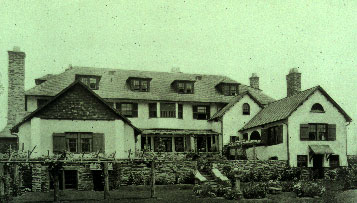
The Mount was built between 1900 and 1902, on a 130 acre tract of Lenox land Wharton purchased for just over $40,000. She based the mansion in large part on Belton House, in Lincolnshire, England, designed by Sir Christopher Wren. The architecture was handled by the firm Hoppin & Koen (not, as is frequently stated, her friend and literary collaborator Ogden Codman, whom she replaced after initial planning for being too expensive), but the lion's share of the credit goes to Wharton herself, whose instructions the architects merely followed to the letter. The house she outlined reflected the sensibilities she had put forth in her own book on the subject, "The Decoration of Houses." She could be said to be an advocate of minimalism - at least by the "never-say-when" standards of the Gilded Age - nonetheless, the expense of the project was extreme. Despite Wharton's substantial wealth, the final touches had to wait until 1905 brought a much needed injection of cash, in the form of "House of Mirth" royalties.

Wharton called The Mount her "first real home," and considered it an ideal environment for writing, which she worked on each morning sitting up in bed, saying that she preferred to keep the practice of her craft from interfering with her other obligations. In the decade that she kept residence at her sprawling estate along Laurel Lake, Wharton completed some of her finest work. In particular, a fair majority of the events and characters in "Ethan Frome," including Frome himself, were directly drawn from local inspiration. While living there with her husband, Edward (Teddy) Wharton - a wealthy socialite born into the same circles as Edith (maiden name Jones, the family referred to in the once popular catch-phrase "keeping up with the Joneses") - she frequently entertained as guests many luminaries of the literary and intellectual world, including Richard Watson Gilder, Howard Sturgis, Clyde Fitch and Henry James.

Wharton sold the property in 1912, as her marriage to Teddy (described by some contemporaries as "charming but dim"), was dissolving. She never returned. It was remarked that in the end Wharton found Paris to be her true "spiritual home." While this may be true, it was The Mount, above and beyond any other location, which in later years would come to be thought of as her spectral home. The property has changed hands half a dozen times since then, but Wharton's presence, both historical and otherwise, has left a palpable and seemingly unshakable mark on the estate.
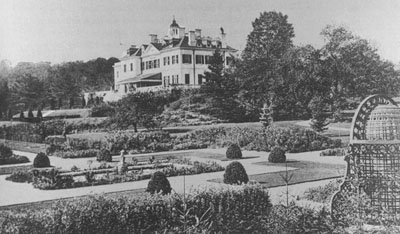


The Mount came for a time under the ownership of Carr van Anda, managing editor of the New York Times, who in 1943 sold it to Foxhollow School, which had purchased the former Vanderbilt estate adjacent to it a few years earlier. For about 30 years, The Mount served as a dormitory for the girls' preparatory school, and it is during this period that the first rumors of a ghostly presence began circulating. "There were lots of stories," said one former student. " Of course, girls' boarding schools will be girls boarding schools."

Dorothy Carpenter, another alumna of Foxhollow, reported the following: "People use to talk about it all the time.... Every time we'd hear a creak, we'd say it was Edith Wharton's ghost, but nobody really thought it was." Carpenter's perspective on the stories changed, however, when she returned to the house in the early '70s. The house had fallen into disuse by then, and Carpenter spent two months living there alone while she worked on restoration of the ballroom ceiling. One day, she was staring off absently out the window, when she saw a woman in period clothing walking across the terrace. She recognized her instantly from pictures she'd seen, but the version she was looking at now seemed far more vivid, more "alive" than any representation. "At the time, I thought maybe I'd been inhaling too much plaster dust."

As most locals know, in the late '70s The Mount was acquired by the legendary theatre troupe Shakespeare & Company, who occupied the site for more than 20 years. During this period, apparitions and spectral tableaus were reportedly witnessed by some of the brightest luminaries of the regional theater world. Dennis Krausnick, a former Jesuit priest turned actor and director, was one of the first people to enter the building. He reported that while he was working alone in the house, he heard footsteps constantly, but could find no one in the house upon searching. Josephine Abady, former head of the Hampshire College theater department and artistic director for Berkshire Theater Festival, described to one writer how she saw an apparition of Wharton several times while on the premises, and was haunted constantly by a rustling sound not unlike the swishing of a someone in a long dress walking by. On at least one occasion, she saw the Wharton figure in the company of a man who looked very much like Henry James, not knowing at the time that James had been a favorite house guest there.

This same male ghost was reported by none other than Shakespeare & Company founder Tina Packer, perhaps tellingly in the "Henry James Bedroom." Another actress, Andrea Haring, described a supernatural scene of both the Whartons, as well as James, all apparently engaged in conversation. The sheer appropriateness of the idea of The Mount being haunted by both Wharton and James cannot be overstated. Among her other literary accomplishments, Wharton is generally held in high regard as one of the finest American purveyors of the ghost story, who cared passionately about the subject and brought many novel touches to the genre. As for Henry James, well, I won't gush, but "Turn of the Screw" is quite simply, in my opinion, among only two or three other pieces of writing committed to paper contending for the title of greatest horror story ever.

With such a foundation - combined with the building's reincarnations as first a prep school, then theatrical mecca, both highly charged, creative environments - perhaps ghostly sightings were inevitable. Maybe Wharton really was right about ghost stories, after all.


"Sources":

Berkshire Evening Eagle, May 20, 1943

Fitchburg Sentinel & Enterprise May 30, 2002

Myers, Arthur. The Ghostly Register (Contemporary, 1986)

Ogden, Tom. The Complete Idiot’s Guide to Ghosts & Hauntings (Alpha Books, 2004)

Owens, Carole. The Berkshire Cottages: A Vanishing Era (Cottage Press, 1994)


--
Joe Durwin is a freelance writer and one possible answer to the question "Who ya gonna call?" Send comments or reports of the strange to joe@durwin.net.

Saturday, April 15, 2006

MCLA course project has students researching unexplained phenomena

By Jennifer Huberdeau, North Adams Transcript
April 14, 2006


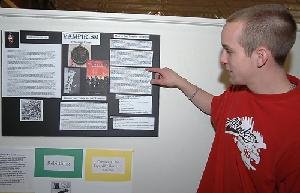
MCLA junior George Inman delved into the subculture phenomenon of vampirism — both the psychic- and blood-feeding kind. Photo by Paul Guillotte/North Adams Transcript


NORTH ADAMS — Floating lanterns, wandering lights, strange winds and eerie voices calling from within the Hoosac Tunnel are staple legends surrounding the infamous portal. The validity of claims about the haunting of the tunnel was one of many subjects explored in a "Skeptic Fair" at Massachusetts College of Liberal Arts.
"I'm still 50/50 on my findings. It think part of it is fabricated because of the history of the tunnel. There are things I can't explain, but I believe a large part of it is psychological. You get an eerie feeling at the tunnel, but it is dark, damp and cold inside the tunnel," said Julia Kowalski, a senior from South Bridge.

Students in psychology professor Thomas Byrne's class, the "Psychology of Superstition and the Unexplained," presented their findings on topics ranging from alien abductions and crop circles to the practices of Reiki and chiropracty.

"The basic idea was for my students to examine why or why not people believe these things and to examine their own belief systems. They were given a lot of leeway to choose their topic, I only asked they go into the project with an open mind — without preconceived opinions," Byrnes said. "They were asked to investigate their topic, find evidence and decide if the claims were true or false."

Kowalski said her initial idea was to investigate the infamous crop circles, but on a suggestion of a friend, decided to look at the Hoosac Tunnel because of her ability to gain "hands-on" evidence.

"I actually brought a tape recorder into the tunnel. I went into the tunnel about 2,500 feet," she said. Kowalski was trying to recreate a similar experiment done by college students during the early 1980s. That experiment captured what some people would call electronic voice phenomena or "muffled voices."

"I didn't have any muffled voices, just those of my friends and myself. I think one explanation for the muffled voices could be contributed to echoes in the tunnel," Kowalski said. She said other things like wandering lights could possibly be train lights.

"Your head plays tricks on you especially when you're in a place that's underground and is dark, damp and cold. The temperature is about 15 degrees colder in the tunnel, so any burst of air from the tunnel is cold and could contribute for the strange winds people encounter," she said.

One tale she found was about a hunter, Frank Webster, who disappeared near the tunnel in 1874. Webster was found days later, beaten and without his rifle. He claimed strange voices called him into the tunnel, where a ghost took his gun and then beat him.

Fabrications?

"There's nothing to prove some person didn't do it. I think a lot of stories are fabricated. I think this is where a lot of stories come into play," she said.

She said the tunnel's history has taken on its own life, with varying versions of the circumstances of the tunnel workers deaths and even discrepancies of what the term 'hoosac' actually means.

"In my research I found many people wrote the American Indian word 'hoosac' was supposed to mean forbidden. It actually means "stone place" in Mohican," Kowalski said.

George Inman, a junior, studied the underground subculture of vampyrism and the characteristics of the movements followers.

"There are two kinds of vampires, those who believe they are psychic vampires and that they feed off of other people's minds and those who are more traditional and feed off of blood. They cut themselves and feed off of each other," he said.

Inman said a lot of the subculture is influenced by the original inspiration for Dracula, Vlad the Impaler. He said the followers dress in black and claim they are sensitive to light, such as Vlad did.

"They also all seem to play Vampire: The Masquerade. It's huge around the world and they claim that it allows them social acceptance. The popularity is unbelievable," Inman said.

He said the followers of vampyrism seem to have similar characteristics: emotional irritability and instability, depression, belief in psychic powers, a strong sex drive and a "thirst" best described as comparable to a migraine headache.

"They seem to have a seclusionary lifestyle, but coming together gives them a sense of community and a release of romanticism," Inman said.

Senior Jodi Browning of Plaistow, N.H., focused on the phenomenon of alien abduction claims. In her research, she found over 6,000 Americans have claimed to be abducted since 1960.

"There is no documentation of abductions before the 1960s," she said. "Another odd thing is that a very large percentage of abductees claim to have telepathically communicated with the aliens, but the conversations take place in English."

While Browning did not discredit the possibility of aliens existing, she did say she leaned toward believing the empirical studies done by psychologists which seem to link many abduction stories with traumatic events, including sexual abuse.

"The empirical studies are more objective. I tend to believe that for some people it is easier for them to believe they were abused by aliens. I also think there is a large connection between media influence and hallucinations with the claims," she said.

Another student's study showed that there is no solid link between healing and the practice of Reiki, while an investigation into chiropractic services found that autistic children receiving the therapy had positive results including increased speech and vocalization, better bladder control and an evening of leg lengths.


--------------------------------------------------------------------------------

Jennifer Huberdeau can be reached at jhuberdeau@thetranscript.com.

Monday, April 10, 2006

The mystery of the Monument Mountain stone heap

guest story borrowed from The Advocate Weekly, April 06, 2006

The mystery of the Monument Mountain stone heap
By LION G MILES


Thursday, April 06

In 1882, Charles J. Taylor published his "History of Great Barrington," a generally well-researched account that still is the standard chronicle of the early days of that town.

As accurate as Taylor tried to be, some serious historical errors inevitably found their way into his book. On pages 60-62, he inserted the text of a letter that appears authentic but is actually a put-up job, if not an outright forgery. It contains information that has been accepted over the years, things like the word "Mahaiwe" and the size of the famous Indian stone heap that gives Monument Mountain its name, but recent research in primary manuscript sources tells a different story.

Taylor found the letter in a rather dubious source, The Berkshire Courier of November 15, 1866. It immediately becomes suspicious because neither the writer nor the recipient are identified. The dateline of "Indian Town" in November 1735 is anachronistic because there was no Indian town at that time, the Mohicans not receiving their grant at Stockbridge until the next year. In the letter's description of the Rev. John Sergeant's baptism of Chief Konkapot, it borrows word for word the profession of faith delivered by another Indian (Ebenezer) in 1734, the text of which is found in Rev. Sergeant's journal. In fact, there is little information in the letter that could not have been found in Sergeant's journal or other printed sources. The main exception is the name "Mahaiwe," which is not found elsewhere to my knowledge. Taylor said it is the Mohican word for "place down stream" but admitted it should be spelled "Neh-hai-we." While that may be true (the related Delaware tribe used the word "Nahiwi" for "down the river"), the confusion added to the suspicious nature of the letter.

Another anomaly in the letter is the statement that the "Great Wigwam" of Chief Umpachene was "at the ford a mile or two south [of Monument Mountain]." Presumably this is the spot now commemorated by a marker at the "Old Indian Fordway" on Bridge Street. The marker claims that there was a battle with the Indians there in 1676, but it is documented that the fight occurred further to the south, probably in Sheffield. The other error is in the location of the "Great Wigwam," which was on the Green River two miles to the south. Sergeant's journal clearly shows that the two groups of Indians lived 8 to 10 miles apart, Konkapot in the meadow at Wnahktukook (Stockbridge) and Lieutenant Umpachene at Scatekook (Green River). When Sergeant first arrived at Great Barrington in 1734, he wrote that "I board at Mr. Ingersol's; and teach the Children at the Lieutnts. Wigwam." For the first six months of his mission Sergeant, lived with David Ingersoll at his house near the present site of the Mason Library and taught the Indians two miles south at Scatekook.

The greatest fallacy in Taylor's letter relates to the stone heap at Monument Mountain. It is described as "a pile of stones some six or eight feet in diameter, circular at its base and raised in the form of an obtuse cone. It is raised over the grave of the first Sachem who died after they came into this region. Each Indian, as he goes by, adds a stone to the pile." This wording is so close to that in the 1829 "History of Berkshire County" that it suggests copying, but the text is different enough to indicate some alteration: "The pile was six or eight feet in diameter, circular at its base and raised in the form of an obtuse cone ... over the grave of one of the Aborigines. ... Every Indian who passed the place, threw a stone upon the tomb of his countryman." No source is given for the 1829 version, but it is possible that it was the creation of the Rev. David Dudley Field, who had collected the materials for the history. Curiously, it was his son, Jonathan Edwards Field, who had provided the Taylor letter to the Berkshire Courier in 1866.

Further evidence for the falsity of the Taylor letter is found in Timothy Dwight's "Travels in New England and New York" (published in 1821 but written in the 1790s), which states that the name of Monument Mountain "is derived from a pile of stones about six or eight feet in diameter, circular at its base, and raised in the form of an obtuse cone over the grave of one of the Aborigines," etc. Certainly this is the source of the quote in Taylor's book, a secondary account first written in 1798 and not an eyewitness report of 1735. Dwight did not see the stone pile himself and was relying on hearsay.

Until now, we have had only three published eyewitness accounts of the monument, none of which give specific details of its size or location. Sergeant wrote in his journal on November 3, 1734: "There is a LARGE Heap of Stones, I suppose TEN CART LOADS, in the Way to Wnahktukook, which the Indians have thrown together, as they pass'd by the Place; for it us'd to be their Custom, every Time any one pass'd by, to throw a Stone to it; But what was the End of it they cannot tell" (Emphasis is mine). The Rev. Gideon Hawley wrote an account of a journey he made in 1753. Upon observing an Indian stone heap in New York State, he wrote: "The LARGEST heap I ever observed, is that LARGE collection of small stones on the mountain between Stockbridge and Great-Barrington." In 1761 David Ingersoll stated that "he saw a LARGE heap of stones on the east side of Westenhook or Housatonnock River so called on the southerly end of the Mountain called Monument Mountain."

I emphasize the use of the adjective LARGE to describe the monument. It seems unlikely that a stone pile of only six or eight feet in diameter would be sufficient to fill the ten cart loads mentioned by Sergeant. The truth is that the stone heap was quite large and obvious. In the fall of 1761, Colonel John Van Rensselaer of Claverack, N.Y., employed a surveying party to establish the boundary line between the Van Rensselaer and Livingston Manors of Columbia County. He claimed ownership to the Housatonic River and charged his surveyors to run the line 24 miles east of the Hudson River, bringing it into the present bounds of Great Barrington. On November 25, 1761, Jacob Philip, one of his chain men, deposed in Albany County court and declared: "they Run about half a Mile west of a Heap of Stones Standing on the Southerly End of a Mountain near the Road from Sheffield to Stockbridge - that he and the Rest of the Chainbearers by the Surveyors Directions Measured the said Heap and found it Eighty two Links about the Bottom and seventeen Links high along the Slant of the Said Heap." A link of the chain equaled 7.92 inches so the monument in Great Barrington measured slightly more than 54 feet at the base and stood over 11 feet high, the size of a small house.

Other residents of Berkshire and Albany Counties testified to having seen the large pile and that the bottom stones were sunk deep into the ground, suggesting great antiquity. There was no evidence of a burial beneath the monument although the results of the survey did show two heaps of stones along the line in Columbia County "Erected by the Indians in Memory of two of their Sachems buried in that place." The English settlers at this time were dismantling the numerous stone heaps to obtain building materials, especially for chimneys, and the Great Barrington heap suffered the same fate. It was "all removed" by August 1762 and there has been no trace of it since, despite the many later efforts to find it.

Most contemporary accounts state that the monument was "near" the road (not "on" it) at the southern end of Monument Mountain, and none indicates that it was visible from the road. The earliest map of Stockbridge is a surveyor's plat dated October 15, 1736. On it at the northwest corner of Sheffield (now Great Barrington) is written the bearing of east nine degrees south, 932 perch (rods), "to the monument of stones," and another notation that the monument was north of Moses King's property, 60 perch. This stone heap was located on top of the mountain at the midpoint of the boundary between Great Barrington and Stockbridge and served as a marker between the two towns. It was not the large monument erected by the Indians.

The best evidence for the location of the Indian stone heap comes from the court depositions of those settlers who actually saw it before it was removed. Captain Johannis Hogeboom of Claverack testified in 1762 that it stood "some rod[s] over the Westenhook [Housatonic] River under a Mountain." The half-blood Indian, Joseph Van Gelder, testified in 1768 that it was "on the East side of Westenhook River has been close to it often it is about a Mile from the River." Timothy Woodbridge of Stockbridge deposed that it was "in the Monument Mountain Made of Wood and Stones ... It lies in Great [Barrington] 3 Miles south of Stockbridge." John Philip, the chain man, ran his survey line along the Housatonic "about half a Mile west" of the heap. These distances give us an approximate location for the monument somewhere east of the river at the foot of the mountain and south of Risingdale, far from the traditionally-accepted spot but close to the site of the Indian hunting camp excavated in 1991.

By all accounts, the stone heap bore the Mohican name "Wawanaquasick," a lovely word that might have graced the new schools at Monument Mountain instead of the unimaginative names selected last year. It meant "offering place" and was applied to other Indian stone heaps in our area. Jehoiakim Van Valkenburgh, a Dutch settler who spoke the Mohican language, declared in 1768 that the Indians "added Stones to it and when they did so they said Grand father I recover you." The monument had a practical function as well. Chief Yocum explained in 1754 that there were two such heaps in Great Barrington, the one we are discussing here and the other where the Green River meets the Housatonic. They served as boundary markers between Stockbridge Indian chieftaincies and the Weatogue Indians of Salisbury, Conn.

Taylor wrote an essential history of Great Barrington, but the inclusion of a doctored letter has contributed to a number of misconceptions. The name "Mahaiwe" is possibly a made-up word, the location of the "Great Wigwam" is off by at least two miles and the great Indian stone heap at Monument Mountain was not only quite large but located "under the mountain" near Risingdale instead of on the mountain itself. Though it has been gone for 244 years, it remains in our imaginations as an enduring symbol of Berkshire County's first inhabitants.


Historian Lion G. Miles of Stockbridge specializes in 18th century Berkshire County history.

Monday, March 27, 2006

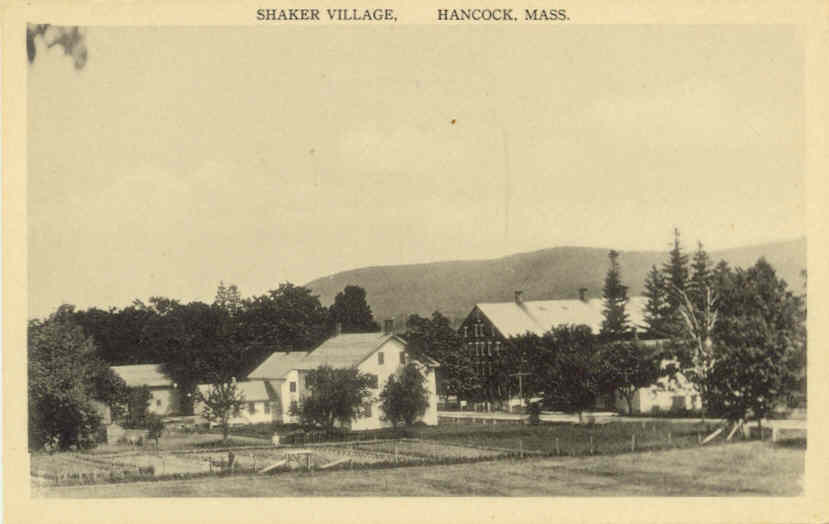
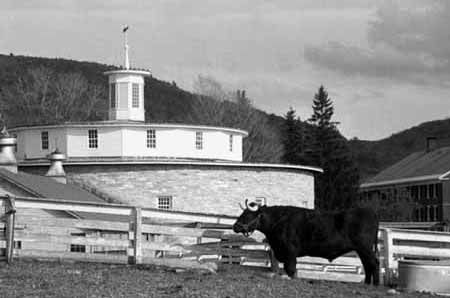
Armageddon Wraps up Early at the Hancock Shaker Village


This region is full of biblically epic sounding sites, many of which don't appear on any standard map. Spots like Devil's Pulpit, North Adam's Witch's Cave, New Marlboro's Gomorrah and its companion Sodom just over in Connecticut (as well as a separate 'Sodom' in Tyringham).

Most of these places have their own little bit of lore attached to them, but perhaps none are the focus of a yarn as epically Biblical as that surrounding Mount Sinai, on the grounds of the Hancock Shaker Village. Named for the mountain where Moses laid down the law(s) for the Israelites, later the site of a monastery built where the remains of St. Catherine of Alexandria were said to have been miraculously transported, this Berkshire hill was alleged to be the site of a grand, apocalyptic confrontation between religious fervor and preternatural evil.

As the story goes, it was a time of distress and difficulty for the Shakers; sin and the temptations of a lustful world had severely tested the devout people of the community. Some local boys had recently been caught playing with the "Devil's cards" [likely regular playing cards]. From other sister communities came news of affairs and elopements between formerly devout Sisters and the most degenerate unbelievers. In the Hancock village meetinghouse, Elder Gabriel Patton harangued the community, bellowing fire and brimstone, with constant, thunderous warnings to be vigil against the influence of the Devil, who seemed to be encroaching on all sides.


Now, there was among them one Sister Martha Tomlinson, a young woman who had come to the community from the eastern part of the state, who had previously lost both her husband and young child to disease. When she had first accepted the Shaker life, she had seemed contented enough, but now a dark state of depression overtook her frequently, often keeping her weeping throughout the night. In the daylight hours, Sister Martha had become increasingly aloof, and apparently ambivalent to the Shaker beliefs. This had come to the attention of some of the other Sisters, and to a lesser extent the Elders as well. Meanwhile, however, Elder Patton had become convinced of the presence of Satan concentrating atop the hill they called Mount Sinai - and, more importantly, convinced of his vulnerability. Sinai, Patton told the others, would be the site where the faithful of the community would defeat the Evil One once and for all; he implored them to steel themselves for the Final Battle.


When the day that had been set for the campaign arrived, Sister Tomlinson became violently ill, and remained in her bed, weak and feverish. All the others gathered, though, every able-bodied man and woman in the community. They rallied in the meetinghouse, where the Elders fitted each of them with a suit of invisible armor, describing its virtues and its powers to shield the faithful from Satan's power. Thus befitted with breastplates of righteousness and the helmets of salvation, they prepared to make war, Ephesians 6:10-17 style. They set out in the early morning darkness, each carrying a Bible in their hands. They advanced on the enemy on the hill in a wide ring, singing hymns and holding out their invisible swords of the Spirit. They advanced nearly shoulder to shoulder; there was not single weak point in their line, and they swiftly began narrowing the circle around the Unspeakable One. He remained invisible, but as they drew the noose tighter and tighter, a malodorous stench filled the air. The Believers recognized the stink: it was the smell of sulfur, of brimstone. Finally the ring of the fellowship became so taut that they were looking into each other's eyes across its center, a massive racket was ensuing in between, sounds of choking growls, rasping curses and a hissing like that of a thousand writhing snakes. Patton roared out to them to advance still further, to leave no escape for suffocated demon. Then, with "one long cry of hatred and baffled anger," the Lord of Darkness expired.

There are a variety of epilogues appended to various versions of this legend. In several tellings, the successful Shakers return to find that Martha Tomlinson has ended her own life, apparently as a last victim of the Devil's wily and desperate tempting. In one version, the flock repairs to the meetinghouse for an ecstatic bout of dancing worship, in which the apparition of John the Baptist comes among them as a blessing. Of course, I prefer the versions that end with a warning: for even though, allegedly, the Prince of Lies himself was vanquished, many of his demonic imps lurk the world still. Furthermore, on some dark and foreboding nights, they may appear at Mount Sinai to pay their respects, and perhaps wreak some bit of vengeful mischief.


As for its historical basis, well. there were Shakers at Shaker Village, but that may be about the extent of the corroboration possible. Frequently, a legend with so many named persons, consistent in version after version, offers some promise for further research but in this case proved a dead end. According to Jerry Grant, Director of Research at the Shaker Museum and Library in Chatham, N.Y., neither Tomlinson nor Patton appears in the list of known Shakers.

"The Sister it may have been possible to miss by the record keepers, but I don't think they would have missed an Elder in the records," Grant explained.
It is quite probable the story may not even have originated with the Shakers, but with neighboring tale-tellers in the area. It was fairly well-traveled by the late-19th century, and may have first appeared in a mid-century newspaper article. Its ultimate origin is murky, but it smacks of fireside fiction. Which is fine by me, I'd rather not contemplate the literal reality of wandering demons in Hancock, especially considering the fact the Imps of Hell rarely turn out to be the sort of eloquent, irreproachably fashion-savvy types seen in the "Hellraiser" movies. Still, it's an irresistible yarn, as far as I'm concerned, and there's plenty more meat to the story, too ponderous to include here. I recommend the interested reader to my favorite treatment, in Willard Douglas Coxey's 1936 "Ghosts of Old Berkshire." The true underlying sweep of the story may be that of a young woman's struggle with depression and loss and her gradual embitterment against the Shaker way of life, with its repression of all passion, all intimacy, all form of personal existence. I picture a period piece boasting Charlize Theron opposite Anthony Hopkins' Elder Patton, all on location, with more exotic dance sequences than "Moulin Rouge" - real Oscar vehicular momentum. But that's another story altogether.


Sources:

Coxey, Willard Douglas. Ghosts of Old Berkshire, 1936

Skinner, Charles M. Myths and Legends of our own Land, 1898

“Our Berkshires: Calling all ghosts.” Berkshire Evening Eagle Oct 27, 1944

Thursday, March 02, 2006

Pittsfield's Hebrew scrolls spark Mormon controversy

Thursday, March 02

When Joseph Merrick, local farmer and innkeeper, purchased a tract of land in west Pittsfield in 1800, he had no expectation that it would prove such fertile ground for growing mystery. Indeed, it was not until 15 years later that a seemingly innocuous piece of refuse found there would go on to arouse the interest of the town's most prominent citizens, and to serve as a potentially crucial clue in controversy surrounding the origins of the Book of Mormon.

In June of 1815, a boy Merrick had employed to clear a piece of yard presented him with a leather strap found among the debris left by plowing. Merrick at first threw it in a box and paid little attention. Only looking at it later did he realize that there was something inside the strap. He cut it open to find several tightly scrolled pieces of parchment. Each was inscribed with Hebrew characters of some sort. Perplexed, Merrick shared the discovery with some of the most learned men at the First Congregational Church, where he served as a deacon. He didn't have to try very hard to get their attention. He had only barely mentioned the find when he found himself called on by a number of curious visitors. Rumors of the object quickly reached Elkanah Watson, father of the American Agricultural Society and probably Pittsfield's most illustrious citizen at the time. Watson wrote in a letter "immediately on hearing of the discovery, I repaired to the house of Mr. Merrick, where I found several clergymen whose curiosity was [also] greatly excited by the strange incident.."

Among those present when Watson arrived was 20-year-old Sylvester Larned, fresh from seminary but already "greatly distinguished for talents and moving eloquence." Larned, though exceedingly well educated for the times, lacked any knowledge of Hebrew. This required the help of William Allen, son of "Fighting Parson" Thomas Allen, and the minister of First Congregational Church at the time. Allen identified the object as a Jewish phylactery, containing four pieces of parchment inscribed with verses from Deuteronomy and Exodus.

Now that they knew what it was, the question of where it came from became all the more exciting to them. No Jewish family or individual had ever lived at that location, so far as anyone knew. Before Merrick it had been the site of "Fort Hill" or Fort Ashley, a blockhouse built by colonial militia during the French and Indian War. Prior to that the area was called "Indian Hill," in reference to it being the site of a former Mohican settlement, and it was this earlier occupation that most intrigued the Pittsfield scholars. In their mind, the phylactery fit quite perfectly into a debate that had begun more than a century and a half before. The theory that the American Indians were descendants of the lost tribes of Israel had first been advanced in 1650, with the publication of Thorowgood's "Jewes in America" and had been a subject of perennial interest in Puritan New England ever since. Watson had already leaped to this conclusion, stating "the artifact must have found its way into this recent wilderness by the agency of some descendants of Israel. this discovery forms another link in the evidence by which our Indians are identified with the ancient Jews." After his initial inspection, Allen was inclined to agree that the phylactery "furnished proof that our Indians were descendants of the ancient chosen people." Adding weight to this conclusion was the late testimony of Dr. West of Stockbridge that "an old Indian" had told him that his ancestors had once "been in the possession of a book which they had, not long since, carried with them, but having lost the knowledge of reading it, they buried it with an Indian Chief."

Shortly thereafter, Allen sent the artifact to Abiel Holmes, a scholar in Cambridge. There is no record of Holmes' opinion, only that he delivered the phylactery to the American Antiquarian Society, on Allen's urging. Nothing much was said or done about the phylactery for several years after that. Most of the parties who had viewed it (and many who hadn't) believed it to be evidence of the Hebrew origins of Native Americans, but by 1816 or so no one outside of select sectarian circles seemed much interested in proving that point. In the early 1820s, Ethan Smith, a congregational minister in Poultney, Vt., became interested in the Pittsfield phylactery. Though he never actually saw it personally, he described it in his 1823 book "View of the Hebrews: The Lost Tribes of Israel in America." That same year, a young man in Palmyra, N.Y., announced that he was to receive a set of plates from an angel. The man was Joseph Smith and the plates were said to contain a history of ancient America.

Later, when these plates were being translated, Oliver Cowdery, one of original "Three Witnesses" of Mormonism's Golden Plates, joined Smith and became the major scribe who assisted in Smith's translation. Cowdery hailed from Poultney, where he had been a parishioner of Ethan Smith's congregational flock and quite likely owned a copy of his book. For this reason, nearly two centuries of skeptics and opponents to Mormonism have theorized that Ethan Smith's ideas, along with certain elements of his style (e.g., his heavy quotation of the Book of Isaiah) may have been one of two major sources of influence on the Book of Mormon (the other being a fictional manuscript by Solomon Spaulding that Smith friend and follower Sidney Rigdon may have provided. It is certain that Joseph Smith did become aware of View of the Hebrews at some point, for he cites it and the artifact found in Pittsfield as supporting evidence of the "Lost Tribes" in America. Furthermore, it is entirely conceivable that Smith could have already have heard of the phylactery prior to 1823.

By then, though, no on was sure where the darned thing was. Isaiah Thomas, the first president of the antiquarian society, told Ethan Smith that he didn't know where it was, or even where to go about looking. Several historians have made attempt over the years to track its whereabouts after being delivered to the society, coming up with only fragmentary possible scenarios. It may or may not have been returned to Sylvester Larned, who in 1818 expressed disappointment that nothing had come of the find. Larned may or may not in turn have sent it to Elias Boudinot, another interested scholar. Larned died of Yellow Fever two years later in New Orleans, at the age of 25, and there is no sign of the phylactery in Boudinot's papers, housed at the Historical Society of Pennsylvania. I tend to think that the Hebrew inscriptions are still in the hands of the Antiquarians - in fact, one AAS librarian in 1917 said that he seemed to remember seeing the scrolls but not didn't know where. As such, it is one of hundreds of fascinating, potentially paradigm-shaking artifacts which resides in a Library Limbo, lost, uncataloged or misfiled in one of the country's major archives or museums.

What relevance does the Pittsfield discovery have today, anyway? Scientific knowledge has advanced, well, let's say slightly, since the early 1800s, at least to a point where belief in Native American groups as descendants of lost Israelite tribes can be effectively dismissed. On the other hand, scholarly opinion over the past decade has increasingly shifted toward the concept of the Americas being an occasional stopping point of many different world groups prior to Columbus. In 1924, some lead artifacts, mostly crosses and swords, with Hebrew and early Latin inscriptions were dug up in Tucson, Ariz. The inscriptions told of a group of Romanized Jews who left the Empire and whose ship (apparently) came to shore in the Gulf of Mexico, from which point they followed the Colorado River inland, establishing a briefly flourishing colony. Of course, questions were raised about the authenticity of the artifacts and, like the Pittsfield phylactery, the "Tucson Crosses" went missing for many years before finally showing up on display at the University of Arizona campus in 2003.

For those who prefer to get somewhat cleaner shave out of old Ockham's razor, an alternate explanation was offered by William Allen, some time after the object left his care, though no one paid much attention. Allen noted that the strap was found in a place where wood chips and dirt had been collecting for years, and he was unable to find out whether it had come from the old earth beneath or from among the recent debris. He did learn that Merrick had employed British and German prisoners during the War of 1812, one of whom could have dropped it there. For my contribution, I'd append that it could have been lost there even earlier. The entire county was suddenly inundated with Hessian deserters following Burgoyne's defeat at Saratoga in 1777 - some of whom never left - and any one of whom could have been the owner of the 18th-century equivalent of a scriptural fanny pack.

Of course, modern forensics could probably provide snappy answers to almost all of the questions surrounding the legendary scripts, if one could only put one's finger on the troublesome strip. "Or," as Charles Fort more eloquently put it, "there could be a real science, if there were really anything to be scientific about."

Sunday, February 26, 2006

Psych. Ward Escapee Questioned in Unsolved Local Murders

http://www.berkshireeagle.com/headlines/ci_3548821

Demagall hunt was too slow
Murder suspect to be questioned in two unsolved county stabbings
By Jack Dew, Berkshire Eagle Staff


Though William S. Demagall was considered a serious threat to himself and others when he escaped Feb. 9 from a locked psychiatric unit at Berkshire Medical Center, police did not launch a broad search for him and didn't identify him as missing for two days, according to an Eagle analysis of police records and interviews with officials involved in the case.
Between Feb. 9 and Feb. 11, when Demagall allegedly murdered George Mancini in Hillsdale, N.Y., it appears there was no widespread hunt for Demagall. The first time he popped onto a police radar screen was on Feb. 10, when his father asked the Pittsfield Police Department to check his old apartment. While police did make that check, they did not enter Demagall into the database for missing persons until Saturday, Feb. 11, according to records kept of police activity during those days.

Now, while Demagall is being held without bail in a New York state jail, Berkshire County investigators apparently are asking whether he could have been involved in the unsolved murders of Jan Stackhouse in Stockbridge and Anthony Colucci in Washington.

Demagall's cousin, John Hobart, 21, of Westfield, has been charged with robbery, and police say he drove Demagall to Mancini's house expecting to rob the man of drugs.

Early report issued

Demagall, a slight 22-year-old with close-cropped hair and a tattoo of a pitchfork on his forehead and arms, allegedly slipped between the bars of a secure courtyard at Berkshire Medical Center's Jones 3 unit on Feb. 9, according to a report provided to The Eagle by a person familiar with the investigation.

The source, who was granted anonymity because he was not authorized to release the report, said the two-page statement was faxed to the Pittsfield Police Department shortly after 1 a.m. on Feb. 10, after hospital personnel had called the department to notify it of Demagall's escape.

"Demegall (sic) is at risk of serious harm to himself or others by virtue of his mental illness," the report said. "As of (Feb. 10), he is paranoid and has stated on 2/3/06 that he would 'hurt anyone who tries to keep him from his freedom.' "

The report said Demagall had stockpiled knives and guns in two caves in the Stockbridge woods over the past two months and had "placed a large shard of glass above a barn door in his grandmother's barn, essentially booby trapping the door."

The report listed six places where Demagall might be found, including his father's former apartment, his grandmother's house and the caves in Stockbridge. It said he might also be hiding in the hospital, though he had last been seen heading north on North Street and had not been seen circling back.

But there is no record in the Pittsfield Police Department's log of either the phone call or the faxed report, and there is no indication that police began looking for Demagall until the next day. Chief Anthony J. Riello said he will conduct a review tomorrow of incoming calls to determine when the hospital first contacted his department.

Riello said he believes his department first became aware Demagall might be in trouble on Feb. 10, when Demagall's father called from New York and asked police to check the father's old apartment on North Pearl Street in Pittsfield, saying his son might stay there. Riello said officers did, but saw no sign of him.

Demagall was not treated as a missing person until Feb. 11 — two days after his escape and the same day he allegedly stabbed and beat George Mancini to death. Again, it was Demagall's father who contacted police, and officers entered Demagall into a national database. When Demagall was picked up the next day in Schodack, N.Y., authorities found his name in the computer and notified Pittsfield he had been found, according to the police log and Riello.

Hospital spokesman Michael Leary could not be reached for comment about the report to police or its timing. In an earlier interview, he said it is hospital policy to alert authorities immediately if someone leaves the locked Jones 3 psychiatric ward without authorization.

Jones 3 is a 15-bed facility that treats people suffering from major depression, bipolar disorder, schizophrenia and other mental illnesses. It is designed to offer patients who might


be suicidal, violent or incapable of caring for themselves an environment where they can be stabilized and treated; it is not a prison or jail, and while there are bars on the windows, there are no armed guards. Every effort is made to avoid using restraints on patients, and they are allowed a great deal of movement within the unit.

Dr. Alex Sabo, chairman of Berkshire Medical Center's Department of Psychiatry and Behavioral Science, said Jones 3 has treated 2,500 patients over the past five years. In that span, only four have escaped. Neither Sabo nor Leary would talk about Demagall or even acknowledge that he had been a patient at Jones 3.

Sometime before 8:58 a.m. on Feb. 11, Demagall entered Mancini's first floor apartment on Breezy Hill Road and stabbed the 56-year-old repeatedly, according to an affidavit filed in U.S. District Court in Albany. Demagall told police that when Mancini didn't die quickly enough he beat him with a paperweight wrapped in a sock, the affidavit states.

Demagall then searched the apartment for drugs, according to the affidavit, and material he could use to build a fire, which he piled on top of Mancini's corpse. When firefighters arrived at 8:58 a.m., they found Mancini's body.

Mancini had only recently moved to Hillsdale. He retired from the Career Institute of Technology in Forks Township, Pa., in 2004, after teaching math for 24 years at the vocational school.

Ronald Roth, the school's director, described Mancini as a gifted teacher who taught all levels and all students.

Asked whether he could envision Mancini being involved with drugs, Roth said, "No. I can't imagine that."

He said everyone who knew Mancini was "shocked and surprised" at his death.

Demagall has been described by officials and acquaintances as a skilled survivalist who had taken to living in the woods on Monument Mountain in Stockbridge. He slept in caves and only sought other shelter when winter temperatures became intolerable.

A former classmate, who asked that her name be withheld because she doesn't want to be associated with Demagall, recalled seeing him in the bar at Pearl's, an upscale Great Barrington steak house. She said he was carrying a large, sheathed hunting knife and trying to bum drinks off friends.

Demagall's caves are located about a mile from the rural Stockbridge road where Jan Stackhouse was found dead on May 1, 2005.

According to an autopsy on Stackhouse, the 52-year-old New York City resident bled to death after a stab wound to the neck. While investigators have said repeatedly that they have made progress in the case, there have been no visible leads.

A person familiar with the Stackhouse investigation said authorities have been struck by Demagall's profile and are interested in talking to him about the case. Though at this point they have not named Demagall a suspect, there are some obvious parallels between his alleged behavior and the place and manner in which Stackhouse died.

Similarly, they want to speak with Demagall about the death of Anthony Colucci, 20, who died from multiple stab wounds on July 4, 2005. Authorities believe he was killed in the Washington section of October Mountain State Forest, about five miles from the spot where Stackhouse's body was found.

District Attorney David Capeless declined comment.

"I will not comment on whether or not we are looking at any specific individual as a suspect or witness in any case. But I would say that, when we become aware of information in the course of investigations such as these, we look into it and pursue it accordingly," Capeless said.

Sunday, January 29, 2006

Second Sight in the Berkshires


According to polls over the last few years, about three quarters of Americans believe in some form of paranormal experience, with more than half of all surveyed adults reporting having had at least one truly paranormal experience in their life.

Some advocates of the reality of Psi (psychic phenomenon) believe that it may be even more common in everyday life than many people have even considered. British biologist Rupert Sheldrake has attempted to muster evidence that such experiences as the sense of being stared at, or thinking of someone who just then telephones, are often examples of extra-sensory faculties complimenting the ordinary senses.

This all made this article difficult to write. I have wanted for some time to put together some verbiage summarizing some of the more colorful incidents in the Berkshires' "psychic" history, but the question of what to include hung over the enterprise. For reasons made obvious above, it would be impossible to give a true overview of every premonition, dream or divinatory luck any Berkshire resident may have ever had, and to relay every such story that has ever been related to me by someone locally would certainly put me over my allotted words. It would also probably be dull - often as not, one person's oracular epiphany is another's yawning cue to leave. I will therefore keep this history confined to a brief sketch of some of the more novel local occurrences drawn from newspapers and from the annals of psychical research.

People have always been interested in prophecies, predictions and all manner of mental mysteries for all of human history, but it was not until the second half of the 19th century that Americans en masse began expressing great interest in the psychic world. Following the table-rapping shenanigans of the Fox sisters in Hydesville, N.Y., in 1848, the spiritualism craze spread through the country like wildfire. In its wake came the very first efforts to study psychic happenings in an organized, scholarly way.

In 1880, a student at Williams College reported a "most singular dream." He had been recovering from an illness just a week before commencement, and while sleeping in the early evening on June 28, he had a feverishly vivid dream that he was on a steamer off of Long Island, watching another steamer burning. Its starboard wheelhouse was ablaze and all that could be made out of the name of the boat were the last three letters "AKA." The craft ran aground and people were leaping off, some drowning. A friend who'd come to check on him woke him, and he relayed the dream to him. The following evening, the friend returned, excited, and began quizzing him about his dream. He then took out a newspaper account of the disaster that had befallen the steamer Seawanhaka. Seawanhaka caught fire at about the same time as the dreamer been asleep - between 5 and 6:30 p.m. the previous day - while passing the "Hell Gate" of the East River, site of many lost boats. The steamer had run aground while burning up, and passengers had leapt off in panicked swarms, with nearly 50 drowning.

In 1914, psychic investigators Richard Hodgson and James Hyslop compared his written testimony about the dream with subsequent newspaper accounts offering more information on the Seawanhaka tragedy and identified many additional similarities of which the Williams College man and his friend were apparently not aware.

By the turn of the century, the Berkshires had become a favored spot for traveling mediums. North Adams in particular seems to have provided fertile ground for fortune telling. More than two dozen professional clairvoyants were advertising in the Transcript between 1895 and 1901. Some of the most colorful included M.Leo Balzac ("All diseases, mysterious feelings, habits, lost physical power etc. positively cured without medicine or the knife OR NO PAY!"), Madame Bartell ("tells the past, present and reveals the future"), Madame Drusilla ("63 Center St., Ladies fifty cents. Gent $1"), Karl von Roth-Hamong ("famous Palmist, Clairvoyant, Astrologist and Author"), and Ora the Mystic ("The Greatest Living Clairvoyant"). My personal favorite, Professor Delano (World's Greatest Life Reader, Clairvoyant and Palmist)," purchased large, lavishly

drawn advertisements - Marvelous Revelations! Magnificent Achievements! People are astonished - throughout the summer of 1899.

But not all would-be seers fared as well. The Eagle reports that in April of 1897, A.R. Devlin, medium and clairvoyant, left Dalton with a light purse, "as business was anything but rushing."

In the '30s and '40s, the most prominent psychic in the area was Clara Jepson of Pownal, whom I already profiled in The Advocate in November 2004. At the time of her reign, her closest competition was Mrs. Elmas Dicranian of Pittsfield. Whereas Clara was known mainly for her success in locating lost valuables, using a handkerchief to divine their whereabouts, Mrs. Dicranian was known primarily for her ability to locate water with a dowsing rod. On occasion, though, she also had visions, which she believed to be of a psychic nature, akin to what some scientists call "remote viewing." Three days after the Eagle interviewed Mrs. Jepson on her feeling on the Lindbergh kidnapping (she suggested that the boy was safe and that he was near his Hopewell, N.J., home - tragically, only the second part proved correct), Mrs. Dicranian told them her view, that he had been kidnapped by "a jealous flier friend of his father."

Likewise, shortly after Jepson was consulted on the disappearance of Paula Welden, Elmas took a bus to Bennington, where she attempted, unsuccessfully,

to lead a detective to the location of the missing girl's body. Meanwhile, in Lenox, psychic reader Mademoiselle Bathsheba Askowith was handling private consultations, dinner parties and lectures.

A number of other miscellaneous occurrences have made their way into paranormal literature. In October and November of 1920, Monterey was the site of two of a series of tests known as the Joan Dale Psychometry Experiments, conducted by Dr. Walter Franklin Prince. In these experiments, the subject Joan Dale (pseudonym) was able to divulge large amounts of previously unknown but verifiable details about a particular person by touching a sealed, shielded envelope.

In 1967, Francis Sibolski of Pittsfield wrote an article for Fate magazine detailing a recurrent vision he'd had over the years of two apparitional men fighting on his street corner alongside a vintage 1937 Plymouth taxicab. He later discovered later that there had been a nasty brawl identical to his vision at the spot between two men in 1938, one of whom died soon after. Some theorists call this type of experience retrocognition.

Many parapsychologists and other scientists at universities around the world maintain that various modern scientific research efforts - such as experiments at Princeton with the effect of the mind on random number generating machines, the remote viewing project run by the U.S. military and experiments with what is known as the Ganzfeld technique, which involves subjects in a state of slight sensory deprivation - offer sufficient evidence for the existence of some forms of Psi, though the mechanism by which it operates remains a matter of speculation. Skeptics, most notably psychologists Susan Blackmore and Ray Hyman, contend that is has not been proven, because many of the individual experiments which make up the available sample of evidence collected over the decades may have been flawed, leaving room for error, cheating and faulty analysis.

Some say that you have to witness a real psychic occurrence to believe it. Others find relevance in the old saying: "For those who believe, no explanation is necessary. For those who do not, no explanation is sufficient." Maybe, but I've always preferred Thomas Huxley's suggestion that a "wise man apportions his belief to the evidence." In this case, that might mean that you can believe that psychic experiences are possible without necessarily buying into every carpetbagger who rides through town, or believing that any combination of psychic happenings could tell you all you need to know about your life.

Wednesday, January 18, 2006

The Devil at Wizard’s Glen

The considerable body of local legend attributed to the area’s pre-colonial native inhabitants presents an interesting puzzle for any Berkshire folklorist to ponder. Early European settlers had some contact with so-called “Stockbridge Indians” – Mohican (sometimes called Mahican) combined with sundry remnants of related tribes- continuously for more than sixty years, and certainly there was a great interchange of stories and cultural ideas. Unfortunately, the majority of the staple Native legends recycled in Berkshire histories and travelogues were not recorded in print until nearly a century after the last of the Stockbridge Mohicans had migrated out of the area. One of the results of this is that much of the existing body of native lore sounds… rather white.

One legend in particular strikes me as a particularly illuminating example of a nucleus of information about indigenous life, embellished by a thick layer of old-fashioned Yankee Puritan storytelling. I am referring to an old tradition surrounding the spot known as Wizard’s Glen, off Gulf Road in Dalton. This gorge, with its rugged jumbling of heaped rock was described by Godfrey Greylock in 1879 as being “as though and angry Jove had here thrown down some impious wall of Heaven-defying Titans. Block lies heaped upon block; squared and bedeviled, as if by more than mortal art…”

Wizard’s Glen draws its name from the belief that this place was a sacred haunt for generations of local Indian shamans, a place of power where they conducted rituals and communed with their spirits. In particular, it was said that they were working incantations to Hobbomocco, the “spirit of Evil.” One broad, square rock with crimson became known as Devil’s Altar, and it was here, rumor had it, that the tribal sorcerers offered up human sacrifices. The crimson stains in the stone were said by early townspeople to be bloodstains, from the many victims ritually slaughtered there.

Several sources from the late 19th and early 20th centuries relay a story attributed to a Dalton man named John Chamberlain. Chamberlain, as sources have him, was “no lover of the Indian race,” which may help to explain some of the content of this legend. The tale itself, as Chamberlain is said to have related it personally, is as follows. Sometime around 1770, he had been hunting and after chasing a deer a great distance, finally slew it around dusk, within the area of the Glen. As he was tending to his kill, a heavy thunderstorm came suddenly, complete with driving rain and hail. He stashed the deer under one boulder and slunk himself into the recess under another. There he tried to catch a little rest while he waited out the storm. He had a clear view of the Devil’s Altar, and as he dozed he tried to put out of his mind the stories he’d heard of the terrible rites that were sometimes conducted here.

The storm was getting progressively worse, with huge claps of thunder blasting overhead. It grew louder and louder until one enormous explosion of lightning lit up the entire night. At that moment, Chamberlain saw the Devil appear right in front of his eyes. The Evil One was sitting on a broken crag directly ahead, looking accommodatingly Western European in his chosen form, replete with wings and horns and hooves- though Chamberlain later opined that the devil had very Indian-like facial features. Around his head a wreath of lightning gleamed, illuminating the scene around him. He was attended by various hideous wraiths, ghosts, imps of hell, etc, in a myriad of grotesque shapes.

A young, nude native girl was brought forth. Shrieking and fighting, she was slowly edged closer to the stone altar, upon which she was hurled viciously. The wizard danced around her for several minutes, finally raising his ceremonial axe for the ritual’s culmination. As the maiden looked away, her eyes locked with Chamberlain’s, who was so moved that he felt he had to intervene. Climbing up from his hiding place, he raised his Bible- which he happened to have one him- into the air, and in Biblically dramatic fashion, spake the great Name of God. A deafening boom of thunder sounded, lightning split the sky a thousand ways, and when it died off the whole mob had gone and he was alone in the darkness. When morning came, he was prepared to chalk up the experience to dreaming, if it were not for the disappearance of his deer.

Obviously, the story is not to be taken as a literal version of a real event. Even as an item of mythology, it lacks great dimension or meaning. The whole narrative is a bit too simple and convenient, the forces in conflict too black and white and the action slightly too camp; stylistically, it seems reminiscent of certain Bible stories, or of Lovecraft, as cranked out by Roger Corman.

Though my prevailing suspicion is that this incident is a fabrication, the more general rumors about the spot may reveal some actual truth about the culture of the Indians who lived here in the 17th and 18th centuries. Though the “crimson stains” in the Devil’s Altar are in fact iron ore deposits, and there is no evidence that any Native American group in this part of North America ever conducted any form of human sacrifice, it is likely that Wizard’s Glen was of some kind of ritual importance to the area’s natives. Hobbomocco, too, is a real Algonquin deity- and it seems to me that it is a clash between two different ways of looking at this figure that is behind the flavor and longevity of this local myth. In the basic Algonquin view of the cosmos, Hobbomocco (also known as Hobbamock, or Abbomacho) was associated with darkness and with night. His name is related to all Algonquin words for death and the dead. He is not directly analogous to the Christian Satan- God’s Accuser. In their worldview, Hobbomocco is not representative of any conflict with the god of nature and creation; rather, he is one side of nature, a sometimes dangerous source of visions and power, which shamans, or powwows, can gain through communing with.

The story of Wizard’s Glen that emerged as the final product of the friction between these two cultural ideas is one in which only a fractional nod to the subjective reality of the civilization on which it is based; emblematic of a social process in which the sensational aspect of the legend are promoted, while the context is devalued and discarded. That is one interpretation. The reader inclined to make a special trip to the Glen, surrounded by echoes while looking up at the spread of mystical rubble, is bound to come up with his or her own interpretation.

Friday, January 06, 2006

The Goshen Tunnel Enigma

The Advocate Weekly
Thursday, December 29
By Joe Durwin

As may be apparent, I like mysteries. Many of the local enigmas I've covered in this column offer little hope for ultimate resolution; often it is a question of belief - you believe in ghosts, and that a particular house is haunted, or you don't and it ain't. Some can't be scrutinized closely enough from afar: for instance, when some strange object whizzes across the sky, unless you're there to see it, who knows?

Some local mysteries are a little more accessible, built into the landscape itself. Their existence is plain as day, their idiosyncrasy unimpeachable. This is especially true in the case of the stone tunnels dug into the earth in Goshen.

The casual observer, coming across the simple stone shaft not far from the cemetery might not think too much of it at first. One might easily surmise that this hole, 15 feet deep and about 3 1/2 feet in diameter, once served as a well. However, near the bottom, this "well" opens onto two more stone-lined shafts protruding out in each direction. The lower tunnel runs west and is narrower and appears to have been meant as a drain to keep the main shaft from filling up with water. It is capped off by flagstones about 70 feet from its mouth. Above it, a slightly wider tunnel measuring 2 by 2 1/2 feet - just large enough to accommodate a crawling adult - runs east about 15 feet toward the cemetery. It is believed that this upper shaft once opened onto a chamber of about 10 square feet, but this caved in long ago.

People have been wondering about these stone tunnels for a long time. Tradition has it that the tunnels were discovered in the early 1800s by two boys who chased a rabbit into its burrow, and in the process of trying to dig it out, they dislodged the flagstone covering the main shaft, which had been buried under sod and bushes. The construction is sometimes called the "Counterfeiter's Den," in keeping with a local legend that they are part of a vast network of tunnels that ran to a hideout under the cemetery used by a savage gang. Some say that the hideout was dynamited and that the ghosts of the gang still haunt the cemetery. Another variation of the legend has it that they were really grave-robbers, not counterfeiters. The truth is, there's really no evidence to connect any criminal gang with the Goshen tunnels, and their discovery took place before the cemetery was laid.

The "Hampshire History" speculates that the structure might have been a shelter from Indian raids. The only problem with that theory is that Goshen, first settled in 1761, was never in any danger of having to worry about such raids.

The sheer time and effort required to quarry and place the flagstones with which the entire complex is lined more-or-less precludes the possibility that anyone could have constructed it in the last two centuries without some historical record existing to describe who built it or why. The very fact that there is no definitive answer to these questions argues strongly for a pre-colonial origin.

It may be that the structure was built by some Native American culture that moved on from these parts long before any white people arrived. If so, it must have served some important function, for so much work to have been put into something so difficult to traverse. It is also likely that that it was not a solitary effort. Archaeologist Salvatore Trento suggests that the tunnels "in all probability, are part of a larger complex of underground constructions yet to be found in the meadows surrounding the Mill River."

Some scholars see similarities between Goshen's underground lair and a stone tunnel in Upton, and with hundreds of other ancient sites around New England - such as Salem, N.H.'s "Mystery Hill," a.k.a. "America's Stonehenge." Many of these sites have been put forth as possible examples of exploration by Vikings, Celts or other visiting cultures that left no other record of their stay. Signs of human presence at Mystery Hill date back possibly as far as 2000 B.C., and at least one source has stated that the samples of soil from around the tunnel indicated that it too might have been dug thousands of years ago. I haven't been able to substantiate this last, so at the present time the age and purpose of the complex remains as much an enigma as ever.

I find myself very curious about the ancient people who might have been here. Were they building a hideout from enemies? A place to store precious treasures? Did it have some ritual significance, as with certain similar prehistoric tunnels found in Scotland and elsewhere? I can't help but wonder what went through their minds as they dug holes into these hills, unaware of the tantalizing mystery they were leaving behind for later inhabitants.

--
Joe Durwin is a Pittsfield native on extended sabbatical in the desert. Send him accounts of unexplained experiences, strange tales or haunted places at joe@durwin.net.

Sunday, December 18, 2005

The Fernbrook Phantom


Fernbrook- early 20th century (courtesy of Gray Locke>


Lenox, Massachusetts is well known for the many mansions built there by wealthy citizens during the Gilded Age. Given their history and square footage, it is perhaps not surprising that there are stories of ghostly residents attached to several of them.

One such residence is to be found in the building now known as High Point on West Mountain Road, currently in use as one of the Hillcrest Educational Center sites. Though much smaller than many of the Gilded Age "cottages," it has nonetheless afforded plenty of space for mysterious happenings.

Originally known as Fernbrook, this house was constructed between 1901 and 1902, as a residence and studio for Thomas Shields Clarke. Clarke was an aristocrat, and a painter and sculptor of some considerable renown, who had exhibited and won awards in Berlin, Paris, London and Madrid. His work was much in demand at that time, and some of his larger bronze and marble works adorn public places in New York, San Francisco, Chicago and other cities.

The cottage itself was designed by Philadelphia architect Wilson Eyre, in the style of a Tyrolean Gothic villa. It was built to contain a spacious studio, modeled after the refectory of a monastery in Sicily, as well as an elaborate library, 13 bedrooms, three baths and six fireplaces. After Clarke died in 1920, the estate was sold to Dr. Robert Metz, who later passed it on to Paul Schmidinger.

Fernbrook has been mentioned for years in a number of "Haunted Places" reference books, accompanied by extremely brief entries. I have never seen more than a sentence or two devoted to it in print, typically just some vague mention of strange noises heard in the house. Fortunately, Robert Gorden of Becket, who worked there for a number of years, was able to shed a great deal more light on its ghoulish history for me.

Fernbrook circa 1920 rear of house.


Gorden revealed that talk of a ghost went back several decades, to around the time Dr. Metz acquired the property, and perhaps even earlier. Over the years, quite a few people had discussed hearing and seeing strange things around the house. Most of the strangest, according to Gorden, seemed to be localized around the area of the basement. Doors that had been left firmly shut would spring open, and from his workshop there he could hear a sound like someone moaning or crying.

"Sometimes I would come around a corner and have the sense that someone or something had just turned the corner ahead of me, or gone through the door," he said. "I don't think I actually 'saw' anything but I often felt that I did, or had just missed someone."

Another employee, a housekeeper there, also had a variety of strange experiences. Her room was also in the basement, beside what had been the original laundry area, and from there she could plainly hear a woman's cries. Doors would slam suddenly and cold drafts would rise up, apparently out of nowhere. On one particularly frightening occasion, she said, she had even seen an apparition of woman pass by, covered all in white.

Curious about the phenomenon, Gorden mentioned it to Paul Schmidinger, who had first come there to work for Dr. Metz in 1937. Metz had said that he'd been told by past servants at the house that Clarke had had an affair with a Welsh girl named Anghorad, who served as the under-house parlor maid. At some point, the girl became pregnant and months later she died. Her body was found in the laundry room, having perished either from a miscarriage or botched abortion attempt, according to rumor.

This story intrigued me, and I wondered whether there might be any historical documentation that might help confirm this sequence of events. There is not a huge amount of information available about Clarke's time in Lenox. What is known is that he stayed at Fernbrook, from May to October, every year from 1904 to 1920. As for the girl, a check of the town's death records for those years failed to turn up mention of anyone listed by that name. The historical record is incomplete, and it is probably safe to say that this was the sort of thing the aristocratic Clarke would not have wanted widely known.

In the end, though, it's pure speculation, and hardly the sort of thing to hang a man's reputation on. Maybe there was no Anghorad; maybe something completely different happened. It could be that the story simply grew more sordid as it was passed around by the house staff. In any case, it makes a compelling narrative, which, as far it goes, helps to explain reports of unusual experiences there over the years.

High Point circa 1990 (courtesy of Gray Locke)


The house changed hands more rapidly after Metz died in the late '40s. Schmidinger sold it in 1956 to Florence Davis, who resold it soon after. Doris Barden turned it into "High Point Art Gallery and Inn," which operated for a few years, before the cottage came to its current use in the 1970s. I've been unable to obtain any information from anyone at Hillcrest regarding the house or its reputation, so I've no idea whether or not any strange occurrences ever come up. Perhaps whatever unpleasantness hung over the place has faded away - or perhaps doors still open, unseen, in the basement.

Monday, December 05, 2005

Curious Canine Encounters

Last week I wrote on the subject of "The Thing," a generic label given to describe any of a number of elusive and unidentified panther-like cats seen popping up sporadically hereabouts.

To be fair, I feel I should mention that dogs, as well as cats, have rained across the scope of my mystery radar. In the interest of equality between these two four-legged mammal families that have ever-vied for the top spots in humankind's affection, I shall take this opportunity to follow-up with a summary of some curious canine encounters.

Like the cougar, the continued existence of the wolf in this area has occasionally been a matter of contention. Like other large fauna, their numbers were not very great in the Berkshires during the early years of European settlement. As Williams College professor Chester Dewey pointed out in an 1829 tract, wolves - like deer and bears - had essentially disappeared from the area by that time. These other two groups have, of course, bounced back since then - the latter even becoming a little too ubiquitous for the taste of some in recent years. By contrast, the last verified wolf kill in this county took place in 1827, but there is some reason to speculate that this may not have been the final chapter in the story. In 1903, for instance, a Hancock man named William Hatch claimed to have shot a 100-pound timber wolf on Potter Mountain, and a similar assertion was made by a man in New Marlboro in 1918. In 1923, an entire pack of wolves was seen repeatedly along the southern rim of the county, in Mount Washington, Sheffield, New Marlborough and Otis. These sightings made headlines as far away as Iowa. Some suggested that they might have made their way down from Canada, driven south by the particularly bad winter that year. Others dismissed it as some kind of mass hysteria - the same explanation offered by skeptics of "The Thing" 20 years later.

Then there were the "mystery dogs" that plagued Stockbridge and the surrounding area in the spring of 1950. This pair of wild canines menaced the countryside for several weeks, killing at least one sheep, a dog and a score of poultry. Positive identification was never made, and it remains a mystery whether these were wolves, so-called "coy-dogs" (coy-wolves being a more accurate label for this hybrid) or some other kind of creature entirely.

The strangest encounter with a crypto-canine that I have come across, though, dates back to just a few years ago, to the 1990s. A former Pittsfield man who wishes to remain anonymous relays the following (excerpted) story:

"It was sometime around near the end of my senior year [of high school] and my friend Kevin [real name omitted] and I were driving around in his car one night. We were bored and driving around like, random places, random roads and whatnot, just for something to do..

"I'm not exactly sure where we were when this happened. somewhere off around the north side of Kirchner Road as you head to Washington [from Pittsfield] and we were driving down this dirt back road way out there and we came to a place where the road became really narrow, like hardly even a road.. And we kinda slowed all the way down, debating whether we should turn around or whatever. and all of sudden this huge black dog comes running at us out of nowhere howling and barking and freaking out.. It scared the *#@! out of us, and Kevin hit the gas and we started hauling down the road, going really fast.

"The dog just started running alongside the car right next to my window. it just stayed right next to us howling and barking.. We were going really fast by this, like 35 or 40 and it stayed right there, right alongside us.. I was too freaked out to look at it, just this big black thing.really dark black. next to the car. It kept on us for like a really long-time - then it was just gone. One second it was right outside my passenger side window and then it was just nowhere around. It was just so weird."

To my folklore-jaded ears, the animal described in this account sounds like no ordinary black dog, but a bona fide "Black Dog." The Black Dog, like the panther discussed in last week's column, is a creature whose purported attributes place it more in the speculative world of the paranormal than in the context of a purely biological animal not yet acknowledged by science. It is fundamentally nocturnal, and more apparitional in nature than a flesh-and-blood creature. It tends to be seen in certain locations repeatedly, and its behavior suggests an aura of premeditation, even foreboding. According to George Eberhart's two-volume encyclopedia "Mysterious Creatures," it is usually seen on rural back roads and "country lanes," and it is frequently described as being able to appear and disappear at will.

The earliest print reference to this creature is in a French manuscript dating back to 856 A.D. Accounts of Black Dogs are especially common in Britain, where it has been sporadically seen for centuries and helped to inspire the Sherlock Holmes classic "The Hound of the Baskervilles." Reports have also come in from various spots around North America; however, the only other description of a (possible) Black Dog in the Berkshires was in 1944, when the Eagle reported on what it called a "disappearing dog mystery."

For several weeks, Pittsfield residents along upper North Street reported nightly barking, always around midnight, from an unseen dog. House-to-house checks were made and a systematic search of the woods was conducted, but no sign of the culprit was ever found.

It may be that this area receives occasional visits from Black Dogs wandering up from Connecticut, where such lore has existed for more than a century. In particular, one such ghoulish hound is said to chronically haunt West Peak. In this area, tradition says that "if a man shall meet the Black Dog once it shall be for joy; and if twice it shall be for sorrow; and the third time, he shall die."

A 1938 history of Connecticut reinforces this tradition, pointing out six mysterious deaths where, in each case, the victim had previously claimed to have seen the Black Dog twice. The Meriden Historical Society has records of other deaths attributed to this hellhound. Now surely West Peak is a safe enough distance to shelter us from the marauding of such doom-harbingers, but reports have also cropped up on occasion in Hartford and Litchfield counties, enough to raise the eyebrow of this semi-superstitious chronicler. So with regards to my informant, and to any other area residents who should happen upon such a mysterious whelp on some back road, I sincerely hope it just the once.

Sunday, November 27, 2005

Mystery Cats Keep on Prowling

Local papers called it “The Thing” – but this was no science fiction monster out of a John Carpenter remake. It was a flesh-and-blood animal, and frequent sightings of it roaming the woods caused quite a stir here in the 1940’s. People began talking about it in the fall of 1945, when a Pittsfield woman walking her dogs on Holmes Road, near the Country Club, spotted a creature she couldn’t identify. It frightened her and her dogs, and she later remarked on the incident to someone at the Berkshire Museum.

The Thing reappeared in early January, when Mr. and Mrs. Holden observed it for about a half hour as it prowled the edge of a piece of woodland adjacent to their Holmes Road property. Their description, of a fawn-colored animal about five feet long, with a long tail, matched that of a panther. Their account piqued the curiosity of Berkshire Museum curator Bartlett Hendricks. No arm-chair analyst, Hendricks headed out to the Holden property the day after their story appeared in the Eagle to investigate some tracks left in the snow. The tracks had been obscured by a light drifting of snow the night before, and definite identification was not possible, though they seemed to be of feline origin. Hendricks said that based on the Holdens’ description, the animal could not have been a bobcat because of its long tail, but that it might have been a small panther.

The panther, also known by the names cougar, puma, painter, mountain lion, or catamount (Puma concolor, in current scientific parlance) has long presented a conundrum for naturalists in the Northeast. These felines were hunted aggressively in the first centuries of European settlement, and were considered to be officially extinct in the eastern United States and Canada as of the late 1800s. However, it seems that the cougars themselves may have missed the memo, as they have continued to be spotted in this region on a more-or-less regular basis since then. For instance, though the last Vermont catamount was supposedly bagged in Barnard in 1881 (its stuffed corpse is still on display at the Historical Society in Montpelier), at least a dozen people reported spotting one on Glastenbury Mountain throughout the summer of 1901. One spooked a man in Williamstown in 1899, and yet another was pursued by a hunter in North Pownal in 1926. These are just a smattering of such examples.

For whatever reason, 1946 saw the beginning of a major wave of interest in such encounters locally. A month or so after a series of sightings on Holmes Road, another man spotted The Thing in a tree on lower South Street. In Williamstown, a pair of childhood sweethearts was chased by another cougar- and it must have been one hell of a chase, for they decided to get married promptly after. The Museum sent sketches of the tracks that had been seen, along with samples of hair believed to belong to the mystery animal, to the Museum of Natural History in New York. The zoologist who answered said that the tracks drawn were indeed consistent with those of a mountain lion, but the hair could not be identified with the limited technology of the day.

Interest in The Thing waned slightly for a year or so after that, until it popped up in Dalton in the summer of 1948. The Mather family twice saw it cross their garden on North Street, and Mrs. Harold Olds saw it behind her barn a little ways down the same street. She described it as a “black beast” that frightened her so badly that she could not remember much else about it. This new version of The Thing was seen several times thereafter in Hinsdale, skulking about in the vicinity of Plunkett Lake, and it was blamed for the slaying of a cow in Peru. These 1948 sightings tended to reiterate Mrs. Olds’ description of a “black beast,” which is quite curious.

While the presence of surviving panther populations in the east is still debated, everyone at least acknowledges that such animals did exist -and still do in the west, as well as a few left in Florida. A black panther, on the other hand, has never been proven to exist. What are usually thought of generically as a “black panther” are in fact certain melanistic leopards, native to Africa and Asia. The incidence of melanism in the puma species has never been demonstrated scientifically. A specimen of one such black panther was said to have been killed in Brazil in 1843, but this report was not confirmed, and this may actually have been a jaguar. The trait of melanism tends to run highest among wild felines living in the tropics or sub-tropics, so the presence of such a creature in North America would be remarkable. Nonetheless, sightings of black panthers have occurred, in fairly high numbers, throughout the U.S. and Canada.

New Brunswick biologist Bruce S. Wright looked at reports of black panthers in the 1950s, in the most in-depth study of the Eastern Panther done to date. He first attempted to explain away the impression of their dark coloration in a number of novel ways, but eventually came to conclude that some melanistic individuals do exist, albeit in small numbers. Making matters even more complicated, though, is the fact that black panther reports often are decidedly weirder than those of their tawny brethren, featuring unusual attributes such as highly aggressive behavior and a fascination with automobiles (some have even attacked cars, if the reports in question are reliable). This, in addition to the fact that such sightings come not only from the western hemisphere, but from such places as the U.K. and Australia, where panthers have never been native, has conferred a certain legendary, even paranormal, connotation to these elusive creatures. They have been referred to on occasion as “the UFOs of the cat world.”

Sightings of panthers, of both the standard and black varieties, have continued sporadically in this area ever since. Encounters throughout New England have increased dramatically over the last couple of decades, to the point where there can’t be very much doubt that there are some cougars lurking in the Northeastern forests. Whether they are groups which have migrated back from the West, descendants of escaped or released “pets,” or, perhaps most logically, representatives of an eastern subspecies declared extinct far too prematurely, is a question which remains to be kicked around. One thing seems certain: these “Things” seem to like it here tolerably well, and I for one hope that they keep making appearances.

Friday, November 11, 2005

Weirdest Week Ever

We all have weird days. Sometimes - perhaps more often than not - these days cluster together and we find ourselves looking back at a whole week that just seems odd. In the final few days of October 1908, this whole region had a week like that. It was, in fact, possibly the strangest week ever seen in these parts. Mind you, no one event that week was, in and of itself, too completely bizarre or unheard of. It was rather a combination of more-or-less unrelated curiosities, grouped so closely together in time as to raise an eyebrow - namely my own. Piecing the events of that week together from newspapers, it isn't apparent whether or not anyone at the time noticed or remarked on this convergence of odd and interesting happenings, but looking back it in hindsight, it certainly seems to me that there was something strange in the air that week.

To start things off, October 20, 1908, was being called "the day of the big smoke" by newspapers all over Massachusetts, as a string of disastrous fires raged across the Berkshires and southern Vermont. A thick pall hung over the area, blotting out the sun. Fires on Bald Mountain and Mount Anthony charred hundreds of acres of forest, while blazes around Lee damaged large tracts of land and threatened to engulf what is now October Mountain State Forest. The peak of Hoosac Mountain was described as nothing but a "mass of flames." These and other spontaneous fires, igniting in brush and dry leaves and spreading quickly, would continue for days to come, and would serve as a dramatic backdrop for the curious incidents that followed.

While firefighters and volunteer workers were busy combating constant fires, the police were also very busy. On the 21st, an unidentified body was discovered by two men on a farm in New Ashford. The badly decomposed body was found under a pile of leaves, along with an overcoat. Authorities were at a loss to explain it, as no one in the vicinity was thought to be missing.

The following day, William Van Sleet and Dr. Sidney Stowell braved the still somewhat smoky skies, setting out in "Heart of the Berkshires," the record-setting balloon of the Pittsfield Aero Club. Their flight took them west to New York, where they were at first mistaken for the "man in the moon" by a Cohoes man who heard them shouting down to him. According to one long-time UFO researcher, Van Sleet's balloon may actually have been sharing the sky with a real space man. Joseph Trainor, editor of UFO Roundup, believes that another object, a "mystery" balloon may have followed a similar route and been witnessed by Luke Minihan and other members of the Aero Club who were attempting to keep tabs on the balloon. The case he makes is flimsy, however, and based primarily on the fact that, unbeknownst to them, the Van Sleet flight got off to a slow start and would not have caught up with the departed automobile. But the front page Eagle story on their flight does not state what time Minihan and his group first spotted the balloon overhead, and furthermore it is unlikely that they would mistake some other "mystery airship" with their own balloon, hazy skies or no.

Meanwhile, Pittsfield police apprehended "a very queer stranger," as the Eagle put it. The man, who was picked up while attempting to sell a bicycle that the arresting officer believed to be stolen, gave his name as William Allen. He had an inch-deep dent in the side of his head, where he said he had been kicked by a horse. He appeared to have amnesia and could not tell the police much of anything else about himself. When asked where he was from, he gestured vaguely, saying "up there." The last thing he remembered, he said, was riding his bicycle in Schenectady the previous Sunday, and everything after that was a blank. This was no returned abductee from Trainor's supposed spaceship - though the truth, when it finally came out two days later, was nearly as sensational. The mysterious "William Allen" was in fact Elroy Kent, a fearsome lunatic who had escaped from Waterbury Asylum in Vermont the previous summer, and soon after had murdered a woman in Wallingford. His arrest made headlines throughout the northeast.

Fires continued to be fought throughout the area: two in Becket were put out just as one broke out in Washington. Blazes also popped up at Greylock, at Florida Mountain, and in North Adams. On the 23rd, a barn burned down in West Pittsfield, and another wreaked havoc on a number of buildings on the north side of Columbus Ave. - my great-grand uncle, William Durwin, helped extinguish the blazes, managing to save all the horses in a barn there. The situation was even worse in Vermont, where continued flames threatened to destroy much of Woodford and Glastenbury. The Bennington Banner stated that the prevailing opinion there was that the fires were being set intentionally.

These ubiquitous conflagrations seemed to have the effect of smoking out curious characters. On the 24th, two different vagrants, both of whom were blind, were picked up in Pittsfield. Not only did they share a disability, but they apparently shared the same name. Though held and questioned separately, they both gave their identity as Charles Wilson. Three days later, a mysterious hermit was stopped near the Congregational Church on South Street. The man said that he this was the first time he had been out Hinsdale in more than 40 years and was wandering around lost. He did not give his name, and after being given directions to a place on North Street, took off and was not seen again.

Certain criminal tendencies were also brought out in the chaotic mix. The Dalton home of U.S. Senator W. Murray Crane was robbed of over $800 in silver. On the 26th, a West Pittsfield man who had just returned from three weeks in Springfield, shot at an unidentified man on West Street, then took his own life, managing to fire two shots into his own head. That same day saw a record crowd in the Pittsfield courthouse, with 24 defendants arraigned on criminal charges.

Then rain came, as it always does in the end, and the infernal flames that swept the hillsides died away. Elroy Kent was extradited to Vermont to stand trial for his crimes (the Elroy family, it is worth mentioning, was full of bad apples - the following summer, Elroy's brother Fred was arrested for the murder of their father), and while it doesn't appear that the issue of the body found in New Ashford was ever fully resolved, things seemed to return to normality. Or, at least, to a state as approximate to normal as things ever do get.

Friday, November 04, 2005

When Wild Men Roamed the Woods


In the news-speak of earlier days, the term "wild man" was used fairly frequently, and often quite vaguely. I come across it regularly in my perusal of American newspapers from the 18th and 19th centuries, and I have been surprised and perplexed by the variety of categories it is used to cover.

In earlier and less sensitive eras, the term was used more or less interchangeably to refer to any two-legged being that presented any connotation of mystery to the average citizen. On some occasions, the "wild man" label is applied to sightings of hairy, ape-like forest denizens - such as one reported near Williamstown in 1879 - who sound suspiciously like what we now think of collectively as "Bigfoot." Sometimes it was simply an ethnocentric way of referring to anyone of Native American origin. It was also used as a blanket brand applied to any kind of hermit or forest-dwelling man about whom little was known. It is on cases of this final type that I will focus my attention this week.

This type of "wild man" included men from a variety of different backgrounds. Some were destitute and unable to find work, mentally ill, heartbroken or criminals on the lamb. Some were simply taciturn old men who preferred the seclusion of caves and wooded hill-country to the company of others and the trappings of society. All were wanderers and loners who lived outside both the tangible and abstract boundaries of civilization, and as such they were figures of mystery and intrigue.

The first recorded "wild man" in this area of which I am aware is a curious character who roamed the woods around Bennington, Vt., in the spring of 1867. For several weeks he was reported seen often around the outskirts of town, usually up to no good. It was said that during the day he holed up in a lair he had staked out in the forest, roaming around only at night. He had a nasty habit of following women walking around town, and of peeking in the windows of houses. He had also, it was rumored, exposed himself on the few occasions when someone accidentally came across his wooded hiding place. It was thought that he was some kind of escaped lunatic, and the entire town appeared to be terrified of him. The wild man kept three pistols in his belt and carried with him a menacing looking dagger, and he was described as being very ugly to look at. The Bennington Banner spoke of the situation in a very dramatic way, saying that "a reign of terror has been inaugurated among our female population," and that "authorities should at once take measures to hunt out the fellow." Hunt him out they did. A posse confronted him at his "lair," and sent him packing.

If an old article in the Fitchburg Daily Sentinel is to be believed, an even stranger character took up residence in the Berkshires in 1899. Squire N.L. Harris discovered the bizarre stranger living in a hillside cave at Mount Washington, after noticing smoke pouring out from it. The Sentinel called him "the strangest bit of humanity seen hereabouts," describing a withered man no more than 4 feet tall, covered in hair and dressed in rags. He had apparently been living on the flesh of birds, lizards and whatever else he could catch manually; the mouth of the cave was littered with small bones and feathers. When Harris finally confronted the man to find out who he was, it became apparent that the man spoke only in some unfamiliar language. Nonetheless, the Squire managed to deduce, by some means not explained, that the "cave man" hailed from somewhere in South America.

The most famous wild man to ever traverse the wilder portions of the Berkshires was the "Old Leather Man." Old Leather Man was a wandering recluse who for more than 20 years walked a circuitous route from western Connecticut to eastern New York with forays into Berkshire County, and possibly even as far north as Canada on occasion. A quiet man of obvious French origins, he wore an outfit comprised completely of roughly-sewn leather patches. In the first few years after he appeared in Connecticut in the early 1860s, he was an object of fear and suspicion. Mothers would even discipline their unruly children with the threat that "old Leathery" would come for them if they did not behave. As time passed, though, he became a celebrated eccentric. People would run to the road when he was making his way through town to get a glimpse of him, or to bring him food or tobacco. His passage and the mystery of his identity were subjects of intrigue and debate, and over the years he became a legend throughout the northeast, occasionally making headlines in newspapers as far away as California.

Some believe his name was Jules Bourglay, a Frenchman who came to the United States after losing his fortune in the leather business, and along with it his chances to marry the woman he loved. This back-story, however, has been exposed as a newspaper hoax. According to Connecticut historian and Leather Man researcher Dan W. Deluca, this fictional account of his origins was first presented in the Waterbury Daily American, a few years before his death. The story was later retracted, but by then the yarn had been picked up by so many other papers that it was difficult to dislodge. His true identity remains a mystery to this day. What is known for sure is that he passed away in Mount Pleasant, N.Y., in 1889, where his headstone bears the fictional moniker. His story - both the real and fictional parts - have inspired a number of depictions since, such as the song "Leatherman" by the rock band Pearl Jam.

The last reported "wild man" in these parts seems to have been in 1942, when Pittsfield residents began complaining of a strange man living in the woods near Pontoosuc Lake. Rumors of a man dressed only in a blanket and carrying a knife circulated throughout the fall. There were reports of houses broken into, and theft of food and various other items. The mystery was laid bare in late November when a state police officer spotted the man, and, after a brief scuffle, arrested him. Upon examination, it became clear that the "wild man" was a young Pittsfield man who had gone AWOL from the army base in Falmouth.

So ended the age of the "wild man," at least in this region. These men, and the reactions they drew from those living in the "civilized" world which they skirted, are an interesting slice of history. They were characters whose lives were shrouded in mystery; because of that, most elicited fear, especially in small communities where people knew a lot about their neighbors. Some, like Old Leather Man, became local legends. Today we would most likely say that such people had "slipped through the cracks" - and, while such cracks still exist, perhaps the fact that we at least acknowledge the presence of cracks in society is progress, of a sort.