Back in 2005, I wrote about Greenwood, known more commonly as “the Old Britton Place,” one of Pittsfield’s most haunted houses of the 19th century. Greenwood burned down in 1890, but floating apparitions have been reported for more than 100 years all around the area of West Housatonic Street where it used to be. The Britton Place is not the only local haunted house to have slipped into the mists of local memory; a number of the old, empty structures that gave many of our forbearers restless chills as they passed by simply do not exist in the present day. Buildings burn, crumble into dereliction, or are demolished to make way for the more desired accommodations of the moment.
A local business stands on the spot where the Fosburgh house, one of Pittsfield’s most illustrious hauntings, once stood. Long before the old frame house on Tyler Street fell into abandonment and disrepair, becoming the subject of the muttered trepidation and the dares of neighborhood children, it was the site of one of the city’s most sensational murders. Indeed, the history of the entire house is wrapped up in one single mysterious night.
It was after two a.m., August 20, 1900, when the fire alarm rang out from the direction box 41 in front of the old Baptist church. The sound could be heard as far away as Dalton and Lenox. From all directions, men came spilling out of nearby houses, some of them still pulling on shoes and shirts.
As veteran Pittsfield journalist Haydn Mason recalled:
“By the time I got organized and on the scene, a strange sight greeted eyes expecting to see the center of the city in flames. Horses hitched to the exercise wagons the Fire department used in those days, were chomping at their bits. Men were excitedly muttering to each other in low voices. Firearms were being hurried over from the Pierson Hardware Store and handed out to men crowding into the wagon. From somebody I heard the word ‘murder’ and I learned that men were going out to guard the roads leading from town.”
Word spread quickly from there: the beautiful young May Fosburgh, 19, had been shot in the heart. As her hysterical family told those who rushed to help, three men with masks over their heads had broken in, firing on May when she blocked their path. Police Chief John Nicholson ordered every man in the department into duty, and a steady stream of volunteers were outfitted with shotguns in front of the hardware store. Nicholson declared the city surrounded, and the following evening was still taking on volunteers for what was called the most sensational manhunt in Pittsfield’s history, which included more than five hundred armed men.
The Fosburghs were a wealthy socialite family from Buffalo, New York, having only arrived a few months previously. R.L. Fosburgh & Son were contractors working on the construction of new buildings for the rapidly expanding General Electric Company. They had taken up residence in the house on the northwest corner of Tyler and Woodlawn Streets in order to be close to their work.
On the night of May’s death, there were several people in the house: her parents, Mr. and Mrs. Robert L. Fosburgh, her brothers Robert S. and James Fosburgh, along with Robert’s wife, Amy, 13- year old Beatrice Fosburgh, and 16-year-old Bertha Sheldon, a house guest. As Robert Sr. later told police, around one o’clock in the morning he was woken by his wife, who asked him to investigate a noise. At this point, he saw two masked burglars, and while he grappled with one, the other knocked him unconscious. When he awoke, he found his wife in the hall bent over May’s body.
Robert Jr. reported being woken by the sound of a struggle and following it to the room shared by Beatrice and May, only to see one of the masked men fire on May in the hallway. After lowering her to the floor, he pursued the man into an unoccupied room where he saw three men in masks, who he failed to stop from escaping down from the second story window.
Chief Nicholson was unhappy with the discrepancy between the number of burglars in the accounts of Robert Sr. and Jr. Then again, this could be written off to the darkness or all three men not being in the room when the father was attacked. But there were other oddities, as well.
Robert Jr. had said that the man had shot May from several feet away, but the gunpowder burns on her nightgown seemed to indicate a discharge closer to one foot away. Also, there were signs of a struggle in Robert Jr.’s room (where they found a nightgown of Amy’s ripped to shreds) of which neither men had said anything. Meanwhile, Beatrice said that she had not seen the burglars, or her brother laying down May, but Bertha Sheldon’s account began with Beatrice exclaiming to her, “Burglars have been here and shot May!”
Finally, James recalled hearing nothing until he’d heard Amy come into his room screaming, “Jim! Jim! Your father’s gone crazy!”
A significant amount of cash and several prominently displayed items of jewelry remained untouched throughout parts of the house where the burglars were said to have been. A .44 revolver was found under Robert Sr.’s bed, but no sign of the murder weapon, a .22, was ever found.
Nonetheless, weeks after May’s death her brother, Robert S. Fosburgh, was indicted for manslaughter. During the trial the following July, the prosecution advanced the theory that he had come home drunk, fought with his father, and ultimately drawn a gun. May, attempting to intervene, was fatally shot.
The trial was widely depicted as a circus. Even before it began, the city received more than 500 letters requesting seating at the proceedings. Local feeling highly favored the possibility that the family had covered up the circumstances of May’s death to avoid scandal. Throughout the rest of the country, however, where the case was a major news story, the trial is depicted as a farce orchestrated against an innocent man by incompetent police unable to find the culprits and prosecutors desperate to close the case. The Daily People, a paper of the Socialist Labor Party, expressed their opinion candidly: “From beginning to end, the testimony was an insult to understanding: it was contradictory, it was flimsy, it was irrelevant.”
After eight days, Judge William B. Stevens ended the proceedings, instructing the jury to acquit Fosburgh. The family finished its work in Pittsfield and departed, never to return.
The house itself seems to have had a strange lingering effect on the minds of some Pittsfielders. No one lived long in the place after that, it would seem. Following the murder and indictment, it was briefly inhabited by owner Mrs. Castle, who put it on the market within months of the end of the trial.
Within its walls, it was rumored, May’s ghost wandered endlessly. Some said they felt a horrid presence just walking past. In its last occupation, it served as apartment housing. When Sun Oil proposed to demolish it in 1950 to put up a gas station, not a single voice objected. Indeed, the memory of the Fosburgh murder was still vivid fifty years after, and there was great enthusiasm for the proposal.
“I certainly am not one to vote in new gasoline stations,” said city councilman Leland C. Talbot, but I’ll certainly go along with this one if it means the city can get rid of that awful place.” The others unanimously echoed this sentiment.
So the run-down house was razed, a filling station put in its place, adjacent to what was then the Church of the Gospel (itself demolished in recent years). Today, the spot belongs to a chain windshield repair company.
As far as I’ve been able to ascertain, there have been no particular incidents of strangeness on the property in a half century or more. Unlike Greenwood, any ghosts that may have inhabited the “Fosburgh Murder Mansion” seem not to have outlived their original dwelling. For all the anxiety that the Fosburgh house may once have engendered, the corner is remarkably mundane today.
Except, of course, for the human mayhem spilling out from the bar across the street. But that’s another story entirely.
----
Joe Durwin is a Pittsfield native currently on sabbatical in the desert. Send unexplained sightings, ghost stories, crackpot theories, bizarre gossip and accounts of the strange to joe@durwin.net
Thursday, May 31, 2007


Thursday, March 15, 2007
SEARLES CASTLE
This story, originally appearing in 2007 in the Advocate Weekly newspaper, has been updated in places and enhanced with photos by Amanda Rae Busch. It has also enjoyed some very worthwhile input in the comment sections from many knowledgeable persons, including students who lived there and relatives and descendants of Searles and others involved in its origins which I recommend also reading. -JD, 10/18/12
THESE MYSTERIOUS HILLS
SCANDAL AND RUMOR SURROUND BARRINGTON'S HAUNTED CASTLE
By Joe Durwin
Photos by Amanda Rae Busch
 I have always had a soft spot for the many fine manor houses that dot the Berkshires, those opulent and gargantuan self-memorials that the uber-rich, with surreal modesty, called cottages. Though constructed in a range of different styles and gradients of grandeur, they all somehow bear the very distinct mark of the Gilded Age in which they were midwifed into existence.
Throughout that mythic era of vast fortunes, stretching for all practical purposes from the post-Civil War Reconstruction to the dawn of modern income taxes with the ratification of the Sixteenth Amendment, wealthy socialites and industrials descended on the Berkshires in waves. For a variety of factors, ranging from the area's established cultural pedigree and natural beauty, to the large-scale availability of fine marble and other crucial building materials, they raced to snatch up local land for their summer estates.
While the lion's share of these estates went up in Lenox and Stockbridge, it is Great Barrington that can boast possession of what is perhaps the most colorful and interesting of these palatial domains. In fact, it is one of the most frequent questions asked by travelers on their first visit to the town: "What's the deal with that castle?"
Indeed.
Kellogg Terrace, aka Barrington House, aka Searles' Castle, of late the John Dewey Academy campus, has been enshrouded in legend virtually since the time of its construction. Rumors of scandal, infidelity, fraud, and murder, have all at one point weaved their way into the castle's legacy, along with whispers of hidden staircases, secret tunnels and restless ghosts.
The castle's story revolves around Mary Hopkins Searles, born Mary Frances Sherwood in Great Barrington in 1826. As a girl, Mary attended the Kellogg School run by her aunts on the very land where the present mansion now stands. In 1854 she married Mark Hopkins, her first cousin and great grandson of Samuel Hopkins, the first Congregational minister in Great Barrington. Known for his skill at turning a profit, Mark became one of the "Big Four" founding owners of the Central Pacific Railroad.
At the time of his death in 1878, he left Mary with a fortune valued at around forty million dollars, equivalent to over 830 million in today's money. Following his death, Mary kept herself busy overseeing the completion of their mansion atop Nob Hill in San Francisco, begun in 1875 (destroyed in the 1906 earthquake, the Mark Hopkins Intercontinental Hotel is built on the spot it occupied).
 In 1881, her last remaining Kellogg aunt died, leaving her the Great Barrington property. The widow Hopkins quickly set about preparations for the palatial chateau seen today, engaging the help of decorator Edward F. Searles, who had worked for her on the Nob Hill home. In the course of the four year, multi-million dollar construction of Kellogg Terrace, Mrs. Hopkins and Searles found themselves more and more in each other's company, and in 1887 they married.
He was 46, a comparatively modest decorator with a known taste for massive estate houses. She was 68, and the wealthiest woman in America at the time.
Naturally, people talked.
One of the most amusing stories that circulated was that Searles had in fact been pursuing the marital mother lode for some time, but continued to be gently rebuffed by the Mrs. Hopkins (it was even rumored that the widow favored a different suitor entirely). Finally, while seeing her off for the train to New York, he slung an arm around her waist and kissed her full on the mouth. The widow found herself faced with scandal, with half of Stockbridge society looking on. Without missing a beat, so the story goes, she loudly introduced her nearest companions to her fiancé, Edward Searles.
Such stories earned Searles the nickname "the Napoleon of love."
 As for the house itself, it has been called the finest example of the French chateau period in America. The exterior was designed by the firm of McKim, Mead & White, and built from blue dolomite quarried on the property. The final structure measured 180 feet across and 100 deep, varying from four to six stories in height, with a total of 68,000 square feet.
 The interior, with its many rooms and halls, was overseen by Searles, and outfitted lavishly in a dizzying variety of styles. Coming through the huge, German-made bronze doors that used to adorn the front entry, the early visitor came through the vestibule and into the great hall, paneled in English oak. This opens into the atrium, a vivid example of Greek Ionic architecture recreating the Erechtheum in Athens. The atrium is surrounded by 16 matched marble columns, with walls of rose ivory marble quarried in the Atlas Mountains of Africa.

 According to legend, the eccentric Searles also oversaw the construction of a network of secret passageways and staircases throughout the mansion. In one version of the legend which appeared in a recent collection of folklore, Searles used one of these staircases to carry on an affair with one of the servants while Mrs. Searles, then sickly, remained bed-ridden in the master bedroom. In this version, Edward eventually poisoned the ailing Mrs. Hopkins Searles, but within weeks of her death both the maid and Searles died of accidents in the house.
It almost goes without saying that "all three are said to haunt the manor to this day."
In fact, rumors of foul play surrounded the death of Mrs. Searles almost from the moment it occurred. The newlyweds took up residence at the castle (which Searles had renamed Barrington House) in 1887, and from the beginning their life together was shrouded in mystery. Only a very limited number of guests were invited to the few parties which took place there, a strange thing for such a significant estate. On the streets, Mrs. Hopkins Searles was always seen with a black parasol, and holding a black fan which obscured her face. And years later, former servants told of Edward's habit of constantly moving furniture and making loud noises throughout the house at night, something they believed he'd done to scare her.
 According to her obituary, Mary Frances died on July 26, 1891 of complications with "dropsy" (edema) following a long bout with "the grip" (influenza), at Edward's Pine Lodge estate in Methuen Massachusetts. Her funeral was a small invitation-only affair held in the Methuen house, with no one admitted to the burial at a mausoleum constructed elsewhere on the grounds. In Great Barrington, rumors abounded that she'd actually been buried at night, on the grounds of the castle, with no one but servants present.
Whatever the circumstances of her death, the reading of her will was a very real bombshell. It awarded virtually everything, amounting to more than 50 million dollars and including a substantial part of Central Pacific Railroad, to Searles, specifically disinheriting her adopted son Timothy Hopkins. This lead to a lengthy and heavily publicized legal battle, as Timothy and a variety of other vague relations challenged the nature of her marriage to Searles.
Searles spent three full days testifying on the stand. With a candid eloquence that would have made Anna Nicole blush, he declared that he had married for love and for money, but love was the stronger motive. Later, he quietly settled with Timothy for a few million.
Searles spent less and less time in Great Barrington following Mary's death. In Windham, New Hampshire, he built a medieval castle based on Stanton Harcourt in Oxfordshire. The majority of the best furniture and treasures from the Barrington House were spirited away to his Methuen estate, or to their Fifth Avenue home in New York. Searles died in Methuen in 1920, sparking off another wave of legal claims from potential Hopkins heirs as the fortune changed hands again, the Great Barrington castle going to a business associate of Edward's named Arthur T. Walker.
 In modern times, the existence of such truly excessive monument estates as single family homes –and seasonal ones at that- has become untenable, to some even unthinkable. One by one throughout the 20th century, the vast cottages of the Berkshires became resorts, schools, yoga centers. Barrington House was no exception. In the 1920s it was sold to Barrington School, and once again the Kellogg grounds became host to a girls' school. Through the fifties, the castle was owned by the Home Insurance Company and became a storage place for records they didn't want to lose in the event of a nuclear holocaust in New York.
One modern legend has it that in the late 1970s, a boy snuck into yet another secret tunnel, this one running from the basement out beneath the pond behind the castle. The tunnel caved in, killing him and flooding the basement. The tunnel was cemented shut, and the boy became yet another resident ghost.
Since 1984, the estate has been home to the John Dewey Academy, a preparatory school for troubled teens. After more than two decades there, the school has faced some struggles with operating out of castle, and the possibility of relocation has hovered for some years. In recent years, the academy has sought to find a buyer for the property, valued in 2006 at 4.5 million dollars (about 2% of its cost to construct, in adjusted dollars). That's a whole other story, one which, as Thomas Bratter, founder and headmaster at the Academy, once told me, in itself "borders on insanity."
John Dewey Academy from Keith Forman on Vimeo.
With the future of the castle uncertain, what are we to make of the past? Did Edward Searles marry his wife for her money, and then kill her for it? Perhaps.
Then again, perhaps us common folk just can't help but be suspicious of what goes on with the people who live up in the castle.
---
ADDENDUM: I again toured the castle in 2009 with Amanda Rae Busch, a former editor of Berkshire Living magazine, and one of the truly great travel journalists of my generation. Her report on this adventure can be found here.
SELECTED SOURCES:
A History of Searles Castle in Great Barrington, Massachusetts, by Lila Parrish (1985)
Homes of the Berkshires 1870-1930, by Richard Jackson (2006)
Weird New England, by Joseph A. Citro (2005)
Berkshire Cottages: A Vanishing Era, by Carole Owens. (1984)
New York Times July 26, 1891
The Berkshire Eagle: July 7, 1962; November 21- 22, 1977
THESE MYSTERIOUS HILLS
SCANDAL AND RUMOR SURROUND BARRINGTON'S HAUNTED CASTLE
By Joe Durwin
Photos by Amanda Rae Busch

Throughout that mythic era of vast fortunes, stretching for all practical purposes from the post-Civil War Reconstruction to the dawn of modern income taxes with the ratification of the Sixteenth Amendment, wealthy socialites and industrials descended on the Berkshires in waves. For a variety of factors, ranging from the area's established cultural pedigree and natural beauty, to the large-scale availability of fine marble and other crucial building materials, they raced to snatch up local land for their summer estates.
While the lion's share of these estates went up in Lenox and Stockbridge, it is Great Barrington that can boast possession of what is perhaps the most colorful and interesting of these palatial domains. In fact, it is one of the most frequent questions asked by travelers on their first visit to the town: "What's the deal with that castle?"
Indeed.
Kellogg Terrace, aka Barrington House, aka Searles' Castle, of late the John Dewey Academy campus, has been enshrouded in legend virtually since the time of its construction. Rumors of scandal, infidelity, fraud, and murder, have all at one point weaved their way into the castle's legacy, along with whispers of hidden staircases, secret tunnels and restless ghosts.
The castle's story revolves around Mary Hopkins Searles, born Mary Frances Sherwood in Great Barrington in 1826. As a girl, Mary attended the Kellogg School run by her aunts on the very land where the present mansion now stands. In 1854 she married Mark Hopkins, her first cousin and great grandson of Samuel Hopkins, the first Congregational minister in Great Barrington. Known for his skill at turning a profit, Mark became one of the "Big Four" founding owners of the Central Pacific Railroad.
At the time of his death in 1878, he left Mary with a fortune valued at around forty million dollars, equivalent to over 830 million in today's money. Following his death, Mary kept herself busy overseeing the completion of their mansion atop Nob Hill in San Francisco, begun in 1875 (destroyed in the 1906 earthquake, the Mark Hopkins Intercontinental Hotel is built on the spot it occupied).

He was 46, a comparatively modest decorator with a known taste for massive estate houses. She was 68, and the wealthiest woman in America at the time.
Naturally, people talked.
One of the most amusing stories that circulated was that Searles had in fact been pursuing the marital mother lode for some time, but continued to be gently rebuffed by the Mrs. Hopkins (it was even rumored that the widow favored a different suitor entirely). Finally, while seeing her off for the train to New York, he slung an arm around her waist and kissed her full on the mouth. The widow found herself faced with scandal, with half of Stockbridge society looking on. Without missing a beat, so the story goes, she loudly introduced her nearest companions to her fiancé, Edward Searles.
Such stories earned Searles the nickname "the Napoleon of love."

 The interior, with its many rooms and halls, was overseen by Searles, and outfitted lavishly in a dizzying variety of styles. Coming through the huge, German-made bronze doors that used to adorn the front entry, the early visitor came through the vestibule and into the great hall, paneled in English oak. This opens into the atrium, a vivid example of Greek Ionic architecture recreating the Erechtheum in Athens. The atrium is surrounded by 16 matched marble columns, with walls of rose ivory marble quarried in the Atlas Mountains of Africa.
 According to legend, the eccentric Searles also oversaw the construction of a network of secret passageways and staircases throughout the mansion. In one version of the legend which appeared in a recent collection of folklore, Searles used one of these staircases to carry on an affair with one of the servants while Mrs. Searles, then sickly, remained bed-ridden in the master bedroom. In this version, Edward eventually poisoned the ailing Mrs. Hopkins Searles, but within weeks of her death both the maid and Searles died of accidents in the house.
It almost goes without saying that "all three are said to haunt the manor to this day."
In fact, rumors of foul play surrounded the death of Mrs. Searles almost from the moment it occurred. The newlyweds took up residence at the castle (which Searles had renamed Barrington House) in 1887, and from the beginning their life together was shrouded in mystery. Only a very limited number of guests were invited to the few parties which took place there, a strange thing for such a significant estate. On the streets, Mrs. Hopkins Searles was always seen with a black parasol, and holding a black fan which obscured her face. And years later, former servants told of Edward's habit of constantly moving furniture and making loud noises throughout the house at night, something they believed he'd done to scare her.

Whatever the circumstances of her death, the reading of her will was a very real bombshell. It awarded virtually everything, amounting to more than 50 million dollars and including a substantial part of Central Pacific Railroad, to Searles, specifically disinheriting her adopted son Timothy Hopkins. This lead to a lengthy and heavily publicized legal battle, as Timothy and a variety of other vague relations challenged the nature of her marriage to Searles.
Searles spent three full days testifying on the stand. With a candid eloquence that would have made Anna Nicole blush, he declared that he had married for love and for money, but love was the stronger motive. Later, he quietly settled with Timothy for a few million.
Searles spent less and less time in Great Barrington following Mary's death. In Windham, New Hampshire, he built a medieval castle based on Stanton Harcourt in Oxfordshire. The majority of the best furniture and treasures from the Barrington House were spirited away to his Methuen estate, or to their Fifth Avenue home in New York. Searles died in Methuen in 1920, sparking off another wave of legal claims from potential Hopkins heirs as the fortune changed hands again, the Great Barrington castle going to a business associate of Edward's named Arthur T. Walker.

One modern legend has it that in the late 1970s, a boy snuck into yet another secret tunnel, this one running from the basement out beneath the pond behind the castle. The tunnel caved in, killing him and flooding the basement. The tunnel was cemented shut, and the boy became yet another resident ghost.
Since 1984, the estate has been home to the John Dewey Academy, a preparatory school for troubled teens. After more than two decades there, the school has faced some struggles with operating out of castle, and the possibility of relocation has hovered for some years. In recent years, the academy has sought to find a buyer for the property, valued in 2006 at 4.5 million dollars (about 2% of its cost to construct, in adjusted dollars). That's a whole other story, one which, as Thomas Bratter, founder and headmaster at the Academy, once told me, in itself "borders on insanity."
John Dewey Academy from Keith Forman on Vimeo.
With the future of the castle uncertain, what are we to make of the past? Did Edward Searles marry his wife for her money, and then kill her for it? Perhaps.
Then again, perhaps us common folk just can't help but be suspicious of what goes on with the people who live up in the castle.
---
ADDENDUM: I again toured the castle in 2009 with Amanda Rae Busch, a former editor of Berkshire Living magazine, and one of the truly great travel journalists of my generation. Her report on this adventure can be found here.
SELECTED SOURCES:
A History of Searles Castle in Great Barrington, Massachusetts, by Lila Parrish (1985)
Homes of the Berkshires 1870-1930, by Richard Jackson (2006)
Weird New England, by Joseph A. Citro (2005)
Berkshire Cottages: A Vanishing Era, by Carole Owens. (1984)
New York Times July 26, 1891
The Berkshire Eagle: July 7, 1962; November 21- 22, 1977
Friday, January 12, 2007
Mystery, Murder, and Mayhem Surround Area's Oldest Inn
http://advocateweekly.com/thesemysterioushills
By Joe Durwin
 New Boston Inn, at the junction of routes 8 and 57 West in Sandisfield, is the oldest and longest-running Inn in the Berkshires. The Inn’s history begins about 270 years ago, when Daniel Brown, one of Sandisfield’s first settlers, built his home there in 1737. In 1760 it became a functioning tavern and respite for travelers passing through western Massachusetts. A few years later, it served as a meeting place and hospice for soldiers during the Revolution.
In the twentieth century, it played host to a number of notables: Ann Lindbergh stayed there while writing her memoirs, Liz Taylor and Richard Burton were frequently spotted in the tavern, and Bing Crosby is known to have popped his head in on occasion. During the tenure of Russell and Rosalind Chapin, who owned the place from the mid 1940s to the late ‘50’s, New Boston gained a reputation for exquisite food. Rosalind’s recipes were frequently raved about in the nationally syndicated column by culinary writer Gaynor Maddox.
Several interesting architectural features were built into the inn. Walls within were built at such an angle that doors would close on their own, and a slanted wall leaning out from the floor of the dining room helped ensure that snow would not build up at the windows. The tavern is walled with twenty-two inch planks of Kings Wood, so named because the oak they were cut from was illegally retained by colonists after being marked by royal deputies for export to England. The upstairs ballroom, with its barrel-vaulted ceiling, was originally suspended from chains, so the floor would give when filled with dancers.
By Joe Durwin
 New Boston Inn, at the junction of routes 8 and 57 West in Sandisfield, is the oldest and longest-running Inn in the Berkshires. The Inn’s history begins about 270 years ago, when Daniel Brown, one of Sandisfield’s first settlers, built his home there in 1737. In 1760 it became a functioning tavern and respite for travelers passing through western Massachusetts. A few years later, it served as a meeting place and hospice for soldiers during the Revolution.
In the twentieth century, it played host to a number of notables: Ann Lindbergh stayed there while writing her memoirs, Liz Taylor and Richard Burton were frequently spotted in the tavern, and Bing Crosby is known to have popped his head in on occasion. During the tenure of Russell and Rosalind Chapin, who owned the place from the mid 1940s to the late ‘50’s, New Boston gained a reputation for exquisite food. Rosalind’s recipes were frequently raved about in the nationally syndicated column by culinary writer Gaynor Maddox.
Several interesting architectural features were built into the inn. Walls within were built at such an angle that doors would close on their own, and a slanted wall leaning out from the floor of the dining room helped ensure that snow would not build up at the windows. The tavern is walled with twenty-two inch planks of Kings Wood, so named because the oak they were cut from was illegally retained by colonists after being marked by royal deputies for export to England. The upstairs ballroom, with its barrel-vaulted ceiling, was originally suspended from chains, so the floor would give when filled with dancers.

Perhaps the most frequently discussed bit of historical background, and certainly the most relevant for the purpose of this column, is an obscure but sensational event said to have taken place in the summer of 1805. A young woman named Harriet, so the story goes, was preparing for her wedding at the Inn when a jealous suitor burst in with a gun, fatally wounding her. Ever since, some believe, the inn has been haunted by the memory of that tragic event. It is said that the shade of young Harriet, dressed in the bridal black typical of the day, wanders the halls and rooms, and that it is she who is responsible for the many strange occurrences reported there.

Strange voices and the sounds of footsteps are frequently reported, along with doors that refuse to open and music boxes that begin playing on their own are among the many disturbances cited. An even stranger account was given to me by current owner Barbara Colorio. During the summer of 2005, two hundred years after Harriet’s dreadful demise, another wedding was being held at New Boston Inn. Suddenly, all the fire alarms began going off, and could not be stopped. Even after disconnecting the system from the power and back up batteries, the blaring continued.
Considering how well known the story of Harriet’s murder has become, it is curious that so little in the way of specific information about the incident can be found. Though mentioned in various local histories, no further details are offered than those given here; Harriet’s last name, the name of her killer, and the exact date of the slaying are all among the facts shrouded in the fog of historical obscurity. The inn even offers a free night in the haunted ballroom for anyone who can supply these particulars; according to Local History librarian Ann-Marie Harris, the Berkshire Athenaeum fields several inquiries a year about this tantalizing mystery.
As if to make up for the lack of historical data surrounding Harriet’s death, New Boston Inn is one of the most heavily investigated of any haunted place in the county. A plethora of prominent ghost-hunting groups and paranormal researchers have visited this Sandisfield landmark, hoping to shed light on its spooky enigmas.
In 2004, the Inn was investigated by the O.R.I.O.N. Paranormal group, headed by Michael Sinclair. The O.R.I.O.N. group’s website features photos they believe indicate paranormal phenomena in the Inn, and Sinclair was so intrigued by the amount of activity there that he organized a second investigation, this time with the help of the team from The Atlantic Paranormal Society (TAPS), stars of the popular television show Ghost-Hunters.
Considering how well known the story of Harriet’s murder has become, it is curious that so little in the way of specific information about the incident can be found. Though mentioned in various local histories, no further details are offered than those given here; Harriet’s last name, the name of her killer, and the exact date of the slaying are all among the facts shrouded in the fog of historical obscurity. The inn even offers a free night in the haunted ballroom for anyone who can supply these particulars; according to Local History librarian Ann-Marie Harris, the Berkshire Athenaeum fields several inquiries a year about this tantalizing mystery.
As if to make up for the lack of historical data surrounding Harriet’s death, New Boston Inn is one of the most heavily investigated of any haunted place in the county. A plethora of prominent ghost-hunting groups and paranormal researchers have visited this Sandisfield landmark, hoping to shed light on its spooky enigmas.
In 2004, the Inn was investigated by the O.R.I.O.N. Paranormal group, headed by Michael Sinclair. The O.R.I.O.N. group’s website features photos they believe indicate paranormal phenomena in the Inn, and Sinclair was so intrigued by the amount of activity there that he organized a second investigation, this time with the help of the team from The Atlantic Paranormal Society (TAPS), stars of the popular television show Ghost-Hunters.

This subsequent exploration appeared on an episode of the show which aired on the Sci-Fi channel in December 2004. In it, the investigation by the TAPS team comes up with mixed results. They conclude that most of the photos of “orbs” or “ectoplasm” taken by the O.R.I.O.N. group could be attributed to bits of particulate matter from insulation blowing out from the ceiling, but are unable to posit viable explanations for other occurrences reported by witnesses. As a test, they place a pen in a certain location in a room which is then shut and locked, only to find that it has moved slightly when they return to that room.
Paranormal investigator and author Jeff Messenger also shared with me his experiences doing research on the inn. Last January he explored the place with Phantasm Psychic Research group, headed by David Considine. They monitored the interior for several hours with high tech equipment, but captured only one brief anomaly on film, “a twisting line of light that floated to the back of the room and faded away.”
Trying a more low-key approach for a second investigation, Messenger returned to the Inn in May without the rest of the team. Keeping an all-night vigil from room 7, he found the building much more active this second time. Though it was not windy that night, he heard repeated knocking sounds on the walls and ceiling. He even tried a “white noise” experiment in an attempt to snare some samples of Electronic Voice Phenomena (EVP). This is a method by which paranormal investigators attempt to make recordings of spectral voices not ordinarily audible by capturing them against a background of white noise, such as from a detuned radio receiver. At one point in the night, he got a recording of a very faint female voice coming through the static, whispering “…I’m here.”
“None of this was proof positive of a haunting,” Messenger remarks, “but it certainly piqued my interest even more in the New Boston Inn.”
With a murky past, any number of reports of strange activity, and an owner who is very approachable on the subject New Boston Inn is a fertile ground for research, both scientific and historical. It remains a cornucopia of tantalizing secrets, just waiting for the right combination of luck and persistence to uncover them. On top of the thrill of discovering those secrets, there’s still the standing offer of a free night in the haunted ballroom, for anyone who can supply any more information about the ill-fated Harriet, or her jealous suitor…
Tuesday, December 19, 2006
Pittsfield Ghost Train
[late posting this here...]
http://www.advocateweekly.com/thesemysterioushills/ci_4705378
By JOE DURWIN
Thursday, November 23
My interest was aroused last week by debate over the cause of a mysterious noise heard by a number of Berkshire county residents.
The Berkshire Eagle reported that numerous locals had complained of a horrible sound emanating from the vicinity of the railroad tracks running through area. The noise was first reported by Christine McAllister of Pittsfield, who lives about a mile from the nearest tracks.
"It sounds like a UFO landing," McAllister said.
How could that not pique my interest?
Following the first complaint, other reports came in from every town in the central part of the county. Theories included a jet engine, construction equipment and a malfunctioning siren. From my secret bunker far away in Arizona, I, of course, pondered more esoteric possibilities.
In the end, the awful racket was found to be the result of a broken bearing on an engine belonging to the CSX Railroad. The engine was pulled and the necessary repairs made. So came to an end the mystery of the pernicious cacophony that had plagued the senses of citizens in almost half the county.
Meanwhile, the drama surrounding these complaints reminded me of an older, more curious phenomenon which has plagued local rail lines in the past - that of the Pittsfield Ghost Train. The story of the Ghost Train and its brief, but vivid, appearances has made its way into several magazine articles and a number of books on ghosts and hauntings, but for all the repetition and discussion in such circles, very little is known about it.
The story begins, as nearly as I can tell, in February 1958, at the Bridge Lunch, the diner which formerly occupied the corner of North Street and Eagle. John Quirk, then proprietor of the diner, along with his lunch customers, watched a steam locomotive come barreling down the tracks at a shocking speed, headed east. From his vantage point, Quirk could see the train in vivid detail, despite its extreme speed. He said the engine was pulling a baggage car and five or six coaches, and he could even see the coal in the tender.
When the strange train was reported to railroad officials, however, the residents were informed curtly that no train had passed by at that time. Furthermore, officials pointed out, no steam engine had operated on that line in many years.
About a month later, in early March, the mystery locomotive came rocketing under the North Street Bridge again, this time around 6:30 in the morning. It was witnessed this time by diner employees Steve Strauss and Timothy Koutsonecolis, along with a smattering of early-morning customers. The description matched the first sighting precisely: a steam locomotive hauling east at high speed, with a baggage car and half a dozen coaches trailing.
That was the last time anyone has formally come forward to report the mysterious train, as far as I've ever been able to ascertain. I've heard vague rumors of other sightings of a phantom steam engine along that line over the last few years, hazy allegations by friends of friends of friends, nothing worthy of investigation. I've also walked alongside that very same stretch of train track probably more than a thousand times in my youth, and I've yet to see anything that resembled the description given by the folks at the Bridge Lunch in '58, although I and others have observed that there often tends to be a far higher proportion of dead animals under the North Street bridge than under any of the parallel bridges in town.
Stories of phantom trains in general have been relatively common since the 19th century. As a class, they are sandwiched into an awkward and difficult to comprehend category of paranormal conveyances, including phantom ships (several of which have been alleged to roam the Bermuda Triangle), phantom planes, cars and even phantom covered wagons in the Old West. Some toss into this mixed bag the black Cadillacs driven by the Men in Black who plague UFO witnesses, and the mysterious vanishing vans mentioned in connection with worldwide sightings of "phantom clowns" as well as many cattle mutilations.
The phantom train phenomenon has often been said to be confined to the United States and Britain, suggesting it may have some specific cultural significance as folklore. However, international cases, though rarer, do exist. In the same year that the Pittsfield ghost train was reported, stories of a phantom locomotive over the fallen bridge on the River Kwai circulated in the international press. Another spectral engine is said to run in St. Louis, Saskatchewan, and in recent years the Stockholm metro system has been plagued with reports of the Silverpilen ghost car. In Eurasia, researcher Paul Stonehill has documented a number of phantom train legends throughout Russia and other eastern European countries.
Still, America retains the lion's share of these legendary paraphysical vehicles - perhaps appropriate, considering no other country ever so effectively built an empire on the backs of railroad travel. Of the phantom train accounts in my files, nearly 40 come from the United States alone, and from every region of the country.
The most famous such railroad haunting is "Lincoln's Death Train," the astral recollection of the train which carried the body of America's assassinated president. Stories of this train have circulated since just after Abe's death. It is said to be sighted at various times throughout the month of April rolling along the New York Central Railroad, with a particular affinity for April 27. On that day, so the stories go, clocks and watches all along the route are found inexplicably behind several minutes, evidence of the mysterious passage of Lincoln's Death Train. Curiously, this is also the date that a phantom train wreck is said to appear each year on the tracks near Ashville, N.C., reenacting the worst railroad disaster in the history of the state.
As for Pittsfield's ghost train, it could be a spectral reincarnation of the Boston & Albany passenger train that met with disaster in Chester in 1893, killing 14 people. That's the worst nearby train disaster I'm aware of, but if that's the case, why has it only been seen in Pittsfield, heading toward its inevitable sudden stopping point? Are people in Dalton, Hinsdale, Washington, and especially Chester, simply not paying close enough attention?
Perhaps, as I had briefly hoped last week, it will one day make another glaringly public trip through Pittsfield or the surrounding area, so someone can get a better look at it.
http://www.advocateweekly.com/thesemysterioushills/ci_4705378
By JOE DURWIN
Thursday, November 23
My interest was aroused last week by debate over the cause of a mysterious noise heard by a number of Berkshire county residents.
The Berkshire Eagle reported that numerous locals had complained of a horrible sound emanating from the vicinity of the railroad tracks running through area. The noise was first reported by Christine McAllister of Pittsfield, who lives about a mile from the nearest tracks.
"It sounds like a UFO landing," McAllister said.
How could that not pique my interest?
Following the first complaint, other reports came in from every town in the central part of the county. Theories included a jet engine, construction equipment and a malfunctioning siren. From my secret bunker far away in Arizona, I, of course, pondered more esoteric possibilities.
In the end, the awful racket was found to be the result of a broken bearing on an engine belonging to the CSX Railroad. The engine was pulled and the necessary repairs made. So came to an end the mystery of the pernicious cacophony that had plagued the senses of citizens in almost half the county.
Meanwhile, the drama surrounding these complaints reminded me of an older, more curious phenomenon which has plagued local rail lines in the past - that of the Pittsfield Ghost Train. The story of the Ghost Train and its brief, but vivid, appearances has made its way into several magazine articles and a number of books on ghosts and hauntings, but for all the repetition and discussion in such circles, very little is known about it.
The story begins, as nearly as I can tell, in February 1958, at the Bridge Lunch, the diner which formerly occupied the corner of North Street and Eagle. John Quirk, then proprietor of the diner, along with his lunch customers, watched a steam locomotive come barreling down the tracks at a shocking speed, headed east. From his vantage point, Quirk could see the train in vivid detail, despite its extreme speed. He said the engine was pulling a baggage car and five or six coaches, and he could even see the coal in the tender.
When the strange train was reported to railroad officials, however, the residents were informed curtly that no train had passed by at that time. Furthermore, officials pointed out, no steam engine had operated on that line in many years.
About a month later, in early March, the mystery locomotive came rocketing under the North Street Bridge again, this time around 6:30 in the morning. It was witnessed this time by diner employees Steve Strauss and Timothy Koutsonecolis, along with a smattering of early-morning customers. The description matched the first sighting precisely: a steam locomotive hauling east at high speed, with a baggage car and half a dozen coaches trailing.
That was the last time anyone has formally come forward to report the mysterious train, as far as I've ever been able to ascertain. I've heard vague rumors of other sightings of a phantom steam engine along that line over the last few years, hazy allegations by friends of friends of friends, nothing worthy of investigation. I've also walked alongside that very same stretch of train track probably more than a thousand times in my youth, and I've yet to see anything that resembled the description given by the folks at the Bridge Lunch in '58, although I and others have observed that there often tends to be a far higher proportion of dead animals under the North Street bridge than under any of the parallel bridges in town.
Stories of phantom trains in general have been relatively common since the 19th century. As a class, they are sandwiched into an awkward and difficult to comprehend category of paranormal conveyances, including phantom ships (several of which have been alleged to roam the Bermuda Triangle), phantom planes, cars and even phantom covered wagons in the Old West. Some toss into this mixed bag the black Cadillacs driven by the Men in Black who plague UFO witnesses, and the mysterious vanishing vans mentioned in connection with worldwide sightings of "phantom clowns" as well as many cattle mutilations.
The phantom train phenomenon has often been said to be confined to the United States and Britain, suggesting it may have some specific cultural significance as folklore. However, international cases, though rarer, do exist. In the same year that the Pittsfield ghost train was reported, stories of a phantom locomotive over the fallen bridge on the River Kwai circulated in the international press. Another spectral engine is said to run in St. Louis, Saskatchewan, and in recent years the Stockholm metro system has been plagued with reports of the Silverpilen ghost car. In Eurasia, researcher Paul Stonehill has documented a number of phantom train legends throughout Russia and other eastern European countries.
Still, America retains the lion's share of these legendary paraphysical vehicles - perhaps appropriate, considering no other country ever so effectively built an empire on the backs of railroad travel. Of the phantom train accounts in my files, nearly 40 come from the United States alone, and from every region of the country.
The most famous such railroad haunting is "Lincoln's Death Train," the astral recollection of the train which carried the body of America's assassinated president. Stories of this train have circulated since just after Abe's death. It is said to be sighted at various times throughout the month of April rolling along the New York Central Railroad, with a particular affinity for April 27. On that day, so the stories go, clocks and watches all along the route are found inexplicably behind several minutes, evidence of the mysterious passage of Lincoln's Death Train. Curiously, this is also the date that a phantom train wreck is said to appear each year on the tracks near Ashville, N.C., reenacting the worst railroad disaster in the history of the state.
As for Pittsfield's ghost train, it could be a spectral reincarnation of the Boston & Albany passenger train that met with disaster in Chester in 1893, killing 14 people. That's the worst nearby train disaster I'm aware of, but if that's the case, why has it only been seen in Pittsfield, heading toward its inevitable sudden stopping point? Are people in Dalton, Hinsdale, Washington, and especially Chester, simply not paying close enough attention?
Perhaps, as I had briefly hoped last week, it will one day make another glaringly public trip through Pittsfield or the surrounding area, so someone can get a better look at it.
Sunday, October 29, 2006
Ghost-Hunters of the Berkshires, Past and Present
http://advocateweekly.com/thesemysterioushills
By JOE DURWIN
After writing on the subject for The Advocate for just about two years now, it occurs to me that there are a lot of ghosts in the Berkshires. At least, there are a lot of stories about ghosts. I can't actually confirm the precise number of actual ghosts in the area, even if I could give you an exact definition of a ghost, or say honestly that I even have any kind of integrated belief system on the whole matter.
But there are all those stories - a long tradition of them, reaching back to the earliest years of local history. Accordingly, there is also a long tradition of investigation and research into this rich lore by interested local residents. This seemed like a good time to take a look at some of the individuals, past and present, who have made it their business to chronicle the area's haunted atmosphere.
The first really notable attempt to record information about the mysteries in these hills was undertaken by Willard Douglas Coxey, a circus man turned writer, who penned two tomes on the history and folklore of the area. His 1931 "Ghosts of Old Berkshire" is a classic collection of some of the most early and pervasive stories, mostly limited to tales from the colonial era and "Indian legends" - ostensibly stories of the Mahican people who once inhabited the southern and central parts of Berkshire County, filtered through generations of retelling and restructuring by early white Americans. He was working on another book on early Dutch settlers when he died in 1943.
Perhaps the most nationally famous local ghost-purveyor, Arthur Myers, passed away just this past April at the age of 88. Born in Buffalo, Myers was the author of 21 published books; he also wrote for dozens of newspapers and magazines, winning three Associated Press awards for investigative reporting. Myers worked as a reporter and feature writer for the Berkshire Eagle from 1957 to 1964 and as editor of the Berkshire Sampler from '71-77.
Myers wrote five books on ghosts and the occult, including "The Ghostly Register" (1986), "Ghostly American Places" (1990) and "A Ghost-Hunter's Guide" (1993), all of which are still in print and popular sellers. He conducted detailed investigations of The Mount in Lenox, the Ashley House in West Springfield, the cursed ghost town of Dudleytown, Conn., and dozens of other sites throughout New England and the rest of the country.
In some of his final interviews and conversations, Myers expressed a sense of optimism and curiosity about death. "I'm just anxious to see what the next dimension will be," he told one family member.
While Myers was writing about local hauntings, in North Adams Ali Allmaker was studying the problem from an academic vantage point. Born in Germany in 1921, Allmaker had a background in electrical engineering and worked at Sprague Electric Company before joining the faculty of North Adams State College in 1961. He worked in the physics department until 1968, when he transferred to the philosophy department. While there, he taught courses and workshops covering ESP, hauntings and other "supra-normal" topics, and was invited to give frequent talks on the subject throughout the region.
He also did some fairly extensive ghost-hunting of his own. Thirty years before there were TV shows about it on every network, this mild-mannered philosophy professor was investigating reports of hauntings throughout the area, and with methods more advanced than those use in many cases today.
He investigated places like the Park McCullough mansion in Bennington, Vt., and the famous Porter-Phelps house in Hadley, as well as more obscure locations in Savoy, Hancock and elsewhere. His research at different sites included a broad range of tools, such as thermometers, compasses, Geiger counters and devices to measure fluctuations in electromagnetic fields. At times, even more unorthodox equipment like security alarms, Ouija boards and joy buzzers, came into play. In one house, something appeared to communicate with him through a series of knocks, and in another, he thought he once may have seen the apparition of a woman, but admitted that it might have been his sense of heightened expectation.
"I take a very dim view of people who just go out and see ghosts time after time," Allmaker once cautioned in an interview, but concluded that ultimately too many cases he had examined could not simply be explained away: "There's just no satisfying hypothesis or theory about what these things are."
This tradition of high-tech local ghost-hunting is being carried on into the 21st century by the Berkshire Paranormal Group. Based out of the North Adams Masonic Temple, the BPG has conducted investigations throughout the area using state of the art technology: infrared thermometers, EMF detectors, wireless motion detectors, digital voice recorders and extensive video and photographic equipment. Attempting to cover all the bases, the group also approaches their research with more esoteric methods like seances and psychic communication.
The group was started by three members of the Lafayette Graylock Masonic lodge, Josh Mantello and his father Nick Mantello, along with Greg Onorato, when they became intrigued by the history of the building they were currently occupying. The former Houghton Mansion has long been believed to be haunted by several ghosts, including that of North Adams' first mayor, Albert C. Houghton. After observing an investigation of the mansion by the New England Ghost Project, based out of Dracut, Mass., they became actively interested in the subject. There are now eight members affiliated with the group.
In addition to doing investigations, the group conducts tours and sleepovers in the mansion, and an annual "Contact" convention, bringing together speakers from around the country for three days of haunted happenings. As Josh Mantello told me, "This helps educate the public about the paranormal and help them maybe understand what has puzzled them from their past or the house they live in. It also helps educate future investigators because the more people that investigate, the more chances there will be to find proof."
By JOE DURWIN
After writing on the subject for The Advocate for just about two years now, it occurs to me that there are a lot of ghosts in the Berkshires. At least, there are a lot of stories about ghosts. I can't actually confirm the precise number of actual ghosts in the area, even if I could give you an exact definition of a ghost, or say honestly that I even have any kind of integrated belief system on the whole matter.
But there are all those stories - a long tradition of them, reaching back to the earliest years of local history. Accordingly, there is also a long tradition of investigation and research into this rich lore by interested local residents. This seemed like a good time to take a look at some of the individuals, past and present, who have made it their business to chronicle the area's haunted atmosphere.
The first really notable attempt to record information about the mysteries in these hills was undertaken by Willard Douglas Coxey, a circus man turned writer, who penned two tomes on the history and folklore of the area. His 1931 "Ghosts of Old Berkshire" is a classic collection of some of the most early and pervasive stories, mostly limited to tales from the colonial era and "Indian legends" - ostensibly stories of the Mahican people who once inhabited the southern and central parts of Berkshire County, filtered through generations of retelling and restructuring by early white Americans. He was working on another book on early Dutch settlers when he died in 1943.
Perhaps the most nationally famous local ghost-purveyor, Arthur Myers, passed away just this past April at the age of 88. Born in Buffalo, Myers was the author of 21 published books; he also wrote for dozens of newspapers and magazines, winning three Associated Press awards for investigative reporting. Myers worked as a reporter and feature writer for the Berkshire Eagle from 1957 to 1964 and as editor of the Berkshire Sampler from '71-77.
Myers wrote five books on ghosts and the occult, including "The Ghostly Register" (1986), "Ghostly American Places" (1990) and "A Ghost-Hunter's Guide" (1993), all of which are still in print and popular sellers. He conducted detailed investigations of The Mount in Lenox, the Ashley House in West Springfield, the cursed ghost town of Dudleytown, Conn., and dozens of other sites throughout New England and the rest of the country.
In some of his final interviews and conversations, Myers expressed a sense of optimism and curiosity about death. "I'm just anxious to see what the next dimension will be," he told one family member.
While Myers was writing about local hauntings, in North Adams Ali Allmaker was studying the problem from an academic vantage point. Born in Germany in 1921, Allmaker had a background in electrical engineering and worked at Sprague Electric Company before joining the faculty of North Adams State College in 1961. He worked in the physics department until 1968, when he transferred to the philosophy department. While there, he taught courses and workshops covering ESP, hauntings and other "supra-normal" topics, and was invited to give frequent talks on the subject throughout the region.
He also did some fairly extensive ghost-hunting of his own. Thirty years before there were TV shows about it on every network, this mild-mannered philosophy professor was investigating reports of hauntings throughout the area, and with methods more advanced than those use in many cases today.
He investigated places like the Park McCullough mansion in Bennington, Vt., and the famous Porter-Phelps house in Hadley, as well as more obscure locations in Savoy, Hancock and elsewhere. His research at different sites included a broad range of tools, such as thermometers, compasses, Geiger counters and devices to measure fluctuations in electromagnetic fields. At times, even more unorthodox equipment like security alarms, Ouija boards and joy buzzers, came into play. In one house, something appeared to communicate with him through a series of knocks, and in another, he thought he once may have seen the apparition of a woman, but admitted that it might have been his sense of heightened expectation.
"I take a very dim view of people who just go out and see ghosts time after time," Allmaker once cautioned in an interview, but concluded that ultimately too many cases he had examined could not simply be explained away: "There's just no satisfying hypothesis or theory about what these things are."
This tradition of high-tech local ghost-hunting is being carried on into the 21st century by the Berkshire Paranormal Group. Based out of the North Adams Masonic Temple, the BPG has conducted investigations throughout the area using state of the art technology: infrared thermometers, EMF detectors, wireless motion detectors, digital voice recorders and extensive video and photographic equipment. Attempting to cover all the bases, the group also approaches their research with more esoteric methods like seances and psychic communication.
The group was started by three members of the Lafayette Graylock Masonic lodge, Josh Mantello and his father Nick Mantello, along with Greg Onorato, when they became intrigued by the history of the building they were currently occupying. The former Houghton Mansion has long been believed to be haunted by several ghosts, including that of North Adams' first mayor, Albert C. Houghton. After observing an investigation of the mansion by the New England Ghost Project, based out of Dracut, Mass., they became actively interested in the subject. There are now eight members affiliated with the group.
In addition to doing investigations, the group conducts tours and sleepovers in the mansion, and an annual "Contact" convention, bringing together speakers from around the country for three days of haunted happenings. As Josh Mantello told me, "This helps educate the public about the paranormal and help them maybe understand what has puzzled them from their past or the house they live in. It also helps educate future investigators because the more people that investigate, the more chances there will be to find proof."
Thursday, September 14, 2006
Haunted History Plays out at the Equinox
By JOE DURWIN
The Advocate Weekly
Thursday, September 14
The Equinox in Manchester Village, Vt., has to be near the very top of the list of finest accommodations in the region. This resort inn is steeped in history and saturated with historic atmosphere, but tradition may not be the only thing living on at the Equinox.
Indeed, if even half the stories of encounters with the mysterious put forth by employees and lodgers are true, then it seems the Equinox may have several guests who do not appear in any of the reservations books.
The history of the Equinox is that of a host of different business enterprises, numerous individual buildings and 17 major architectural changes, all coalescing over time into one disjointed narrative. The first structure to occupy this site was the Marsh Tavern, established in 1769. Unfortunately, the Tory leanings of its proprietor, William Marsh, made it among the first pieces of property seized by revolutionaries in the war against Britain, who used it to plot insurgent schemes. By the end of the century, the Marsh Tavern had fallen into disuse, and in 1801 Thaddeus Munson had an inn erected next to it. Munson's Tavern eventually became known as Vanderlip's Hotel, then later The Taconic.
Meanwhile, Franklin Whitin Orvis, son of successful Manchester merchant Levi Orvis, consolidated the family mansion with his father's store to create a 65-room structure that opened in 1853 as the Equinox House. He offered 60 additional rooms in the Equinox Junior (then called "the Annex") across the street. In 1880, Franklin purchased the Taconic and eventually came to add the Charles Orvis Inn, the home built in 1861 by his brother, founder of the Orvis Company.
The Equinox's tenure as a premiere getaway resort for the wealthy and powerful began in the mid 1860s, when Mary Todd Lincoln summered there with sons Robert and Tad. Abraham was to join them in the summer of 1865, and special renovations were done in preparation for his visit, but John Wilkes Booth had a different travel package in mind for him. Robert returned to Manchester often in the following years, building his Hildene estate in Manchester and attracting ever larger groups of his wealthy friends from New York and Chicago. The Equinox continued to shine as a bucolic retreat for society's upper crust, providing lodging for four presidents until the time of the Depression, after which it limped along for many years, changing owners numerous times.
The point at which the Equinox began to acquire its reputation for being haunted is less easy to place, though the real deluge of unusual reports seems to have begun with the hotel's resurrection. From 1973 until 1985, the hotel remained closed for business, but underwent massive renovation by its then owner Francesco Galesi. Since then, employees and guests have reported a consistent stream of mysterious happenings.
My friend Joe Citro collected an impressive catalog of witness accounts in his book "Green Mountain, Dark Tales" (2001). Indeed, he found that unlike many haunted hotels, bizarre phenomena are not confined to one or two rooms; virtually every part of the sprawling 183 room resort has generated stories of inexplicable experiences. Guests and staff alike report hearing voices and footsteps in empty rooms, sudden temperature changes, and objects vanishing or moving unaccountably. Security guards will find doors to vacant rooms open, and inside find shades disturbed, rocking chairs rocking and other signs of recent activity.
Objects will often vanish and reappear elsewhere in the Equinox. In one second floor room, missing furniture and other items were discovered piled up like a pyramid. One hotel guest complained to the concierge that he'd stepped out of his room for a moment, returning only to find that the keys he'd left on the table had been separated from the ring and thrown around the room.
The most absorbing account came from Robert Cullinan, a security guard at the Equinox since its opening. One night in the '90s, he was called up to investigate a "disturbance" in room 329; when he arrived, he found a family of four in near-hysterics, and had little difficulty discerning why. The rocking chairs were rocking rhythmically, while the shades on the lamps spun slowly around of their own accord. Most upsettingly, the bed appeared to be lurching, one leg at a time, across the floor. Just then, Cullinan felt something invisible push him - so hard that he nearly went down, all 220 pounds of him.
The family was graciously provided with another room, but six other employees attested to witnessing the unusual events in room 329 that night.
For their part, Rock Resorts, the current owners of The Equinox, doesn't seem particularly anxious to play down the hotel's legendary reputation, and has even incorporated it into a special package with their other reputedly haunted hotel, La Posada de Santa Fe in Santa Fe, N.M. Stay at one between Oct. 29 and Nov. 16, and you get a discount on the other. Cute, eh?
Meanwhile, if the place is haunted, who by? The most prevalent theory, and the one most favored by the hotel's PR staff, I'd imagine, is that the spectral remnants of Mary and Tad Lincoln have made themselves a permanent part of the landscape they enjoyed so much. At least one person has claimed to have heard the sounds of a mother comforting a whining child, and Tad was a brat, from what I've read. Then again, that's pretty universal, and it seems a little too convenient that the particular mother and child that elected to haunt the place happen to be such a great tie-in with the very history that made the Equinox famous in the first place.
Another possibility arises from the fact that part of the Equinox Junior also functioned as a jailhouse for some time. It's been rumored that in the process of renovation, some bones were discovered. Fearing another delay in an already obstacle-ridden process, it was disposed of and went unreported.
Some wonder if this may be the root cause of some of the misfortunes which befell the place, including a propane explosion in 1985 which badly burned a large portion of the hotel.
Maybe it's a lot simpler than all that, though, when you really stop and think about the setting. It's seems likely it's really just out of state ghosts with expensive tastes.
Joe Durwin is a local mystery buff who would like the Equinox management to know that he would gladly arrange a full scale state-of-the-art investigation of their bizarre phenomena in exchange for a complimentary two-night stay. Send reports of local weirdness to joe@durwin.net
The Advocate Weekly
Thursday, September 14
The Equinox in Manchester Village, Vt., has to be near the very top of the list of finest accommodations in the region. This resort inn is steeped in history and saturated with historic atmosphere, but tradition may not be the only thing living on at the Equinox.
Indeed, if even half the stories of encounters with the mysterious put forth by employees and lodgers are true, then it seems the Equinox may have several guests who do not appear in any of the reservations books.
The history of the Equinox is that of a host of different business enterprises, numerous individual buildings and 17 major architectural changes, all coalescing over time into one disjointed narrative. The first structure to occupy this site was the Marsh Tavern, established in 1769. Unfortunately, the Tory leanings of its proprietor, William Marsh, made it among the first pieces of property seized by revolutionaries in the war against Britain, who used it to plot insurgent schemes. By the end of the century, the Marsh Tavern had fallen into disuse, and in 1801 Thaddeus Munson had an inn erected next to it. Munson's Tavern eventually became known as Vanderlip's Hotel, then later The Taconic.
Meanwhile, Franklin Whitin Orvis, son of successful Manchester merchant Levi Orvis, consolidated the family mansion with his father's store to create a 65-room structure that opened in 1853 as the Equinox House. He offered 60 additional rooms in the Equinox Junior (then called "the Annex") across the street. In 1880, Franklin purchased the Taconic and eventually came to add the Charles Orvis Inn, the home built in 1861 by his brother, founder of the Orvis Company.
The Equinox's tenure as a premiere getaway resort for the wealthy and powerful began in the mid 1860s, when Mary Todd Lincoln summered there with sons Robert and Tad. Abraham was to join them in the summer of 1865, and special renovations were done in preparation for his visit, but John Wilkes Booth had a different travel package in mind for him. Robert returned to Manchester often in the following years, building his Hildene estate in Manchester and attracting ever larger groups of his wealthy friends from New York and Chicago. The Equinox continued to shine as a bucolic retreat for society's upper crust, providing lodging for four presidents until the time of the Depression, after which it limped along for many years, changing owners numerous times.
The point at which the Equinox began to acquire its reputation for being haunted is less easy to place, though the real deluge of unusual reports seems to have begun with the hotel's resurrection. From 1973 until 1985, the hotel remained closed for business, but underwent massive renovation by its then owner Francesco Galesi. Since then, employees and guests have reported a consistent stream of mysterious happenings.
My friend Joe Citro collected an impressive catalog of witness accounts in his book "Green Mountain, Dark Tales" (2001). Indeed, he found that unlike many haunted hotels, bizarre phenomena are not confined to one or two rooms; virtually every part of the sprawling 183 room resort has generated stories of inexplicable experiences. Guests and staff alike report hearing voices and footsteps in empty rooms, sudden temperature changes, and objects vanishing or moving unaccountably. Security guards will find doors to vacant rooms open, and inside find shades disturbed, rocking chairs rocking and other signs of recent activity.
Objects will often vanish and reappear elsewhere in the Equinox. In one second floor room, missing furniture and other items were discovered piled up like a pyramid. One hotel guest complained to the concierge that he'd stepped out of his room for a moment, returning only to find that the keys he'd left on the table had been separated from the ring and thrown around the room.
The most absorbing account came from Robert Cullinan, a security guard at the Equinox since its opening. One night in the '90s, he was called up to investigate a "disturbance" in room 329; when he arrived, he found a family of four in near-hysterics, and had little difficulty discerning why. The rocking chairs were rocking rhythmically, while the shades on the lamps spun slowly around of their own accord. Most upsettingly, the bed appeared to be lurching, one leg at a time, across the floor. Just then, Cullinan felt something invisible push him - so hard that he nearly went down, all 220 pounds of him.
The family was graciously provided with another room, but six other employees attested to witnessing the unusual events in room 329 that night.
For their part, Rock Resorts, the current owners of The Equinox, doesn't seem particularly anxious to play down the hotel's legendary reputation, and has even incorporated it into a special package with their other reputedly haunted hotel, La Posada de Santa Fe in Santa Fe, N.M. Stay at one between Oct. 29 and Nov. 16, and you get a discount on the other. Cute, eh?
Meanwhile, if the place is haunted, who by? The most prevalent theory, and the one most favored by the hotel's PR staff, I'd imagine, is that the spectral remnants of Mary and Tad Lincoln have made themselves a permanent part of the landscape they enjoyed so much. At least one person has claimed to have heard the sounds of a mother comforting a whining child, and Tad was a brat, from what I've read. Then again, that's pretty universal, and it seems a little too convenient that the particular mother and child that elected to haunt the place happen to be such a great tie-in with the very history that made the Equinox famous in the first place.
Another possibility arises from the fact that part of the Equinox Junior also functioned as a jailhouse for some time. It's been rumored that in the process of renovation, some bones were discovered. Fearing another delay in an already obstacle-ridden process, it was disposed of and went unreported.
Some wonder if this may be the root cause of some of the misfortunes which befell the place, including a propane explosion in 1985 which badly burned a large portion of the hotel.
Maybe it's a lot simpler than all that, though, when you really stop and think about the setting. It's seems likely it's really just out of state ghosts with expensive tastes.
Joe Durwin is a local mystery buff who would like the Equinox management to know that he would gladly arrange a full scale state-of-the-art investigation of their bizarre phenomena in exchange for a complimentary two-night stay. Send reports of local weirdness to joe@durwin.net
Saturday, September 09, 2006
Can New Owners Silence the Screams at Adams' Haunted Hospital?
Advocate Weekly- These Mysterious Hills
By JOE DURWIN
The former W.B. Plunkett Memorial Hospital in Adams has not been a hospital since before I was born, and until recently, hadn't been anything else, either - which put it in an interesting position, for an empty, abandoned hospital is a magical thing indeed.
A building like Plunkett, left dark and boarded up and bereft of human activity, is practically begging to become overgrown in shadowy tangles of rumor and lore.
By the time I first heard about it in the early '90s, the "old asylum in Adams" was a source of mystery to many Pittsfield teenagers, and a frequent site of the youthful practice known to academic contemporary folklorists as legend-tripping, and to everyone else in straight society as trespassing. A spate of publicized arrests in 2003, followed closely by the development of the property into condominiums by Scarafoni Associates, ultimately ended this practice, and lead to even more frequent disclaimers and warnings about private property on popular ghost-hunting Web sites.
But for many years before that, the intrepid told tales of ghastly sights and sounds, of echoing screams and apparitions of patients who had died horribly there. The first person who ever showed me the foreboding hilltop building on Edmund Street told me quite matter-of-factly that one part of the place was haunted by a legless ghost that could be heard groaning and crawling along the floor.
In more recent years, someone claimed on an Internet message board to have a photo of a spectral woman taken inside the hospital. When I tracked him down, he declined to let me have a copy, citing the potential legal implications of his having it.
W.B. Plunkett died before the hospital he had built first opened in 1918, and it was subsequently completed by his brother C.T. Plunkett. It was a thriving institution for several decades, though perhaps disappointingly for some, never an asylum for the insane - at least, no more so than your average hospital. The hospital fell into decline in the late '60s and early '70s. Amidst and among other problems, in 1970 its administrator and his wife, the head of nursing, became embroiled in scandal when he was convicted of possessing thousands of pornographic photos and "letters pertaining to wife-swapping practices" and was asked to resign. The hospital limped along for a couple of years before its license was suspended in June of 1973.
For most of the time since, its been informally labeled haunted. But then, that doesn't come as much of a surprise; you can't swing a dead psychic black cat without hitting an abandoned/haunted hospital or asylum in New England. Most of them even basically look alike. Meanwhile, a quick Google search for haunted hospital yielded a couple million results.
And why not? Sure, people live in their houses, but they do an awful lot of their dying in hospitals. Some of them quite horribly - a cursory search of local papers turned up dozens of obituaries of people of all ages dying painfully after fires, accidents, etc., including, interestingly enough, one North Adams man who perished of shock at Plunkett after a train crushed his legs. Perhaps some of all that has to seep into a place, linger in its pores a while.
Now that it's no longer a boarded-up bastion of shadows and busted piping, but an elaborate development with 13 occupied units, is it still haunted? As Dave Carter of Scarafoni Associates informed me with admirable simplicity, "We have not had any reports of ghosts at Plunkett Hill Condominiums."
Time will tell.
----
Joe Durwin is a mystery mongerer who would like to see things done with a lot more of the great old creepy buildings sitting empty in the area. Send weird stories, ghost photos, cursed artifacts, or pernicious rumors to joe@durwin.net, or write him care of The Advocate.
By JOE DURWIN
The former W.B. Plunkett Memorial Hospital in Adams has not been a hospital since before I was born, and until recently, hadn't been anything else, either - which put it in an interesting position, for an empty, abandoned hospital is a magical thing indeed.
A building like Plunkett, left dark and boarded up and bereft of human activity, is practically begging to become overgrown in shadowy tangles of rumor and lore.
By the time I first heard about it in the early '90s, the "old asylum in Adams" was a source of mystery to many Pittsfield teenagers, and a frequent site of the youthful practice known to academic contemporary folklorists as legend-tripping, and to everyone else in straight society as trespassing. A spate of publicized arrests in 2003, followed closely by the development of the property into condominiums by Scarafoni Associates, ultimately ended this practice, and lead to even more frequent disclaimers and warnings about private property on popular ghost-hunting Web sites.
But for many years before that, the intrepid told tales of ghastly sights and sounds, of echoing screams and apparitions of patients who had died horribly there. The first person who ever showed me the foreboding hilltop building on Edmund Street told me quite matter-of-factly that one part of the place was haunted by a legless ghost that could be heard groaning and crawling along the floor.
In more recent years, someone claimed on an Internet message board to have a photo of a spectral woman taken inside the hospital. When I tracked him down, he declined to let me have a copy, citing the potential legal implications of his having it.
W.B. Plunkett died before the hospital he had built first opened in 1918, and it was subsequently completed by his brother C.T. Plunkett. It was a thriving institution for several decades, though perhaps disappointingly for some, never an asylum for the insane - at least, no more so than your average hospital. The hospital fell into decline in the late '60s and early '70s. Amidst and among other problems, in 1970 its administrator and his wife, the head of nursing, became embroiled in scandal when he was convicted of possessing thousands of pornographic photos and "letters pertaining to wife-swapping practices" and was asked to resign. The hospital limped along for a couple of years before its license was suspended in June of 1973.
For most of the time since, its been informally labeled haunted. But then, that doesn't come as much of a surprise; you can't swing a dead psychic black cat without hitting an abandoned/haunted hospital or asylum in New England. Most of them even basically look alike. Meanwhile, a quick Google search for haunted hospital yielded a couple million results.
And why not? Sure, people live in their houses, but they do an awful lot of their dying in hospitals. Some of them quite horribly - a cursory search of local papers turned up dozens of obituaries of people of all ages dying painfully after fires, accidents, etc., including, interestingly enough, one North Adams man who perished of shock at Plunkett after a train crushed his legs. Perhaps some of all that has to seep into a place, linger in its pores a while.
Now that it's no longer a boarded-up bastion of shadows and busted piping, but an elaborate development with 13 occupied units, is it still haunted? As Dave Carter of Scarafoni Associates informed me with admirable simplicity, "We have not had any reports of ghosts at Plunkett Hill Condominiums."
Time will tell.
----
Joe Durwin is a mystery mongerer who would like to see things done with a lot more of the great old creepy buildings sitting empty in the area. Send weird stories, ghost photos, cursed artifacts, or pernicious rumors to joe@durwin.net, or write him care of The Advocate.
Wednesday, August 23, 2006
The Missing 'Monument to Sacrifice'
http://www.advocateweekly.com/thesemysterioushills
A tiny graveyard on the western slope of Lebanon Mountain, tucked away just off Route 20 in Bates Memorial State Park, remains as a very obscure local reminder of the legacy of the Bates family for whom the park is named, and a physical window into the curious story of the mammoth obelisk that very nearly got built there. It contains only a few simple headstones, clustered around a six foot tall granite cross marking the grave of Lindon W. Bates Jr. The cross bears the inscription Le vrai caractere perce toujours dans le grandes circonstances, true character always shows through in great circumstances.
Most of the standard local histories that I own or have perused have little of significance to say about the Bates family history. One of my staple reference tomes, Clay Perrys New Englands Buried Treasure (1946), spares a tiny passage describing the Bates family ghost house, near which the family began constructing a monument to their perished son, and from which, it is said, they rose suddenly from the dinner table one night and fled the place forever, leaving their belongings and never offering an explanation. To someone of my peculiar bent, such an off-hand morsel seems designed to tantalize the reader into a state of absolutely insufferable curiosity. Was there any relationship between this story and the old legend of a devil exorcised years earlier by the nearby Shakers, I wondered? What I found upon closer examination was better than another local haunted house yarn- in the true roots of that tiny plot is a storybook saga that stands as emblematic of an entire chapter in American history.
The Bates family first purchased 800 acres of land from the Shakers, building a summer villa named Lebanon Lodge between the Hancock and New Lebanon Shaker communities. Times had been good for Lindon Bates Sr.; Bates Engineering and Construction Company was a profit-generating giant even before they were contracted for the Panama Canal. He, along with his wife Josephine and his sons, Lindon Jr. and Lindell, were deep in the heart of New York high society, and like many of their peers at the time, decided on the Berkshires for the location of a part time estate. Unlike many of the monumentally wealthy families who took up residence in the area in the Gilded Age, though, they seem to have actually been happy, morally decent people, with no apparent skeletons in their closet.
Lindon Jr. in particular seems to have lead an almost storybook life of exemplary kindness, courage and generosity, the kind of tale that would be too cheesy to believe in fiction, or perhaps at all, if it werent so well documented. He had been instilled at an early age with a real concept of noblesse oblige, the sense of ones wealth being a matter of providence, and the belief that the individual lucky enough to acquire wealth has a grave duty to those less fortunate, and must act honorably and generously at all times. Until recently, I had thought the rumored existence of such an inclination among members of the extremely wealthy class could safely be relegated to the domain of fairy tale and propaganda. Perhaps this conclusion was premature.
Lindons future seemed bright from a young age. After graduating Harrow School in England, he took up studies at Yale at the age of 12, graduating top of his class in 1902 with a degree in Civil Engineering, accolades in sports, sciences, and fluency in a plethora of languages. He explored and traveled extensively, covering the Nile, the Amazon, Siberia and Mongolia among other exotic locales, meanwhile writing four books and numerous articles. Nonetheless, more than once he stated that some of his happiest times took place at Lebanon Lodge, hiking and admiring the extraordinary views of the Housatonic valley from atop Richmond Peak.
He became involved in politics early, rising up in Republican party while campaigning for Teddy Roosevelt. He served two terms in the New York legislature, where he pushed and steadily forged support for a rigorous progressive platform, getting legislation passed for Workmans Compensation, civil service merit systems, and various kinds of aid for widows and the unemployed.
One of his political associates wrote of him, One of his most striking characteristics was his indifference to opinion. He wanted the right thing done and did not care whether he or someone else did it. By twenty-five, some were already looking to him as a possible future President.
When War erupted in Europe in 1914, Lindon dedicated himself to organizing a massive relief effort, marshalling millions of dollars in food and financial aid to Belgium. The King of Belgium eventually awarded him with the Belgian cross for his philanthropic labors on behalf of their nation. In the spring of 1915, Lindon was also desperately needed to supervise the raising of the Galveston flood plain, a massive undertaking. Hence, when the Belgian government asked him to come manage food distribution throughout their country, Lindon Bates Sr. pleaded with him to put off the trip. The Belgian Embassy also continued to plead, and with hardly any time spent pondering, he left New York on the S.S. Lusitania on May 2.
Six days later, the world was stunned by the headlines: the Lusitania had been torpedoed by a German U-Boat in the North Sea. An unexpected second explosion (said by some to have been caused by munitions that were secretly carried onboard) occurred immediately, and the ship sank within twenty minutes time. Twelve hundred civilians were killed.
Lindons body was not immediately accounted for, but his last moments had already been pieced together by the testimony of survivors. When the torpedo struck, he was on deck conversing with another passenger, Amy Pearl. He left her with her husband and set out into the melee to locate her children. Another witness reported seeing him take off his life preserver and put it on a hysterical elderly woman, getting her on one of the last boats launched. He was last seen heading back below deck. His body washed up 230 miles from the wreck two and a half months later.
An enormous funeral took place in New York, with condolences from Roosevelt, and eulogies by Ogden Mills, future first lady Lou Henry Hoover, and many others. One such eulogy reads: Thus it stands forever. The bravest are the tenderest; the loving are the daring. Lindon Wallace Bates. Son of America. Friend of the helpless and destitute. The life that he lived and the death that he died endure in the judgment of an unforgetting God. Later, privately, his younger brother Lindell brought his remains home, interring them in a temporary crypt carved out of the bedrock near his beloved Lebanon Lodge.
His parents commissioned architect Donne Barber to design an enormous monument, to Lindon Jr. and to all the Lusitania victims, to be built on their property. The structure he designed, drawings of which still exist, was to be a 130 foot tall granite obelisk replicating Pompeiis Pillar in Alexandria. It was to be spot lit on three sides, and the lights would remain on forever.
The loss of their eldest son had hit the Bates family hard, though. Josephine remained depressed the rest of her life. Lindon Sr. dumped abnormally high amounts of the family fortune into research on ship camouflage. Then the United States entered the Great War, and the noble ideals of an entire generation were slaughtered, their bright hopes for a better world dying off in the gunfire and mustard gas. The Bates family never really recovered, and plans for the massive Monument did not survive the times- nor, some would say, did any real sense of noblesse oblige in this country.
Lindell fenced off the tiny plot where Lindons humble cross now stands. Lindon Sr. was buried there in 1924, Josephine in 1934, Lindell in 1937. In 1954, Lindon Sr.s sister Mary Wallace Bates, whose life story is an interesting tale in its own right, became the last person interred there. Lindell bequeathed the remaining acres to Pittsfield upon his death, about half of which remain as public park land today. Aside from these few small graves, no trace of Lebanon Lodge, its supposed ghost house, or the envisioned Monument to Sacrifice remains only a half-remembered fairy tale about a distant time, when a very few individuals believed that they had both the means and the will to transform the world into a better place.
-----
Joe Durwin is a Pittsfield native currently on sabbatical in the desert. Send oddball rumors, crackpot theories, bizarre gossip, and accounts of the strange to joe@durwin.net or write to him care of the Advocate.
A tiny graveyard on the western slope of Lebanon Mountain, tucked away just off Route 20 in Bates Memorial State Park, remains as a very obscure local reminder of the legacy of the Bates family for whom the park is named, and a physical window into the curious story of the mammoth obelisk that very nearly got built there. It contains only a few simple headstones, clustered around a six foot tall granite cross marking the grave of Lindon W. Bates Jr. The cross bears the inscription Le vrai caractere perce toujours dans le grandes circonstances, true character always shows through in great circumstances.
Most of the standard local histories that I own or have perused have little of significance to say about the Bates family history. One of my staple reference tomes, Clay Perrys New Englands Buried Treasure (1946), spares a tiny passage describing the Bates family ghost house, near which the family began constructing a monument to their perished son, and from which, it is said, they rose suddenly from the dinner table one night and fled the place forever, leaving their belongings and never offering an explanation. To someone of my peculiar bent, such an off-hand morsel seems designed to tantalize the reader into a state of absolutely insufferable curiosity. Was there any relationship between this story and the old legend of a devil exorcised years earlier by the nearby Shakers, I wondered? What I found upon closer examination was better than another local haunted house yarn- in the true roots of that tiny plot is a storybook saga that stands as emblematic of an entire chapter in American history.
The Bates family first purchased 800 acres of land from the Shakers, building a summer villa named Lebanon Lodge between the Hancock and New Lebanon Shaker communities. Times had been good for Lindon Bates Sr.; Bates Engineering and Construction Company was a profit-generating giant even before they were contracted for the Panama Canal. He, along with his wife Josephine and his sons, Lindon Jr. and Lindell, were deep in the heart of New York high society, and like many of their peers at the time, decided on the Berkshires for the location of a part time estate. Unlike many of the monumentally wealthy families who took up residence in the area in the Gilded Age, though, they seem to have actually been happy, morally decent people, with no apparent skeletons in their closet.
Lindon Jr. in particular seems to have lead an almost storybook life of exemplary kindness, courage and generosity, the kind of tale that would be too cheesy to believe in fiction, or perhaps at all, if it werent so well documented. He had been instilled at an early age with a real concept of noblesse oblige, the sense of ones wealth being a matter of providence, and the belief that the individual lucky enough to acquire wealth has a grave duty to those less fortunate, and must act honorably and generously at all times. Until recently, I had thought the rumored existence of such an inclination among members of the extremely wealthy class could safely be relegated to the domain of fairy tale and propaganda. Perhaps this conclusion was premature.
Lindons future seemed bright from a young age. After graduating Harrow School in England, he took up studies at Yale at the age of 12, graduating top of his class in 1902 with a degree in Civil Engineering, accolades in sports, sciences, and fluency in a plethora of languages. He explored and traveled extensively, covering the Nile, the Amazon, Siberia and Mongolia among other exotic locales, meanwhile writing four books and numerous articles. Nonetheless, more than once he stated that some of his happiest times took place at Lebanon Lodge, hiking and admiring the extraordinary views of the Housatonic valley from atop Richmond Peak.
He became involved in politics early, rising up in Republican party while campaigning for Teddy Roosevelt. He served two terms in the New York legislature, where he pushed and steadily forged support for a rigorous progressive platform, getting legislation passed for Workmans Compensation, civil service merit systems, and various kinds of aid for widows and the unemployed.
One of his political associates wrote of him, One of his most striking characteristics was his indifference to opinion. He wanted the right thing done and did not care whether he or someone else did it. By twenty-five, some were already looking to him as a possible future President.
When War erupted in Europe in 1914, Lindon dedicated himself to organizing a massive relief effort, marshalling millions of dollars in food and financial aid to Belgium. The King of Belgium eventually awarded him with the Belgian cross for his philanthropic labors on behalf of their nation. In the spring of 1915, Lindon was also desperately needed to supervise the raising of the Galveston flood plain, a massive undertaking. Hence, when the Belgian government asked him to come manage food distribution throughout their country, Lindon Bates Sr. pleaded with him to put off the trip. The Belgian Embassy also continued to plead, and with hardly any time spent pondering, he left New York on the S.S. Lusitania on May 2.
Six days later, the world was stunned by the headlines: the Lusitania had been torpedoed by a German U-Boat in the North Sea. An unexpected second explosion (said by some to have been caused by munitions that were secretly carried onboard) occurred immediately, and the ship sank within twenty minutes time. Twelve hundred civilians were killed.
Lindons body was not immediately accounted for, but his last moments had already been pieced together by the testimony of survivors. When the torpedo struck, he was on deck conversing with another passenger, Amy Pearl. He left her with her husband and set out into the melee to locate her children. Another witness reported seeing him take off his life preserver and put it on a hysterical elderly woman, getting her on one of the last boats launched. He was last seen heading back below deck. His body washed up 230 miles from the wreck two and a half months later.
An enormous funeral took place in New York, with condolences from Roosevelt, and eulogies by Ogden Mills, future first lady Lou Henry Hoover, and many others. One such eulogy reads: Thus it stands forever. The bravest are the tenderest; the loving are the daring. Lindon Wallace Bates. Son of America. Friend of the helpless and destitute. The life that he lived and the death that he died endure in the judgment of an unforgetting God. Later, privately, his younger brother Lindell brought his remains home, interring them in a temporary crypt carved out of the bedrock near his beloved Lebanon Lodge.
His parents commissioned architect Donne Barber to design an enormous monument, to Lindon Jr. and to all the Lusitania victims, to be built on their property. The structure he designed, drawings of which still exist, was to be a 130 foot tall granite obelisk replicating Pompeiis Pillar in Alexandria. It was to be spot lit on three sides, and the lights would remain on forever.
The loss of their eldest son had hit the Bates family hard, though. Josephine remained depressed the rest of her life. Lindon Sr. dumped abnormally high amounts of the family fortune into research on ship camouflage. Then the United States entered the Great War, and the noble ideals of an entire generation were slaughtered, their bright hopes for a better world dying off in the gunfire and mustard gas. The Bates family never really recovered, and plans for the massive Monument did not survive the times- nor, some would say, did any real sense of noblesse oblige in this country.
Lindell fenced off the tiny plot where Lindons humble cross now stands. Lindon Sr. was buried there in 1924, Josephine in 1934, Lindell in 1937. In 1954, Lindon Sr.s sister Mary Wallace Bates, whose life story is an interesting tale in its own right, became the last person interred there. Lindell bequeathed the remaining acres to Pittsfield upon his death, about half of which remain as public park land today. Aside from these few small graves, no trace of Lebanon Lodge, its supposed ghost house, or the envisioned Monument to Sacrifice remains only a half-remembered fairy tale about a distant time, when a very few individuals believed that they had both the means and the will to transform the world into a better place.
-----
Joe Durwin is a Pittsfield native currently on sabbatical in the desert. Send oddball rumors, crackpot theories, bizarre gossip, and accounts of the strange to joe@durwin.net or write to him care of the Advocate.
Friday, June 09, 2006
Phone Calls From Korendor
Joe Durwin
June 8, 2006
Advocate Weekly
“In the wee hours of the morning, when the first golden rays of the sun were probing the black veil of a cold December night for an opening through which to illuminate the world, I held my ninth radio communication with people from another planet.”
Be alerted, reader: this is not the opening line from a science fiction novel, though it would probably play well in that context. Instead, these were the words with which a Berkshires man named Bob began his account of his years of personal contact with the Korendians. It all began in July, 1961, when the then eighteen year old radio buff was browsing around the short-wave bands with his equipment, “searching for something interesting to listen t,” finally selecting a BBC station. It was not long before an irritating noise disturbed his listening, and as he attempted to identify its cause, a clear, feminine voice spoke out from his headphones “Bob, we’d like you to stay on this frequency for a while.”
The voice proceeded to introduce herself as Lin-Erri, a native of the Planet Korendor, currently speaking to him from a spacecraft several miles from Earth.
By his own account, Bob was understandably dumbfounded. He notes that he had read a couple of books and some newspaper articles on the subject of flying saucers (as had quite a substantial part of the American population by 1961), but described himself as “still somewhat skeptical of such things.” Prior to that, in a 1958 letter to the editor that appeared in the Berkshire Evening Eagle, this same young man had stated that based on his reading (which included notorious extraterrestrial contactee claimant George Adamski’s book Flying Saucers Have Landed) he was “inclined to inclined to accept for fact the existence of the extraterrestrial beings and their spacecraft.” Still, there believes in aliens, and then there’s having aliens chat you up one evening.
Lin-Erri told Bob that they had become interested in the mountains of the Berkshires, specifically in a certain unnamed material to be found there that was useful to some of their electronic devices. Lin-Erri and her companions became interested in speaking to Bob because of his interest in UFOs, as well as in “world peace and the future of mankind.” She gave him instructions on how to upgrade his equipment in order to have two-way communication with him, and from that time on Bob spoke with Lin-Erri and other Korendians frequently. Their home planet, they said, was very similar to earth, but with a higher percentage of oxygen in the atmosphere. Korendor was the third planet in the 12 planet system orbiting the star Korena, which lay about three degrees from Arcturus in the constellation Bootes, not visible from Earth with our current telescopic technology. In appearance, the Korendians were not unlike us; though typically shorter in stature, they appear similar enough to travel and work among us without notice.
Bob described his continued contacts with the Korendians in articles that were published in UFO International between 1963 and 1969. These accounts, along with some supplemental information, were later gathered into a privately printed book entitled UFO Contact From Korendor, e-book versions of which are currently still available on the internet. He describes finally meeting with representatives of the Korendian race, including Lin-Erri and others, traveling in their spacecraft and visiting their underground base in the Berkshires. His accounts included detailed descriptions of their technology, diagrams of their vehicles, and even photographs of alleged flying saucers, of which I was only able to obtain some murky Xerox’s. The majority of the material he presented consisted of transcriptions of conversations, primarily messages and social diatribes from his Korendian contacts. At times his story reads like a “100 ways Korendor is better than Earth” list. The Korendians seem to have had a very progressive platform, even for the sixties: besides denunciation of war, atomic weapons, and racial inequality, they preached a possible salvation for humanity intertwining both greater technology and greater morality, a more conscious existence free of “dangerous emotionalism.” They predicted that Communism in its current tyrannous incarnation would collapse under its own weight and that the west should try to coexist peaceably with it in the meantime. Korendians were even said to have been behind the Great Northeast Blackout of 1965, in order to prompt the U.S. to modify and upgrade its grid system.
There’s more to Bob’s story, hundreds of pages of testimony recounting his encounters with the Korendians. Later, at least two other individuals, John W. Dean and Cameron Colin Boyd, also reported contacts with the kindly folk from Korendor; Dean’s are described in his book Flying Saucers Close-up, along with what he maintains are examples of Korendian writing and vocabulary. Bob maintains to this day that he is the only Korendian contact, and that others who have made such claims are either frauds or victims of deception by forces aligned against the Korendian cause.
As to the veracity and potential significance of Bob’s own reports, different people have come to different conclusions. Gabriel Green, editor of UFO International, embraced and published his accounts, couching them with enthusiastic editorial notes. They were also championed by retired Air Force pilot turned UFO investigator Wendelle Stevens, who had them published in book form. Whitley Strieber notes that the name Lin-Erri phonetically translates into the Gaelic “body of light,” drawing parallels between the Korendians and ancient lore of the Sidhe or Faerie beings, right down to their underground realms. UFO theorist John Keel suggests that they, along other UFO beings, fairies, and so forth down through the ages are all “ultraterrestrials”, beings of sort of semi-material, daemonic dimensional reality bordering ours.
Generally speaking, though, even among the admittedly fringe pursuit of ufology, this type of “contactee” narrative, most famously associated with George Adamski, is treated with little credibility, and rarely seriously discussed in UFO circles today. One skeptic, though, ufologist Allan Grise, came to the Berkshires to visit Bob at his home, and was intrigued by what he found. A professional engineer and ham-radio buff, Grise looked at Bob’s equipment and found that “everything seemed to make sense. The circuits were all appropriate to extend the receiving range.” He also listened to some tapes purported to be of conversations with Lin-Erri, whose voice he describes as having “a singsong, melodious quality,” and whose halting speech patterns suggested someone foreign managing well in English.
Bob stayed out of the contactee scene of conventions and lecture circuits, confining his public face to his written accounts. Grise found him to be uninterested in self-promotion, volunteering little but amenable to questions. Over email exchange I found it to be similar; he was resistant to the idea of any press coverage, but was kind enough to clarify some points for me. He’s not loopy- schizophrenic, megalomaniacal, anything like that - and I’ve dealt with “UFO nuts,” believe me. As for the UFO base in the Berkshires (vague rumor of which initially lead me to Bob’s story) various internet sites identify Mt. Everett as being the site of an underground alien base, but Bob tells me he knows nothing about that. As to where exactly the base he described in his claims is located, and whether or not he still has involvement with the Korendians, Bob only jokes “I could tell you, but then I’d have to kill you.”
If his story IS a fabrication, he deserves to take his rightful place alongside Orson Welles, L. Ron Hubbard, Lovecraft and other great science fiction crossover artists. I, like most people, might have a hard time endorsing the idea of such a vast extraterrestrial presence going so secretly among us. It’s not such a bad scenario, though, should it someday turn out that Bob was right all along; these Korendians seem like nice enough blokes, provided they don’t end up being rodent-eating reptiles underneath, with books on How to Serve Man.
UPDATE- 2012: A couple of years after this was published, Renaud launched a new website which contains all of his original articles, plus new accounts of encounters with the Korendians in the years since, along with extensive graphics and maps. Check it out, and then leave a comment back here if you like, with your own thoughts on the material.
June 8, 2006
Advocate Weekly
“In the wee hours of the morning, when the first golden rays of the sun were probing the black veil of a cold December night for an opening through which to illuminate the world, I held my ninth radio communication with people from another planet.”
Be alerted, reader: this is not the opening line from a science fiction novel, though it would probably play well in that context. Instead, these were the words with which a Berkshires man named Bob began his account of his years of personal contact with the Korendians. It all began in July, 1961, when the then eighteen year old radio buff was browsing around the short-wave bands with his equipment, “searching for something interesting to listen t,” finally selecting a BBC station. It was not long before an irritating noise disturbed his listening, and as he attempted to identify its cause, a clear, feminine voice spoke out from his headphones “Bob, we’d like you to stay on this frequency for a while.”
The voice proceeded to introduce herself as Lin-Erri, a native of the Planet Korendor, currently speaking to him from a spacecraft several miles from Earth.
By his own account, Bob was understandably dumbfounded. He notes that he had read a couple of books and some newspaper articles on the subject of flying saucers (as had quite a substantial part of the American population by 1961), but described himself as “still somewhat skeptical of such things.” Prior to that, in a 1958 letter to the editor that appeared in the Berkshire Evening Eagle, this same young man had stated that based on his reading (which included notorious extraterrestrial contactee claimant George Adamski’s book Flying Saucers Have Landed) he was “inclined to inclined to accept for fact the existence of the extraterrestrial beings and their spacecraft.” Still, there believes in aliens, and then there’s having aliens chat you up one evening.
Lin-Erri told Bob that they had become interested in the mountains of the Berkshires, specifically in a certain unnamed material to be found there that was useful to some of their electronic devices. Lin-Erri and her companions became interested in speaking to Bob because of his interest in UFOs, as well as in “world peace and the future of mankind.” She gave him instructions on how to upgrade his equipment in order to have two-way communication with him, and from that time on Bob spoke with Lin-Erri and other Korendians frequently. Their home planet, they said, was very similar to earth, but with a higher percentage of oxygen in the atmosphere. Korendor was the third planet in the 12 planet system orbiting the star Korena, which lay about three degrees from Arcturus in the constellation Bootes, not visible from Earth with our current telescopic technology. In appearance, the Korendians were not unlike us; though typically shorter in stature, they appear similar enough to travel and work among us without notice.
Bob described his continued contacts with the Korendians in articles that were published in UFO International between 1963 and 1969. These accounts, along with some supplemental information, were later gathered into a privately printed book entitled UFO Contact From Korendor, e-book versions of which are currently still available on the internet. He describes finally meeting with representatives of the Korendian race, including Lin-Erri and others, traveling in their spacecraft and visiting their underground base in the Berkshires. His accounts included detailed descriptions of their technology, diagrams of their vehicles, and even photographs of alleged flying saucers, of which I was only able to obtain some murky Xerox’s. The majority of the material he presented consisted of transcriptions of conversations, primarily messages and social diatribes from his Korendian contacts. At times his story reads like a “100 ways Korendor is better than Earth” list. The Korendians seem to have had a very progressive platform, even for the sixties: besides denunciation of war, atomic weapons, and racial inequality, they preached a possible salvation for humanity intertwining both greater technology and greater morality, a more conscious existence free of “dangerous emotionalism.” They predicted that Communism in its current tyrannous incarnation would collapse under its own weight and that the west should try to coexist peaceably with it in the meantime. Korendians were even said to have been behind the Great Northeast Blackout of 1965, in order to prompt the U.S. to modify and upgrade its grid system.
There’s more to Bob’s story, hundreds of pages of testimony recounting his encounters with the Korendians. Later, at least two other individuals, John W. Dean and Cameron Colin Boyd, also reported contacts with the kindly folk from Korendor; Dean’s are described in his book Flying Saucers Close-up, along with what he maintains are examples of Korendian writing and vocabulary. Bob maintains to this day that he is the only Korendian contact, and that others who have made such claims are either frauds or victims of deception by forces aligned against the Korendian cause.
As to the veracity and potential significance of Bob’s own reports, different people have come to different conclusions. Gabriel Green, editor of UFO International, embraced and published his accounts, couching them with enthusiastic editorial notes. They were also championed by retired Air Force pilot turned UFO investigator Wendelle Stevens, who had them published in book form. Whitley Strieber notes that the name Lin-Erri phonetically translates into the Gaelic “body of light,” drawing parallels between the Korendians and ancient lore of the Sidhe or Faerie beings, right down to their underground realms. UFO theorist John Keel suggests that they, along other UFO beings, fairies, and so forth down through the ages are all “ultraterrestrials”, beings of sort of semi-material, daemonic dimensional reality bordering ours.
Generally speaking, though, even among the admittedly fringe pursuit of ufology, this type of “contactee” narrative, most famously associated with George Adamski, is treated with little credibility, and rarely seriously discussed in UFO circles today. One skeptic, though, ufologist Allan Grise, came to the Berkshires to visit Bob at his home, and was intrigued by what he found. A professional engineer and ham-radio buff, Grise looked at Bob’s equipment and found that “everything seemed to make sense. The circuits were all appropriate to extend the receiving range.” He also listened to some tapes purported to be of conversations with Lin-Erri, whose voice he describes as having “a singsong, melodious quality,” and whose halting speech patterns suggested someone foreign managing well in English.
Bob stayed out of the contactee scene of conventions and lecture circuits, confining his public face to his written accounts. Grise found him to be uninterested in self-promotion, volunteering little but amenable to questions. Over email exchange I found it to be similar; he was resistant to the idea of any press coverage, but was kind enough to clarify some points for me. He’s not loopy- schizophrenic, megalomaniacal, anything like that - and I’ve dealt with “UFO nuts,” believe me. As for the UFO base in the Berkshires (vague rumor of which initially lead me to Bob’s story) various internet sites identify Mt. Everett as being the site of an underground alien base, but Bob tells me he knows nothing about that. As to where exactly the base he described in his claims is located, and whether or not he still has involvement with the Korendians, Bob only jokes “I could tell you, but then I’d have to kill you.”
If his story IS a fabrication, he deserves to take his rightful place alongside Orson Welles, L. Ron Hubbard, Lovecraft and other great science fiction crossover artists. I, like most people, might have a hard time endorsing the idea of such a vast extraterrestrial presence going so secretly among us. It’s not such a bad scenario, though, should it someday turn out that Bob was right all along; these Korendians seem like nice enough blokes, provided they don’t end up being rodent-eating reptiles underneath, with books on How to Serve Man.
UPDATE- 2012: A couple of years after this was published, Renaud launched a new website which contains all of his original articles, plus new accounts of encounters with the Korendians in the years since, along with extensive graphics and maps. Check it out, and then leave a comment back here if you like, with your own thoughts on the material.
Monday, June 05, 2006
Ubiquitous Ghosts of Southern Vermont College
Thursday, May 25
BENNINGTON, Vt. - Southern Vermont College is perhaps the most populously haunted spot in southern Vermont.
If even half the accounts that have trickled out of that place are true, at times it almost seems that spectral wanderers on the Bennington campus must be just about tripping over one another, playing out their ancient, eerie pursuits in the aetherial background behind the bustling campus of the living.
The college is housed on what was originally the estate of Edward Hamlin Everett, who purchased 500 acres from the John Holden estate in 1910. Everett lived in Bennington for most of his youth, leaving in 1869 to pursue wealth farther west. He was not disappointed. He gradually purchased up all of the American Bottle Co. - and in the process of trying to cut costs on the glass fires, prospected and became the first person to strike oil in Ohio. In '86 he married Amy King, the daughter of a Newark aristocrat whose glassworks factory Everett had just acquired.
Along with homes in Newark and Washington (not to forget the chateau in Vevy, Switzerland - times were good for Edward), he built himself a marvelous summer mansion in Bennington.
Legend has it that, not long after, Amy drowned there while swimming, quite unexpectedly - some say freak accident, some suicide, some murder. According to her obituary, however, Amy King Everett died at their Washington home, in March of 1917. She had suffered from a prolonged, unnamed illness and died following a "severe operation."
In 1920, Edward remarried, this time to Grace Burnap, originally from Hopkinton, Mass. Tradition has it that the three daughters he had with Amy never cared for their father's second wife. Two of them had already married and moved before their mother's death, the third not long after - and it's believed they resented the way Everett went on to sire two more children with this new, much younger wife. When Edward died in 1929, the stage was set for a venomous and quite public legal battle.
When the will was unveiled, it bequeathed the bulk of his fortune to Grace, leaving only about one tenth of the family's enormous wealth to his three daughters from his first marriage. The daughters sued, arguing that their father had not been in his right mind when the will was signed and that his second wife, who after all was not much older than the oldest of them, had exercised undue influence on him.
What became dubbed "The Battle of Bennington Millions," or "The Second Battle of Bennington," began. It was the largest and most talked about court case in the state, launching to fame the lawyer Warren Austin, who went on to become the U.S. ambassador to the United Nations (and they didn't give that job to just any old nut with a moustache, back then). Witnesses included Sen. Arthur Capper of Kansas and Laura Harlan, daughter of former Chief Justice John Harlan. Grace Everett herself was subjected to three continuous days of relentless grilling on the witness stand. As Joseph Citro, Vermont's most esteemed gothic author, put it, the proceedings "left the magnificent Glass and Bottle Baron of the American Industrial Revolution looking like a pitiable weakling, utterly dominated by his Lady Macbeth of a wife." The court sided with Everett's first daughters, awarding them each about a third of the fortune, with the remaining amount going to Grace and her two daughters.
Some say that great dramas and great sorrows of this sort leave a mark behind in certain places - perhaps a kind of shadow radiating in the poorly understood fabric of the physical universe, a wisp of smoke: In short, they are haunted.
Since the college first took up residence on the Everett estate in the mid 1970s, a steady stream of unexplained disturbances and mysterious figures have been sighted. Security guards whisper about doorknobs turning in empty rooms and doors that close by themselves. According to a college administrator, on one occasion in 1982, a security guard called him when he could not identify the source of some strange noises. When they finally tracked the sounds to an office on the third floor, they found that the door, which was locked from the outside and had no other entrance, had somehow been blocked from the inside by a heavy desk. In what was once the old carriage house, there've been numerous reports of doors and windows locking and unlocking by themselves and computers that snap on and off suddenly.
One of the most frequently reported phenomena is the appearance of a woman in white, roaming the main house and grounds, thought by some to be the ghost of Edward's first wife.
There might be other candidates for ghostly representation wandering the environs. In 1956, Bennington witnessed the mysterious double suicide of the Lundoffs, a reclusive older couple living right beside the former Everett estate. Clemons W. Lundoff, and his wife, Hilda, were found sitting in their parked car in the garage, having died of carbon monoxide poisoning only shortly before. Although they'd lived there for a number of years, the Lundoffs had kept to themselves and had no known friends in the area, nor relatives. The city sold their property at auction, and the motive for their suicide pact remained a mystery. However, in 1922, I discovered, he was indicted, along with six others, for war fraud, including some 500 Army contracts. This mark may go some way toward explaining the couple's reclusively - and perhaps their violent end.
There are also rumors of shadowy figures in dark hooded robes lurking around the edges of the campus at night, and students sometimes speak matter-of-factly about the Black Hooded Monk. This has become associated with the fact that before SVC, the estate was the site of St. Joseph's School, a Catholic seminary. But it reminds me of various rumors I've heard of people in hooded black robes in other locations around Bennington County.
Writer Hal Crowther gave an account of a bizarre incident he witnessed 1962, while he was attending Williams College. While in Bennington one night, he and his roommate were approached by some girls who invited them to a spot where they were blindfolded and led into a wooded area. When the blindfolds were taken off, they found themselves near a pond abutting a stone wall, surrounded by dark robed women.
As Crowther described it, "There was some chanting, not in any language I knew - and I had studied Latin. Then one woman got up on the wall, took off her robe and dived into the pond. As if it was very deep. And here's the strangest part: She didn't come up." Crowther later saw the girl alive in Bennington and was never sure what to make of the experience. Some Bennington College girls having a prank at the expense of some buttoned-down Williams boys, perhaps? Such a thing wouldn't exactly have been an historical anomaly. Nonetheless, there are a couple of local informants who've insisted to me that some sort of CULT did or does exist in the Green Mountains, conducting strange rituals in the night. My Wiccan friends don't seem to know anything about it, but who knows?
All in all, the estate is ensconced in history and mystery, a great combination for a full-flavored college experience or a gripping horror novel. Appropriately, some that believes that the Everett Mansion, along with a few other locations around the area, served to inspire Shirley Jackson's nightmarish Hill House, but that is a whole other story, for another week.
BENNINGTON, Vt. - Southern Vermont College is perhaps the most populously haunted spot in southern Vermont.
If even half the accounts that have trickled out of that place are true, at times it almost seems that spectral wanderers on the Bennington campus must be just about tripping over one another, playing out their ancient, eerie pursuits in the aetherial background behind the bustling campus of the living.
The college is housed on what was originally the estate of Edward Hamlin Everett, who purchased 500 acres from the John Holden estate in 1910. Everett lived in Bennington for most of his youth, leaving in 1869 to pursue wealth farther west. He was not disappointed. He gradually purchased up all of the American Bottle Co. - and in the process of trying to cut costs on the glass fires, prospected and became the first person to strike oil in Ohio. In '86 he married Amy King, the daughter of a Newark aristocrat whose glassworks factory Everett had just acquired.
Along with homes in Newark and Washington (not to forget the chateau in Vevy, Switzerland - times were good for Edward), he built himself a marvelous summer mansion in Bennington.
Legend has it that, not long after, Amy drowned there while swimming, quite unexpectedly - some say freak accident, some suicide, some murder. According to her obituary, however, Amy King Everett died at their Washington home, in March of 1917. She had suffered from a prolonged, unnamed illness and died following a "severe operation."
In 1920, Edward remarried, this time to Grace Burnap, originally from Hopkinton, Mass. Tradition has it that the three daughters he had with Amy never cared for their father's second wife. Two of them had already married and moved before their mother's death, the third not long after - and it's believed they resented the way Everett went on to sire two more children with this new, much younger wife. When Edward died in 1929, the stage was set for a venomous and quite public legal battle.
When the will was unveiled, it bequeathed the bulk of his fortune to Grace, leaving only about one tenth of the family's enormous wealth to his three daughters from his first marriage. The daughters sued, arguing that their father had not been in his right mind when the will was signed and that his second wife, who after all was not much older than the oldest of them, had exercised undue influence on him.
What became dubbed "The Battle of Bennington Millions," or "The Second Battle of Bennington," began. It was the largest and most talked about court case in the state, launching to fame the lawyer Warren Austin, who went on to become the U.S. ambassador to the United Nations (and they didn't give that job to just any old nut with a moustache, back then). Witnesses included Sen. Arthur Capper of Kansas and Laura Harlan, daughter of former Chief Justice John Harlan. Grace Everett herself was subjected to three continuous days of relentless grilling on the witness stand. As Joseph Citro, Vermont's most esteemed gothic author, put it, the proceedings "left the magnificent Glass and Bottle Baron of the American Industrial Revolution looking like a pitiable weakling, utterly dominated by his Lady Macbeth of a wife." The court sided with Everett's first daughters, awarding them each about a third of the fortune, with the remaining amount going to Grace and her two daughters.
Some say that great dramas and great sorrows of this sort leave a mark behind in certain places - perhaps a kind of shadow radiating in the poorly understood fabric of the physical universe, a wisp of smoke: In short, they are haunted.
Since the college first took up residence on the Everett estate in the mid 1970s, a steady stream of unexplained disturbances and mysterious figures have been sighted. Security guards whisper about doorknobs turning in empty rooms and doors that close by themselves. According to a college administrator, on one occasion in 1982, a security guard called him when he could not identify the source of some strange noises. When they finally tracked the sounds to an office on the third floor, they found that the door, which was locked from the outside and had no other entrance, had somehow been blocked from the inside by a heavy desk. In what was once the old carriage house, there've been numerous reports of doors and windows locking and unlocking by themselves and computers that snap on and off suddenly.
One of the most frequently reported phenomena is the appearance of a woman in white, roaming the main house and grounds, thought by some to be the ghost of Edward's first wife.
There might be other candidates for ghostly representation wandering the environs. In 1956, Bennington witnessed the mysterious double suicide of the Lundoffs, a reclusive older couple living right beside the former Everett estate. Clemons W. Lundoff, and his wife, Hilda, were found sitting in their parked car in the garage, having died of carbon monoxide poisoning only shortly before. Although they'd lived there for a number of years, the Lundoffs had kept to themselves and had no known friends in the area, nor relatives. The city sold their property at auction, and the motive for their suicide pact remained a mystery. However, in 1922, I discovered, he was indicted, along with six others, for war fraud, including some 500 Army contracts. This mark may go some way toward explaining the couple's reclusively - and perhaps their violent end.
There are also rumors of shadowy figures in dark hooded robes lurking around the edges of the campus at night, and students sometimes speak matter-of-factly about the Black Hooded Monk. This has become associated with the fact that before SVC, the estate was the site of St. Joseph's School, a Catholic seminary. But it reminds me of various rumors I've heard of people in hooded black robes in other locations around Bennington County.
Writer Hal Crowther gave an account of a bizarre incident he witnessed 1962, while he was attending Williams College. While in Bennington one night, he and his roommate were approached by some girls who invited them to a spot where they were blindfolded and led into a wooded area. When the blindfolds were taken off, they found themselves near a pond abutting a stone wall, surrounded by dark robed women.
As Crowther described it, "There was some chanting, not in any language I knew - and I had studied Latin. Then one woman got up on the wall, took off her robe and dived into the pond. As if it was very deep. And here's the strangest part: She didn't come up." Crowther later saw the girl alive in Bennington and was never sure what to make of the experience. Some Bennington College girls having a prank at the expense of some buttoned-down Williams boys, perhaps? Such a thing wouldn't exactly have been an historical anomaly. Nonetheless, there are a couple of local informants who've insisted to me that some sort of CULT did or does exist in the Green Mountains, conducting strange rituals in the night. My Wiccan friends don't seem to know anything about it, but who knows?
All in all, the estate is ensconced in history and mystery, a great combination for a full-flavored college experience or a gripping horror novel. Appropriately, some that believes that the Everett Mansion, along with a few other locations around the area, served to inspire Shirley Jackson's nightmarish Hill House, but that is a whole other story, for another week.
Friday, May 19, 2006
Washington Stone Formations
All photos courtesy of Norman Muller & Peter Waksman
In a lightly wooded area in Washington, Massachusetts, there lies a curious pile of stones. New England, of course, is full of piled stones- the results of centuries of efforts to clear fields from a seemingly endless quantity of unwanted rock. Rocks piled for walls, boundary markers, burial markers, or just to get them out of the way.
New England is also rife with other kinds of rock formations as well, tucked away in remote forested areas, and requiring considerable effort to construct for no apparent practical reason. The cairn in question, along with several related structures nearby, fall into this latter category, and form part of an enigma that has attracted much speculation over the years. In a reasonably open spot on a piece of property on an old country road stands a 7 foot tall cairn of carefully piled stones that has been referred to by some as the Washington Mystery Monument (not to be confused with Monument Mountain ‘mystery’ cairn so thoroughly covered by Lion G. Miles in a recent Advocate article). This formation, along with several other similar stone structures in secluded spots in Washington, constitutes an interesting bit of unsolved local history. It has become customary to withhold from print the exact locations of these sites, both out of respect and to prevent vandalism, and I shall continue this trend here.

Despite the lack of disclosure and general obscurity of these Washington structures beyond local circles, a few determined investigators have examined them, and pondered their origins and meanings. The primary stone formation is comprised of a conical pile seven feet in height, and about seven feet wide at the base. The stones, some weighing hundreds of pounds, are stacked neatly and carefully, with no trace of mortar or clay packing. The tower tapers off at the top to a width of about three feet, and on top, single quartz stone has been placed in the center. At the base of the structure, a small chamber opens facing north. The chamber is about two feet high and a foot deep; in 1969, a reporter for the Springfield Republican pointed out its resemblance to a hearth, but lacking chimney.
A short distance from this obelisk there are two concentric stone circles, deeply implanted in the ground and largely grown over with moss. The outer circle is about 4 feet in diameter, the inner circle 3, inside of which is a large quartz rock. These structures are clearly related to each other, and, I would venture, to other structures not far away. Along a nearby ridge can be found several platform cairns, several of which are built atop boulders. One of these also boasts a small chamber like opening at its base.

Not far from the road, on another secluded piece of property, there is yet another chamber, wider and deeper than the others, this one built directly into a hillside. Centered just above the opening is a rock that stands out from the others, a single piece of hematite.
For many years now, interested parties have been trying to establish the origins of Washington’s crystal-topped, hearth-like cairn and its cousin sites. It is not mentioned in the earliest Berkshire sources, and it is nowhere near where any property lines have run in historically recorded times. A woman born around 1900 on the property where the main cairn stands is reported to have said that the structure had already been there for some time when her father first settled the land, in the 1880s or 90s. The “Stockbridge” Indians are known to have had a summer encampment in that area until the late 1750s, but nothing about any such structures was recounted to those colonial settlers who interfaced with these Berkshire natives.
Even without a clear historical picture of their construction, many interesting observations can be made between this apparently interrelated network of structures, as well as their similarities to other megalithic constructions around New England. The chamber space built into the cairn is a fairly unusual feature, but not unheard of. In Ashfield, Massachusetts, there are several conical stone piles with cavities similarly built into the base. Like the one in Washington, the Ashfield chambers also face due north. At a major site in New York, three out of several hundred cairns were found to have such openings as well. Test digging dug at the base of the opening revealed a six inch layer of charcoal a foot and half below ground. This suggests something burning for extended periods, hinting at the possibility that these spaces may have served for making ritual offerings. The presence of hematite at the hillside chamber is also quite interesting. Hematite was frequently used in making the red ochre so often associated with burial and ritual traditions.
Some have seen in these structures a similarity to altars used for burning offerings by ancient Israelites, stone cairns with fires lit on top. Many American stone piles do seem to bear a resemblance to ones found in Arabia, some in close proximity to stone circles. Others have pointed to them as evidence for early American exploration by Irish, Norse, and other European groups, drawing connections to analogous formations in many ancient cultural groups. It may be an indication that vastly divorced peoples in similar stages of development come to similar conclusions about spirituality. But why these particular patterns of construction? What fundamental concepts do they embody?
I will say that judging from their condition, most of these megaliths seem to be less ancient than the stone tunnels in nearby Goshen, probably built by a more recent culture. They are, however, no less mysterious. They are indelible fountains of possibilities, Rorschach tests etched permanently into the landscapes for future generations.
Sources:
The Search for Lost America: Mysteries of the Stone Ruins in the United States
By Salvatore Michael Trento
“Monument poses mystery in the Berkshires.” Wadsworth R. Pierce, The Springfield Union, July 17 1969
“New information on an interesting Berkshires site.” NEARA Newsletter v.5 , March 1970
Rock Piles:
http://rockpiles.blogspot.com/2006_04_02_rockpiles_archive.html
Thursday, April 20, 2006
The Mount's Literary Phantasmagoria

Advocate Weekly
Thursday, April 20
"Sources," Edith Wharton once wrote, ".are not one what one needs in judging a ghost story. The good ones bring their own internal proof of their own ghostliness; and no other evidence is needed."
A troublesome remark for me, certainly, as a significant amount of my time is spent seeking out the sources of ghost stories, and judging them thereby. In her own case, however, her observation proves apt enough: the stories of paranormal events coming out of her Lenox home the last few decades do have a sort of inarguable internal logic.
The Mount was built between 1900 and 1902, on a 130 acre tract of Lenox land Wharton purchased for just over $40,000. She based the mansion in large part on Belton House, in Lincolnshire, England, designed by Sir Christopher Wren. The architecture was handled by the firm Hoppin & Koen (not, as is frequently stated, her friend and literary collaborator Ogden Codman, whom she replaced after initial planning for being too expensive), but the lion's share of the credit goes to Wharton herself, whose instructions the architects merely followed to the letter. The house she outlined reflected the sensibilities she had put forth in her own book on the subject, "The Decoration of Houses." She could be said to be an advocate of minimalism - at least by the "never-say-when" standards of the Gilded Age - nonetheless, the expense of the project was extreme. Despite Wharton's substantial wealth, the final touches had to wait until 1905 brought a much needed injection of cash, in the form of "House of Mirth" royalties.
Wharton called The Mount her "first real home," and considered it an ideal environment for writing, which she worked on each morning sitting up in bed, saying that she preferred to keep the practice of her craft from interfering with her other obligations. In the decade that she kept residence at her sprawling estate along Laurel Lake, Wharton completed some of her finest work. In particular, a fair majority of the events and characters in "Ethan Frome," including Frome himself, were directly drawn from local inspiration. While living there with her husband, Edward (Teddy) Wharton - a wealthy socialite born into the same circles as Edith (maiden name Jones, the family referred to in the once popular catch-phrase "keeping up with the Joneses") - she frequently entertained as guests many luminaries of the literary and intellectual world, including Richard Watson Gilder, Howard Sturgis, Clyde Fitch and Henry James.
Wharton sold the property in 1912, as her marriage to Teddy (described by some contemporaries as "charming but dim"), was dissolving. She never returned. It was remarked that in the end Wharton found Paris to be her true "spiritual home." While this may be true, it was The Mount, above and beyond any other location, which in later years would come to be thought of as her spectral home. The property has changed hands half a dozen times since then, but Wharton's presence, both historical and otherwise, has left a palpable and seemingly unshakable mark on the estate.
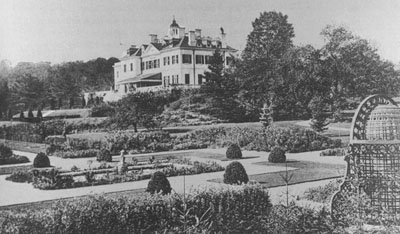
The Mount came for a time under the ownership of Carr van Anda, managing editor of the New York Times, who in 1943 sold it to Foxhollow School, which had purchased the former Vanderbilt estate adjacent to it a few years earlier. For about 30 years, The Mount served as a dormitory for the girls' preparatory school, and it is during this period that the first rumors of a ghostly presence began circulating. "There were lots of stories," said one former student. " Of course, girls' boarding schools will be girls boarding schools."
Dorothy Carpenter, another alumna of Foxhollow, reported the following: "People use to talk about it all the time.... Every time we'd hear a creak, we'd say it was Edith Wharton's ghost, but nobody really thought it was." Carpenter's perspective on the stories changed, however, when she returned to the house in the early '70s. The house had fallen into disuse by then, and Carpenter spent two months living there alone while she worked on restoration of the ballroom ceiling. One day, she was staring off absently out the window, when she saw a woman in period clothing walking across the terrace. She recognized her instantly from pictures she'd seen, but the version she was looking at now seemed far more vivid, more "alive" than any representation. "At the time, I thought maybe I'd been inhaling too much plaster dust."
As most locals know, in the late '70s The Mount was acquired by the legendary theatre troupe Shakespeare & Company, who occupied the site for more than 20 years. During this period, apparitions and spectral tableaus were reportedly witnessed by some of the brightest luminaries of the regional theater world. Dennis Krausnick, a former Jesuit priest turned actor and director, was one of the first people to enter the building. He reported that while he was working alone in the house, he heard footsteps constantly, but could find no one in the house upon searching. Josephine Abady, former head of the Hampshire College theater department and artistic director for Berkshire Theater Festival, described to one writer how she saw an apparition of Wharton several times while on the premises, and was haunted constantly by a rustling sound not unlike the swishing of a someone in a long dress walking by. On at least one occasion, she saw the Wharton figure in the company of a man who looked very much like Henry James, not knowing at the time that James had been a favorite house guest there.
This same male ghost was reported by none other than Shakespeare & Company founder Tina Packer, perhaps tellingly in the "Henry James Bedroom." Another actress, Andrea Haring, described a supernatural scene of both the Whartons, as well as James, all apparently engaged in conversation. The sheer appropriateness of the idea of The Mount being haunted by both Wharton and James cannot be overstated. Among her other literary accomplishments, Wharton is generally held in high regard as one of the finest American purveyors of the ghost story, who cared passionately about the subject and brought many novel touches to the genre. As for Henry James, well, I won't gush, but "Turn of the Screw" is quite simply, in my opinion, among only two or three other pieces of writing committed to paper contending for the title of greatest horror story ever.
With such a foundation - combined with the building's reincarnations as first a prep school, then theatrical mecca, both highly charged, creative environments - perhaps ghostly sightings were inevitable. Maybe Wharton really was right about ghost stories, after all.
"Sources":
Berkshire Evening Eagle, May 20, 1943
Fitchburg Sentinel & Enterprise May 30, 2002
Myers, Arthur. The Ghostly Register (Contemporary, 1986)
Ogden, Tom. The Complete Idiot’s Guide to Ghosts & Hauntings (Alpha Books, 2004)
Owens, Carole. The Berkshire Cottages: A Vanishing Era (Cottage Press, 1994)
--
Joe Durwin is a freelance writer and one possible answer to the question "Who ya gonna call?" Send comments or reports of the strange to joe@durwin.net.
Subscribe to:
Posts (Atom)