These Mysterious Hills
 |
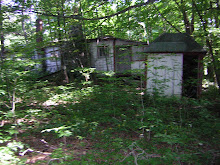
| Camp Windigo, Main House |
Alumni remember Camp Windigo, as it was known and operated until the 1980s, as a place of warm childhood memories. In the nearly three decades it has stood abandoned, however, a darker story of tragedy has emerged.
These days, the yarn one is most likely to hear if you ask around the Berkshires is some variation of the following, culled from an internet posting made a few years back:
"This is a camp that may have been up in the 1980's and is haunted by 6 little girls and a crazy woman. The story is that a camp couselor went crazy and hung 3 girls in a barn on the property and drowned 3 more in a tub then she went and killed herself."
Occasional more recent tellings set the time of the murdered campers in the 1800s. This is problematic, since this property was a farm then, and would not become a camp until the mid 20th century. A trail of internet mentions over the years suggests that this change of era may have originally stemmed from a combination of typos and misinterpretations of vague mentions of "80s."
 Otherwise, this a fairly consistent version of the story as it tends to be told in the region- seven deaths, including a camp counselor and six young campers she murdered. Typical tellings usually but not always conform to the notion that three were hung, and three drowned.
 This is a story that seems to have been around for well over a decade, and I have received a steady trickle of comments about it since I first began publishing These Mysterious Hills in the Advocate more than seven years ago. Several teams of amateur ghost investigators have tromped around the property, and tell of orbs and "mysterious shadows" in their photos, child-size hand prints appearing inexplicably on windows, or the disembodied voices of children crying. At least one purported psychic has claimed to have "made contact" with the spirits of the six murdered girls.
Fortunately for nostaligic former Windigo campers, there's no compelling reason to think these murders ever took place there.
An exhaustive check of records over the years has uncovered not a single shred of evidence to support the claim that six campers were murdered here, or anywhere else in the vicinity. Vital records, local law enforcement files, and media sources for the area are consistently devoid of any reference to such an occurrence, which, if true, would no doubt have made lurid headlines around the region and nationally.
Is it possible that such an atrocity might still have taken place, and somehow become lost or obscured in the folds of history?
While I will allow for this truly remote possibility, I would direct the reader to a few relevant points of reference. During the late 1970s through early 80s, at least three young girls from northern Berkshire County were abducted and murdered: Kim Benoit, of North Adams, Cynthia Krizack, of Williamstown (whose body was found not too far from Windigo, down an embankment in Windsor), and Lynn Burdick, from the town of Florida. There are many in the area that remember these vividly. The slightly more recent murder of Jimmy Bernardo by Lewis Lent in 1990 remains hauntingly vivid to Berkshire residents more than two decades later. Scads of material on all of these can be found around the internet.
Yet no one over the age of forty has any recollection of this rumored murder of six children in the tiny town of Windsor. When I first heard these rumors years ago, one of the first people I asked about it was veteran Berkshire newsman Glenn Drohan, who edited or worked at every major paper in the county since long before the camp slaughter was said to have occcured. He had no idea what I was talking about, and that clinched it for me right there.
Still, as belief in this legend grows- mostly among those born after the supposed event- and recent years have seen a great growing fascination with the site, a bit of historical background on Camp Windigo might be of interest.
History of Camp Windigo
The camp was founded in 1942, by Florence Ryder and Muriel Logan, both Physical Education professors at Smith College, on 75 acres of what had been the farm of John Decelles. The farm house itself dates to 1790, as evidenced by signage on the edge of the house.
About 30 boys and girls would spend July and August at Windigo each year, where they tried their hand at farming with various educational tasks.
"The daily activities which were of the most importance were tending to the animals," said Karen Sawyer, attended there in the early 60s, "Every week there was an animal rotation so a camper got to experience feeding and cleaning up after each type of creature which included bantams, goats, sheep, pig, horses and Eeyore the donkey."
There were six horses in total, and also ducks, laying hens, rabbits, dogs and cats around the little farming camp. The grounds also included a pond, blueberry field, and apple orchard.
"Miss Ryder and Miss Logan also knew all the areas around camp and at least three days a week we took hikes to various areas around the camp," according to Abby Zanger, who was also a camper there during the 60s.
At some point in the 1970s, it was purchased by the Latter Day Saints and became a camp for young Mormons children, with a similar agricultural bent. Neither campers from the first era nor those during its Mormon period have any recollection of any stories about murdered campers ever being told there.
The camp closed in the early to mid 1980s. It was later deeded to the state and became part of Windsor State Forest. In 2010, the Department of Conservation and Recreation were considering tearing down the structure, but at the time of this writing it still stands.
One of the enduring curiosities of the camp is it's name. To the Algonquin people, the word Windigo (also known as Wendigo, Witiko, Weetigo, and other variations) refers to a cannibalistic supernatural creature, a source of fear and dark tales.
Assuming for a moment that the founders of the camp, of whom alumni glowingly, did not intend to evoke such dark associations, I at first wondered if they simply had heard the word without context. Perhaps they simply applied it as a neat sounding native word, in the politically incorrect manner of many camps of the era. This was before the age of serious Native American scholarship and long before the renaissance of cryptozoology and para-creature interest of recent decades. Unless they were aware of an obscure psychological disorder or Algernon Blackwood's classic 1910 horror story of the same name, they might simply not have known.
The bicentennial History of the Town of Windsor offers an alternative explanation, however. According to its brief entry, the camp was dubbed Windigo "because it is in the town of Windsor, the wind often blows there, and the place was originally known as the Windlow place, which is an Indian name."
So is the camp name derived ultimately from another Native American word besides the fabled Wendigo? I have not been able to find the word "Windlow" in what has been preserved of the Mahican language, that of the people encountered by first colonial settlers of the area- or in cursory checks of other Algonquin dialects. This does not rule out the possibility it could have been a word among one of these long dead languages.
Meanwhile, there are ample numbers of Winslows in the Windsor Bush Cemetery right next to the old camp
.
Even if the name is nothing more than a striking coincidence, modern awareness of the violent connotations of the Windigo may well have helped inspire the gory myths of the camp. Then again, a look at the larger lore of murdered campers in our culture, perhaps such a story was inevitable.
Murdered Campers: The Not-So Urban Legend
The subject of murdered campers is fairly well-worn folkloric territory, intimately connected to the very nature of the oral tradition of ghost stories, which we so often associate with camping that the term 'campfire tales' is one of its most common synonyms. For the camper around the fire, the danger to oneself is the clincher which drives home the classic scare story, the whole ominious nature of "and some say he stalks the woods to this very day." The historic threat and its proximal location is the underlying peril intended to give such tellings their "jump" factor.
Folklorists believe these kinds of stories have a greater impact on the psyche and imagination because of the inherent vulnerability of the setting in which they're told, and take place. In the woods, in the dark, far from the familiarity of their own beds and the supposed safety of populated areas, such narratives take on a slight degree more plausibility to the listener. Thus, "camp" becomes a more inherently perilous place, and we are quicker to believe in gruesome tragedy befalling the faceless unnamed campers that went before. The camp boogeyman known as Cropsey is at least a century old, and tales of "Boyscout Betty" and the murdered youths of "Boy Scout Lane" are classics of the scouting community. I still have fond/traumatized memories of the animal-killing psychopath our scout masters convinced us was stalking Camp Chesterfield during the summer of '91.
The 1980s saw this theme explode into a profusion of gory franchises, from Friday the 13th and Sleepaway Camp to Harvey Weinstein's "The Burning." Counselors and campers by the dozens were stalked to their demise around the cabins and shores of places like Crystal Lake; the theme was virtually continuous on the silver screen during the decade Camp Windigo first closed. The meteoric rise of such legends coincides so neatly with the time period during which this little Windsor sleepaway camp fell into unsettling decrepitude that it is hard to believe that these developments are unrelated.
In the realm of urban legend, this story of Camp Windigo bears a striking resemblance to that of Camp Lulu, in Brownsville, Texas. There, it is said, a camp counselor went mad and attacked and killed several campers in his charge. As with Windigo, the victims were all said to be girls, and in most versions the deranged counselor takes his own life, and the camp is closed down in the wake of the tragedy.
Another tale with passing familiarity comes from a closer abandoned camp, that of Camp Connecticut in Colchester. There, the insane counselor is said to have perhaps killed as many as 60 campers!
Though no records of any such happenings support the ghostly legends of these three camps, they may be partly inspired by a very real horror that took place in Oklahoma in 1977. On the first late spring night of Girl Scout camp at Camp Scott, near Tahlequah, Oklahoma, three young Girl Scouts, Doris Denis Milner, Lori Lee Farmer, and Michele Guse, were taken from their shared tent and brutally murdered in the woods. An escaped convict was arrested, but later acquitted of the deaths, and the case remains open. Camp Scott was closed down and abandoned after 50 years of operation. The horrific crime occupied national news for weeks and months- as the supposed murders at Camp Windigo no doubt would have, had they actually occurred.
Whatever Walks There, Walks Alone
If the legendary murders at Camp Windigo most probably never took place, does that mean it's not haunted? Such proclamations are not for me to make.
There is, however, the following anecdote from one Deborah Phillips, whose husband lived in the old house for a time in the 1980s, after it was closed as a camp...
"During one visit I did see (don't laugh) some 'ghosts'...an old man in overalls and a young girl in a dress, out of the corner of my eyes when I entered the living room."
As one internet tipster maintained, "There is something down in the basement that has a very strong presence."
I must admit that I did feel a second or two of anxiety on my last visit to Camp Windigo, and it was just as I was entering the basement. Then again, it might have been because the top three stairs were missing.